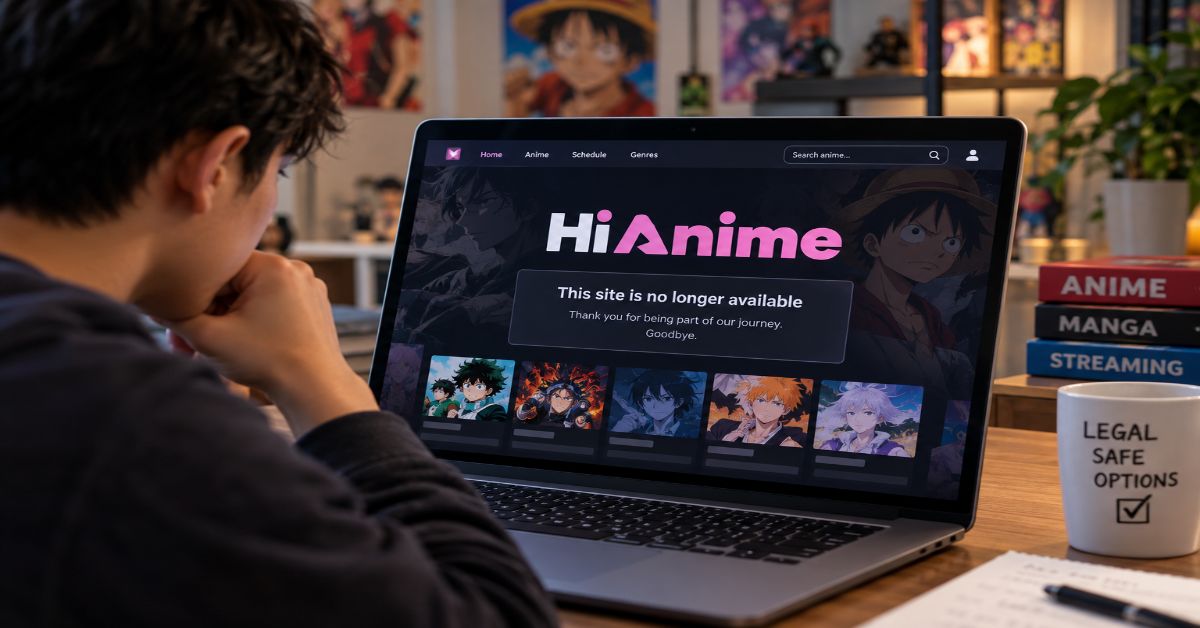
HiAnime no longer points to a verified, active version of the original anime-streaming service in 2026, and that is the key fact to know before clicking anything that uses the name. Ten days after the U.S. Trade Representative added the service to its 2025 Notorious Markets List, the known domains displayed a farewell message on March 13; the timing is striking, but public evidence does not prove that the USTR listing caused the shutdown.
That changes the search intent. People are now asking whether a same-name site is official, whether it is safe, why the original disappeared, and which legal service can replace it. I reviewed ten high-visibility 2026 results and found that most move quickly from the shutdown story into alternatives. Several blur three separate questions: who operates a domain, whether the streams are licensed, and whether the page is technically safe.
I take a stricter approach. I separate documented events from inference, treat current lookalikes as unverified rather than automatically malicious, and compare licensed options by use case. The USTR report says stakeholders reported the service as a piracy market, while also stating that the list does not make legal findings. Vietnamese authorities later announced a large copyright and money-laundering case involving more than 100 sites, but their public release did not name this brand.
The practical answer is simple: do not treat a logo, familiar interface, search ranking, HTTPS padlock, or social-media claim as proof of continuity. Verify the operator and rights source, avoid forced downloads or unusual permission prompts, and use licensed platforms when the title is available there.
What is HiAnime in 2026?
The name now describes two different things: a historical streaming brand with a traceable Zoro.to-to-AniWatch-to-later-brand lineage, and a search term reused by present-day pages, apps, mirrors, and clones whose relationship to that earlier operation is often unclear. Conflating those two entities is the first mistake I saw across the current search results.
The USTR’s March 2026 report says the service was a successor to AniWatch, which itself followed Zoro.to, and says the brand was adopted in March 2024. It also reports more than 244 million visits in August 2025 based on Similarweb data. That is an estimate of web traffic, not an audited count of unique users, but it shows why the name still has strong search demand after the original domains stopped behaving like a normal streaming service.
I use the same provenance test in Rubble Magazine’s Natomanga safety and history guide: a familiar brand word can survive a domain transition even when operator identity, infrastructure, or authorization has changed. For this query, the brand is therefore less useful than the evidence behind a specific destination.
What happened to the original service?
The cleanest way to understand the shutdown is as a timeline, not a single-cause story. Public records show a sequence of rebrands, very large traffic estimates, a U.S. watch-list designation, a farewell message, and later enforcement activity in Vietnam. Those events are related context, but not every link in the chain is proven causation.
| Date | Documented event | What the evidence supports |
| July 2023 | Zoro.to transition | USTR says rights holders and anti-piracy trade groups shut down Zoro.to; the service then appeared as AniWatch. |
| March 2024 | Final rebrand | USTR says AniWatch was rebranded under the later brand name. |
| October 2024 | Traffic peak estimate | TorrentFreak reported Similarweb’s estimate of 364 million web visits. |
| August 2025 | Still very large | USTR cited more than 244 million visits based on Similarweb. |
| March 3, 2026 | USTR listing | The 2025 Notorious Markets List included the service; USTR says the list is not a legal finding. |
| March 13, 2026 | Farewell message | Known domains displayed a goodbye message; public reporting did not establish the cause. |
| July 1, 2026 | Vietnam criminal case | MPS announced a >100-site copyright and money-laundering case; its release did not name the brand. |
Is any current same-name website official?
I could not verify a current corporate page, stable ownership statement, or first-party announcement that authenticates one active same-name domain as the official continuation of the pre-shutdown service. That does not prove every page using the word is malicious. It does mean the burden of proof has shifted: the site should establish its identity rather than asking the user to trust a copied name and interface.
Search rank is not authentication. HTTPS only shows that traffic between a browser and that server is encrypted; it does not certify the operator, the ad stack, or the licensing status of the video. A browser extension, mobile app, Telegram account, Discord message, or social profile with a familiar logo has the same identity problem unless it can be tied to a verifiable operator.
This is the same distinction I make in my KissKH safety and legality analysis: availability, ownership, and authorization are separate claims. If a current page asks for a login, card details, a crypto payment, browser notifications, or an extension before it can even establish who runs the service, I treat that as a reason to leave rather than a reason to investigate further.
The evidence hierarchy below is the quickest way I use to separate a trust signal from a conclusion it cannot support.
| Signal | What it can establish | What it cannot establish |
| Familiar name or copied interface | Brand resemblance | Common ownership, licensing, or safe code |
| HTTPS / padlock | Encrypted connection to that server | Honest operator, licensed content, or safe third-party scripts |
| High search position | Visibility and SEO performance | Official status or security review |
| Stable company, terms, privacy, support | An accountable entity may exist | That every title is licensed in every territory |
| Official rights-holder or platform listing | Authorization for a title, territory, and time window | Permanent access in every country |
Is the site safe now? The risk has changed
I would not claim that every modern clone contains malware; the evidence does not support that. The defensible conclusion is that unverified provenance leaves key questions unanswered: who controls the page, which scripts load, where credentials go, and whether redirects are part of normal playback.
Microsoft Threat Intelligence documented an April 2025 malvertising campaign in which people trying to stream free or pirated movies were redirected from a play-button interaction to scam pages, including a ClickFix page that installed the Lumma Stealer infostealer. Microsoft said a single day could funnel tens or hundreds of thousands of visitors through the redirectors. The research did not identify the historical anime site, so I use it as evidence about the delivery pattern, not a specific clone.
USTR Ambassador Jamieson Greer also warned about consumers “downloading malware when visiting sites engaged in these activities” in the broader illicit-market context. My rule is narrower: unexpected installs, fake CAPTCHA instructions, permission demands, and repeated new-tab redirects are enough reason to exit.
Was the service legal? Separate authorization from enforcement
The strongest public record is precise but narrower than many SEO pages suggest. The USTR Notorious Markets List says stakeholders reported the service as providing pirated movies and television, particularly anime. The same document states that the list does not make findings of legal violations. “Listed by USTR” and “adjudicated illegal by a court” are therefore not interchangeable.
On July 1, 2026, Vietnam’s Ministry of Public Security announced a case alleging that suspects created more than 100 websites, posted more than 26,000 films copied without permission, and earned about 12.85 million USDT in advertising revenue. Seven suspects were prosecuted; the case was ongoing, so charges are not convictions. The ministry’s release does not name the anime brand, although specialist reporting later connected it to the wider investigation.
Viewer liability varies by jurisdiction and conduct. I do not turn operator-focused enforcement into universal legal advice. My Futbol Libre enforcement guide uses the same framework: identify the rights holder, territory, distributor, and behavior before drawing a legal conclusion.
Why did the brand become so large?
Traffic estimates help explain the demand. TorrentFreak reported Similarweb figures of 364 million visits in October 2024 and 331.6 million in November 2024, with roughly 40% of visits attributed to the United States and four in ten visitors estimated to be ages 18 to 24. By August 2025, the USTR report still cited more than 244 million visits. These are third-party web estimates, but the scale is consistent with a platform that had become a default search destination for a large audience.
The harder question is why legal alternatives do not feel like a one-for-one replacement. Anime rights are fragmented by title, season, language, territory, and release window. A service can be excellent for simulcasts but weak for an older dub; another can have a valuable back catalog but no rights in the reader’s country. That fragmentation creates a structural mismatch with the expectation of one universal catalog.
This is why I do not recommend chasing a sequence of unofficial mirrors as though continuity were only a domain problem. My MyFlixer safety and legality guide reaches the same conclusion for general film streaming: a stable playback page is not evidence of a stable rights chain, and a disappearing domain does not prove why it disappeared.
Which legal alternatives replace the use case?
No licensed service reproduces the entire old catalog, so I compare platforms by the job they do. Pricing and availability below are current examples as of September 24, 2026 and can vary by country. I would check the exact title in the reader’s region before subscribing.
Crunchyroll is the most direct fit for viewers who prioritize current anime and simulcasts; its U.S. Fan tier increased to $9.99 per month in February 2026. HIDIVE lists a U.S. monthly plan at $7.99 and focuses on selected simulcasts, exclusives, dubs, and deeper catalog titles, but its geographic availability is more limited. Netflix has a broad anime category alongside its general entertainment catalog, while Tubi and Pluto TV offer free, ad-supported anime in supported markets.
The practical workaround for catalog fragmentation is title-first discovery. Search for the exact series and season on a rights holder, broadcaster, or recognized licensed platform, then verify that the result is available in your territory. That is slower than assuming one site has everything, but it removes the domain-authentication problem and makes the trade-off visible before you create an account.
This comparison is intentionally factual rather than ranked; the right option depends on the title, country, and viewing pattern.
| Service | Current model | Useful for | Main limitation |
| Crunchyroll | Paid; U.S. Fan $9.99/mo | Current anime, simulcasts, broad anime-first catalog | Catalog and pricing vary by territory |
| HIDIVE | Paid; U.S. $7.99/mo | Selected simulcasts, exclusives, dubs, deeper cuts | More limited regional availability |
| Netflix | Paid; regional pricing | Anime plus a broad general-entertainment subscription | Not every seasonal title; catalog varies by country |
| Tubi | Free, ad-supported where available | No-subscription back-catalog viewing | Rotating catalog and regional availability |
| Pluto TV | Free, ad-supported where available | Live anime channels plus on-demand titles | Availability and library differ by market |
What did the top 10 ranking articles miss?
I reviewed ten high-visibility 2026 results before drafting: Wondershare, OtakusNotes, DocumentaryTube, FirestickTVStream, Position Is Everything, Parties365, Android Experto, AnimeVault, GeeksDigit, and AlternativeTo. Their shared strength is speed: most answer “what can I use instead?” quickly. The trade-off is that alternatives often crowd out evidence quality.
The biggest gap is shutdown causation. Some pages describe the March USTR listing and March 13 farewell as though the first directly caused the second. The dates make that plausible, but specialist reporting said there was no evidence establishing the link at the time. I therefore separate sequence from causation.
A second gap is provenance. Some pages label every same-name site unsafe; others send readers toward unofficial replacements. A better question is what evidence connects a destination to an accountable operator. Freshness matters too: at least one current result still showed Crunchyroll’s old $7.99 U.S. Fan price after the 2026 increase to $9.99.
The keyword itself has also changed. Before shutdown it was largely navigational; afterward it became an entity-verification query. That shift is the editorial advantage I would keep updating as the SERP changes.
The Future of HiAnime in 2027
There is no verified public roadmap for a return of the original service, so I would not predict one. The more credible 2027 trend is continued name reuse: a high-demand brand can persist in search after its original infrastructure changes, giving clones, apps, extensions, and social accounts an incentive to borrow the recognition.
Enforcement is also becoming more network-focused. The Vietnamese case described more than 100 websites rather than a single domain, while USTR frames piracy as an ecosystem involving hosting, advertising, and rebranded services. Domain shutdowns will likely remain only one part of the response.
Legal streaming should keep improving catalog depth and distribution, but rights will remain territorial. I would expect title-level verification to age better than any static “best alternative” list.
Key Takeaways
- The March 13, 2026 farewell is documented; a verified official successor is not.
- USTR listed the service in its 2025 Notorious Markets review, but the report explicitly says the list is not a finding of legal violation.
- The July 2026 Vietnamese case alleges more than 100 sites, 26,000 copied films, and about 12.85 million USDT in ad revenue; the public ministry release does not name the anime brand.
- Current same-name domains should be treated as unverified until operator identity and authorization can be established; search rank, HTTPS, and a copied interface are not proof.
- Microsoft’s ClickFix research shows how malvertising around free or pirated streaming can redirect users into credential or malware-delivery flows, although it is not evidence about one specific clone.
- A legal replacement is usually a portfolio: Crunchyroll or HIDIVE for anime-first catalogs, Netflix for a mixed subscription library, and Tubi or Pluto TV for free ad-supported viewing where available.
Conclusion
The useful question in late 2026 is no longer “what is the current URL?” The evidence supports a narrower conclusion: the historical service displayed a farewell in March, its brand had already been identified in USTR’s piracy-market reporting, and there is no current successor I can authenticate from stable first-party ownership evidence. That makes present-day use of the name an identity problem before it is a streaming problem.
I also would not overstate what the evidence proves. The USTR listing is not a court judgment, the timing of the shutdown does not establish its cause, and the Vietnamese criminal case is still an allegation-and-prosecution record rather than a final conviction. Those distinctions matter because they separate reporting from speculation.
For viewers, the lowest-friction safe decision is to verify a title on licensed services by territory instead of chasing mirrors. That may require more than one platform, but it gives you an accountable operator, clearer data practices, and a rights chain that can be checked.
Frequently Asked Questions
Is the original anime site still working in 2026?
The known domains displayed a farewell message on March 13, 2026. I could not verify a current active domain as an official continuation of the pre-shutdown service. Same-name sites may still appear in search, but the name alone does not establish continuity.
Is there an official successor site now?
I found no current corporate ownership statement or stable first-party notice that authenticates one active same-name site as the official successor. Treat any present-day domain, app, extension, or social account as unverified until it can prove a connection to an accountable operator.
Was the historical streaming service legal?
USTR reported the historical service in its Notorious Markets List based on stakeholder allegations of piracy, while also stating that the list itself does not make legal findings. Copyright rules and viewer exposure vary by country, so this article does not provide jurisdiction-specific legal advice.
Are current same-name sites safe to use?
A blanket safe-or-malicious label is not supportable for every same-name page. The practical risk is uncertain provenance. Leave if playback triggers repeated redirects, fake verification steps, downloads, extensions, notification requests, or unusual payment and credential prompts.
What happened to AniWatch and Zoro.to?
USTR describes the lineage as Zoro.to, then AniWatch, then the final rebrand in March 2024. The report says Zoro.to was shut down in July 2023 by rights holders and anti-piracy trade associations before the later rebrands.
What are legal HiAnime alternatives?
Licensed options include Crunchyroll, HIDIVE, Netflix, Tubi, and Pluto TV, but catalog and pricing vary by country. I recommend searching the exact title and season first; no single legal service consistently reproduces the breadth users associated with the old site.
Methodology
I researched this article on September 24, 2026. I reviewed ten high-visibility pages targeting the keyword and checked recurring claims against the USTR 2025 Notorious Markets List, Vietnam’s Ministry of Public Security July 1 case notice, official streaming-service pages, Microsoft Threat Intelligence, and dated specialist reporting.
For internal linking, I verified live Rubble Magazine articles on MyFlixer, KissKH, Natomanga, and Futbol Libre and used each URL once where the reasoning overlaps. I did not stream from, download from, or authenticate unofficial clones, so this article does not claim firsthand testing of those destinations.
The main uncertainty is causation: the March 3 USTR listing and March 13 farewell are documented, but a causal link is not. The Vietnamese ministry release is important enforcement context but does not name this brand. I therefore separate facts, attributed allegations, and inference.
Publication disclosure (use after editorial review): AI assistance was used in drafting, and a human editor reviewed the content before publishing. Before going live, the editor should re-check prices, dates, legal-status wording, hyperlinks, and APA references against the original sources.
References
Office of the United States Trade Representative. (2026, March 3). 2025 Review of Notorious Markets for Counterfeiting and Piracy.
Office of the United States Trade Representative. (2026, March 3). USTR releases 2025 Review of Notorious Markets for Counterfeiting and Piracy.
Ministry of Public Security of Vietnam. (2026, July 1). Prosecution of a case involving copyright infringement, related rights, and money laundering in Hanoi, Ho Chi Minh City, and related localities.
Van der Sar, E. (2026, March 13). Piracy giant HiAnime.to announces mysterious “goodbye.” TorrentFreak.
Maxwell, A. (2025, January 4). HiAnime outranks DisneyPlus in the U.S. with a record 364m monthly visits. TorrentFreak.
Microsoft Threat Intelligence & Microsoft Defender Experts. (2025, August 21). Think before you Click(Fix): Analyzing the ClickFix social engineering technique. Microsoft Security Blog.
Crunchyroll. (2026, February 2). Crunchyroll updates membership pricing to give fans more of what they love.
HIDIVE. (2026). Stream anime simulcasts and dubs.
Netflix. (2026). Anime. Netflix.
Tubi. (2026, June 15). The best anime on Tubi to watch completely free.
Pluto TV. (2026). Anime series and live anime channels.