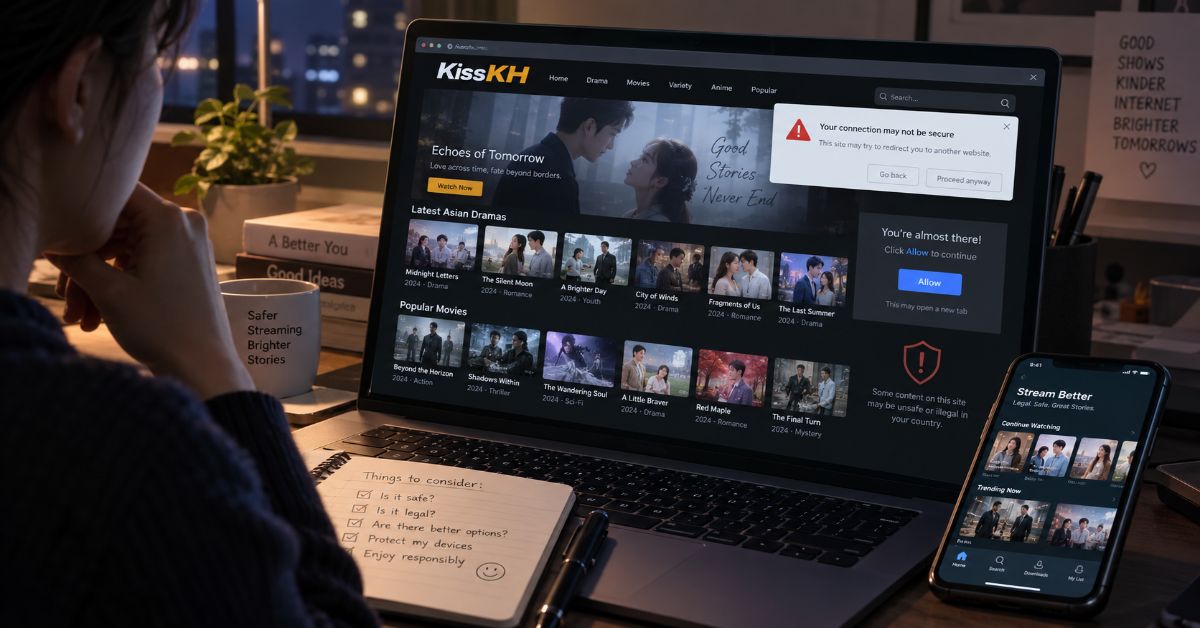
KissKH is a free-streaming name associated with Asian dramas, movies, and related entertainment, but in 2026 the bigger issue is that the name does not reliably identify one transparent, stable operator. I found current search results pointing readers toward different domains, mirrors, apps, and lookalikes, while the strongest safety evidence concerns the wider redirect-and-ad ecosystem rather than a single permanent website. That makes a simple “working link” article less useful than it appears.
I reviewed ten high-visibility current results before drafting this guide. Their recurring strengths are obvious: most explain the catalog, mention pop-ups, discuss copyright, and suggest alternatives. Their recurring weakness is evidence discipline. Several pages treat a recent mirror as the official destination without proving common ownership; some turn a trust score or HTTPS certificate into a broad safety verdict; others say a VPN makes the service safe, even though a VPN does not validate third-party scripts, downloads, login forms, or media rights. Legal sections often flatten very different national rules into one universal claim.
My approach is narrower and more durable. I separate five questions that search results often blend together: What is the brand? Which domain, if any, is canonical? What can browser-security evidence actually prove? What does copyright law say about unauthorized streaming services? And which licensed platforms solve the same viewing need without requiring a user to chase mirrors? Where the evidence is incomplete, I say so. I do not publish live mirror lists, bypass instructions, or unverified app downloads. That keeps the page useful even if today’s address disappears tomorrow—and gives search engines and answer engines clear, checkable claims instead of another short-lived directory.
What Is KissKH, and Why Is the Identity Hard to Verify?
The most defensible description is functional: the name is used by sites and apps that present Asian dramas, films, anime, and television content, commonly at no subscription cost. The harder claim is identity. I could not verify a single current corporate page, ownership disclosure, licensing statement, and permanent domain that ties every site using the name to one accountable operator.
That distinction matters because search ranking is not authentication. A page can copy a familiar interface, use the same brand word, obtain a valid TLS certificate, and still be operated by somebody else. Uptime services also show related domains moving between active and inactive states in September 2026. That is evidence of instability, not evidence that every outage has the same cause or that every successor is controlled by the same people.
I use the same principle in Rubble Magazine’s MyFlixer safety and legality guide: treat a changing streaming brand as a provenance problem before treating it as a navigation problem. The related Futbol Libre guide makes the same point from sports streaming—availability, ownership, and authorization are separate questions.
The table below is the evidence hierarchy I would use before trusting any page that carries the name.
| Signal | What it can establish | What it cannot establish |
| Stable company and contact details | A real accountable entity may exist | That every linked stream is licensed |
| Domain history and uptime | How long an address has existed and whether it is reachable | Who operates it or why it changed |
| HTTPS / valid certificate | Traffic is encrypted between browser and site | Honest ownership, safe ads, or legal content rights |
| Security reputation scans | Known flags, suspicious scripts, or reputation signals | A guarantee that every visit is safe or unsafe |
| Rights-holder or platform licensing statement | Authorization for specific content, territory, and time | Permanent worldwide access to every title |
Is KissKH Safe to Use?
A one-word safety verdict would be misleading. Current secondary scanners and reviews do not even agree with one another: some rate older or popular domains relatively well, while others flag related addresses or report suspicious behavior. That conflict is exactly why I would not use a single score as the article’s conclusion.
The stronger evidence is about the browsing path around free-streaming sites. In August 2025, Microsoft Threat Intelligence described a malvertising campaign in which users who tried to stream free or pirated movies opened scam pages after interacting with a movie. One redirect path led to a ClickFix page that downloaded Lumma Stealer, and Microsoft said redirectors could funnel tens or hundreds of thousands of unique visitors to scam pages in a day. That incident was not specific to this brand, but it proves the mechanism that makes forced tabs, fake player prompts, and unexpected downloads materially important.
Microsoft’s ClickFix and malvertising analysis is therefore more useful than a generic claim that “free streaming equals malware.” Risk is usually layered: the main page, advertising code, redirect destination, download prompt, browser permission, and login form can each be controlled by different parties.
Rubble Magazine’s Natomanga safety guide and ThisVid privacy guide use the same layered model: popularity and uptime are not the same as safe ad behavior, and a normal page load cannot certify every redirect destination.
What Are the Practical Risk Signals?
For an ordinary reader, the useful signals are behavioral rather than cosmetic. A polished layout or padlock icon is weak evidence; an unexpected request to install software or hand over credentials is much stronger evidence that the session has moved into a higher-risk state.
1. A new tab or redirect appears when you press Play, scroll, or close an ad.
2. The page says a special player, codec, extension, APK, or browser update is required.
3. The address bar changes to an unrelated hostname before a login or payment request.
4. The site asks for notification, camera, microphone, or other permissions that are unnecessary for ordinary video playback.
5. A Google, email, or social login is requested even though the operator and privacy policy are unclear.
6. The same brand appears across multiple domains but ownership and contact details do not match.
A VPN does not fix these problems. It can change the network path and obscure an IP address from the destination, but it does not verify a domain, stop credential theft, make a malicious download safe, or prove that a stream is licensed. An ad blocker can reduce exposure to some advertising, but it is also a mitigation layer rather than a trust certificate.
Is This Streaming Service Legal?
I could not verify a current, authoritative licensing record that establishes rights for the rotating sites using this name. That does not justify saying that every page carrying the label is legally identical, but it does mean the burden of proof remains unresolved for recent commercial shows offered outside transparent distribution agreements.
In the United States, the U.S. Copyright Office’s explanation of unauthorized streaming states that unauthorized streaming can infringe a copyright owner’s public-performance right. The 2020 U.S. law on certain unauthorized streaming services is aimed at willful, commercial-scale services; that is different from saying every viewer in every country faces the same liability. Viewer-side rules depend on jurisdiction and on conduct such as merely watching, downloading, redistributing, or operating the service.
The international context is similarly more nuanced than the SERP suggests. EUIPO reported in November 2024 that EU internet users accessed pirated content about 10 times per month on average in 2023 and that streaming remained the most common method. João Negrão, EUIPO’s executive director, pointed to “lack of access to affordable legal content” as one factor behind piracy. That helps explain demand, but it does not establish authorization for any particular service.
A related lesson appears in Rubble Magazine’s Coomer.party status guide: domain availability, platform terms, copyright ownership, and user conduct should be analyzed separately. The same discipline prevents a streaming guide from turning a complex legal question into a misleading yes/no slogan.
What Do the Current Top 10 Results Miss?
My ten-result sample is strong on immediacy and weak on durability. The dominant pages answer what readers type today, but many structures will age badly because they depend on a current mirror, an unsourced feature list, or another unofficial streaming recommendation.
This table summarizes the editorial gap I found and the information gain this article is designed to add.
| Common SERP angle | Recurring weakness | Ranking opportunity |
| “New address” or proxy list | A current mirror is treated as canonical without ownership proof | Teach readers how to verify provenance instead of chasing URLs |
| “Is it safe?” verdict | One trust score, HTTPS, or user anecdote becomes the answer | Separate domain, ad, redirect, credential, and download risk |
| “Is it legal?” section | Jurisdictions and operator/viewer conduct are flattened together | Explain rights-holder authorization and jurisdiction limits precisely |
| Alternative list | Unofficial sites are sometimes presented as safer substitutes | Compare licensed platforms using official availability data |
| VPN/ad-block advice | Privacy tools are framed as if they authenticate the service | Explain what each control mitigates and what it cannot prove |
Which Licensed Alternatives Cover the Same Viewing Need?
The best replacement depends on region and the specific title. Licensed catalogs are intentionally fragmented because rights are sold by territory and time period, so no legitimate service can promise that every drama will be available everywhere forever. The trade-off is clearer ownership, conventional support, official apps, and predictable account security.
Current official service information supports the following comparison.
| Service | What official sources establish | Free access / reach | Main limitation |
| Rakuten Viki | 1,500+ Asian shows and movies in the Viki Pass library; community subtitles; licensed regional catalog | Some titles are free with ads; Viki lists availability in Pakistan and many other countries | Individual titles can still be unavailable by region |
| iQIYI International | Asian TV and films as its core international offering; 1,700+ drama/variety/anime titles; service across 191 territories | Free and VIP content mix | Catalog and subtitle availability vary by title and market |
| KOCOWA+ | Korean dramas, variety, and K-pop from KBS, MBC, SBS and other partners | Officially available across the Americas, Europe, and Oceania | Its help center does not list Asia as a supported region |
| WeTV | Official streaming service for Chinese, Korean, Japanese, Thai and other Asian programming | Free viewing plus VIP features depending on title | Availability and VIP benefits vary by region and title |
For Viki specifically, its official support page says some content can be watched free with ads and SD quality, while Viki Pass adds exclusive content, ad-free viewing, and HD where available. Its regional-availability page also lists Pakistan. The important caveat is licensing: Viki says a subscription does not unlock a show that is not licensed for the viewer’s region.
How Should You Decide Whether a Streaming Page Is Worth Trusting?
I would use a five-step decision rule that remains useful even if domains change.
1. Verify the entity first. Look for a stable company identity, contact route, privacy policy, terms, and official app-store presence that agree with one another.
2. Verify the title, not just the platform. A legitimate service can license one drama in one country and not another, so check the specific show and territory.
3. Treat redirects as a new trust decision. If the hostname changes, reassess before entering credentials, granting permissions, or downloading anything.
4. Prefer official discovery paths. Search the licensed services that specialize in Asian content before relying on a domain list that may be stale tomorrow.
5. Separate convenience from risk. A free stream that loads quickly can still carry a higher privacy, security, legal, or troubleshooting cost than a licensed option.
This framework is intentionally less exciting than a “working link” list. It is also more durable. It helps a reader reach the right decision without depending on a mirror that an editor may not be able to verify a week later.
The Future of KissKH in 2027
I found no credible first-party roadmap for 2027, so any forward-looking section has to be analysis rather than a promise about the brand. The strongest signals point toward continued fragmentation: enforcement pressure on unauthorized streaming, short-lived domains, copycat branding, and a security environment in which malicious advertising can exploit the search path around free media.
USTR’s March 2026 Notorious Markets review described sophisticated online piracy operations and identified 37 online markets, while ACE has documented shutdowns of streaming networks and back-end infrastructure. Those examples show why a domain-centered article can become obsolete quickly.
Legal access is also expanding: Viki maintains a large specialized Asian catalog, iQIYI International says it serves 191 territories, and WeTV operates official web and app distribution. The unresolved pressure point is fragmentation because rights remain split by market.
For 2027, the durable editorial advantage is verification: clearer provenance, title-level licensing checks, official app routes, and explicit uncertainty instead of a race to publish the newest mirror.
Takeaways
- The name alone does not authenticate a domain; operator identity and rights evidence must be checked separately.
- A valid certificate or positive trust score can coexist with risky redirects, third-party scripts, or unclear ownership.
- Microsoft’s 2025 malvertising research shows that a play-button click on a free-movie site can become the first step in a malware-delivery chain.
- Copyright analysis should distinguish provider conduct, rights-holder authorization, territory, and the viewer’s specific actions.
- The current SERP leaves room for a stronger article because many competitors are mirror-centric and under-source their legal and security claims.
- Viki, iQIYI International, KOCOWA+, and WeTV provide verifiable licensed alternatives, but title availability remains regional.
- A useful evergreen guide should teach verification rather than publish a list of addresses that may be wrong next month.
Conclusion
The most useful way to understand this search in 2026 is to stop treating it as a request for one permanent website. The public evidence points instead to a brand name used across changing domains and apps, uneven transparency about ownership, and a browsing environment where the surrounding advertising and redirect chain can matter as much as the video page itself. That is a stronger reason for caution than a dramatic but unsupported claim that every visit is automatically malicious.
Copyright deserves the same precision. I could not verify a current rights framework that would let me describe the rotating sites as an ordinary licensed streaming service, but viewer-side legal exposure is not identical across jurisdictions or behaviors. The safest editorial answer is to separate the operator, the rights holder, the territory, and the user’s conduct.
For readers who simply want Asian dramas, licensed services now cover a substantial share of that demand with clearer ownership and support. They may not reproduce an all-in-one free catalog, and regional licensing can be frustrating. But they remove the need to make a new trust decision every time a mirror, redirect, or lookalike appears.
Frequently Asked Questions
What is the service used for?
The name is associated with free Asian dramas, films, anime, and television series. Multiple domains and apps use similar branding, so the name alone does not prove common ownership or licensing status.
Is the site safe without downloading anything?
Avoiding downloads lowers one risk, but redirects, phishing, tracking, and credential theft can still occur. Safety depends on the exact domain, third-party ads, browser permissions, and whether a click sends you elsewhere.
Is watching through an unofficial mirror legal?
I could not verify a transparent licensing framework for the rotating sites using the name. Copyright rules vary by jurisdiction and by conduct, so a universal viewer-side legal verdict is not reliable advice.
What is the official KissKH website?
I could not verify one permanent, canonical consumer domain that readers should treat as the official address in September 2026. Because lookalikes and mirrors can reuse branding, search ranking and a valid HTTPS certificate are not enough to establish ownership.
What are the best legal alternatives?
For Asian dramas, verifiable options include Rakuten Viki, iQIYI International, KOCOWA+, and WeTV. The best choice depends on your country and title because licensing is regional and can expire.
Does a VPN make free streaming safe?
No. A VPN can hide or change your public IP path, but it does not authenticate a website, prevent phishing, make a download harmless, verify copyright licenses, or stop account tracking through cookies and logins. Treat it as one privacy tool, not a safety certificate.
Methodology
I researched this article on September 21, 2026 and reviewed ten high-visibility current pages: ScamAdviser, Dubai IT Consulting, Wondershare Recoverit, TricTrac.tv, DocumentaryTube, TechShali, Illuminaija, DeRealest Reviews, Tech Be Time, and Android Experto. Search order varies by location and time, so this is a competitive sample rather than a universal ranking.
The main gaps were provenance, conflicting scanner results, overbroad legal claims, and advice that treated VPNs or ad blockers as authentication. Validation prioritized Microsoft Threat Intelligence, the U.S. Copyright Office, USTR, EUIPO, ACE, and official pages from Viki, iQIYI, KOCOWA, and WeTV.
I did not create an account on an unverified mirror, play unauthorized streams, download an APK, bypass a block, or test executable files. I found no credible first-party 2027 roadmap, so the future section is analysis rather than a platform promise.
Five live Rubble Magazine links—MyFlixer, Futbol Libre, Natomanga, ThisVid, and Coomer.party—were inserted only where the conceptual connection was direct. AI assistance was used for research organization, drafting, and document production. A human editor must verify statistics, named claims, references, links, and first-person wording before publication.
References
European Union Intellectual Property Office. (2024, November 28). Europeans access illegal content online 10 times each month.
Office of the United States Trade Representative. (2026, March 3). USTR releases 2025 Review of Notorious Markets for Counterfeiting and Piracy.
Alliance for Creativity and Entertainment. (2024, January 18). ACE and TrueVisions shut down two notorious piracy sites in Thailand.
iQIYI International. (2026). About iQIYI International.
KOCOWA Help Center. (2025, March 13-14). What is KOCOWA?; Is KOCOWA available to watch in my country?
WeTV. (2026). Official service profile and VIP information.
ScamAdviser. (2026, July 23). KissKH review: Is it safe or a risky streaming site? Used as secondary context, not as a definitive security audit.