The safest way to treat myflixer in 2026 is not as a single official streaming destination, but as a search label tied to a shifting set of domains and related brands. That distinction matters because U.S. trade officials now identify MyFlixerz/Sflix as a major piracy network, while security researchers have documented malware delivery through the same kind of free-movie redirect chains that make unofficial streaming attractive in the first place.
I reviewed ten prominent current informational results before drafting this guide. Most did one useful thing: they steered readers toward legal alternatives. But the SERP also repeats the same template—define the brand, warn about legality, list Tubi/Pluto/Plex, add a VPN paragraph, then stop. That leaves several harder questions unresolved. Is there a canonical domain? What does a “safe” scanner result actually prove? How do advertising redirects change the threat model? What has happened since the 2024 FMovies enforcement wave? And what should a reader do when the search result they click today is not the same operator or domain they saw last month?
This article answers those questions with dated evidence and a stricter separation between identity, copyright, browser security, and viewing alternatives. I did not open pirate streams, download players, install APKs, or publish working mirror links. I also do not treat a trade-association allegation, a government watchlist, or a security scan as interchangeable evidence. Each supports a different claim. That evidence hierarchy is the central advantage of this guide: it helps you decide what you can actually verify before you hand an unfamiliar page your attention, browser permissions, credentials, or device.
What Is MyFlixer in 2026?
The name is best understood as a moving identity rather than a stable, first-party product with one permanent domain, app store listing, company page, and licensing statement. The current public record uses closely related names—especially MyFlixerz and Sflix—and connects them to multiple domains and shared streaming infrastructure. That does not prove every site using a similar name has the same owner. It does prove that name recognition alone is a weak trust signal.
That identity problem is similar to the one I documented in Rubble Magazine’s SoSoActive domain-safety guide: a familiar brand string can persist while domains, operators, and claims diverge. For streaming searches, the cost of assuming continuity is higher because the page may immediately request notification permission, open third-party ads, or offer an installer.
Two primary sources sharpen the picture. The Motion Picture Association’s October 2025 submission called MyFlixerz/Sflix a priority notorious streaming network and reported that related domains drew more than 622 million visits in August 2025. USTR’s March 2026 report then included MyFlixerz, also known as Sflix, in its Notorious Markets List and repeated the 622 million-visit figure, attributing the network’s revenue to banner ads, pop-ups, and redirects. USTR also explicitly says its list is not a judicial finding of legal violations, so I use it as an official enforcement and market-risk record, not as a substitute for a court ruling.
The timeline below matters because older articles often freeze the brand at one domain or one takedown event.
| Date | Verified event | What it establishes | What it does not establish |
| Aug. 2024 | ACE-backed action dismantled the FMovies network; reporting named MyFlixer among associated brands. | The brand had documented links to a major enforcement target. | That every later lookalike domain is the same operator. |
| Aug. 2025 | MPA reported 622M+ visits across the MyFlixerz/Sflix related network. | Large scale and a shared-network model. | An audited user count or ownership of every mirror. |
| Mar. 2026 | USTR listed MyFlixerz/Sflix in the 2025 Notorious Markets review. | Current official U.S. trade-enforcement concern. | A criminal conviction or legal finding against each site. |
| Jul. 2026 | DOJ said more than 1,000 World Cup streaming domains were seized across three actions. | Domain-level anti-piracy enforcement is active and can scale quickly. | That those seizures were specifically MyFlixer domains. |
Is MyFlixer Safe to Use?
A one-word “safe” or “unsafe” verdict is too blunt. The useful question is which layer of the session you are evaluating. A domain can have HTTPS, load a movie catalog, and still send a click through an advertising chain that lands on a phishing page or malware lure. Likewise, a reputation scanner can fail to detect a problem that appears only for some visitors, countries, ad impressions, or times of day.
The strongest recent evidence is broader than one brand. In August 2025, Microsoft Threat Intelligence described a campaign in which users who tried to stream free or pirated movies triggered scam pages by interacting with a movie. One redirect path led to a ClickFix page that installed Lumma Stealer. Microsoft said the redirectors could funnel tens or hundreds of thousands of unique visitors to scam pages in a single day.
The consumer-risk concern is not limited to private security research. In July 2026, HSI Deputy Executive Associate Director Matthew Millhollin warned, “Streaming content from illicit websites opens your devices to unknown risks.” The Justice Department tied that warning to its World Cup domain-seizure operation and specifically cited malicious software and payment-information theft as potential harms from illicit streaming services.
That is why I focus on behavior rather than a badge. Rubble Magazine’s guide to malware, redirects, and riskware uses the same model: unexpected players, fake updates, notification requests, and sudden domain changes are the signals that should change your next action.
Use this risk table as a practical filter. It separates what you can observe from what it may imply.
| Risk layer | What you may see | Why it matters | Safer response |
| Domain identity | A familiar logo on a new top-level domain | Branding does not prove common ownership or continuity. | Verify the operator independently; do not reuse credentials. |
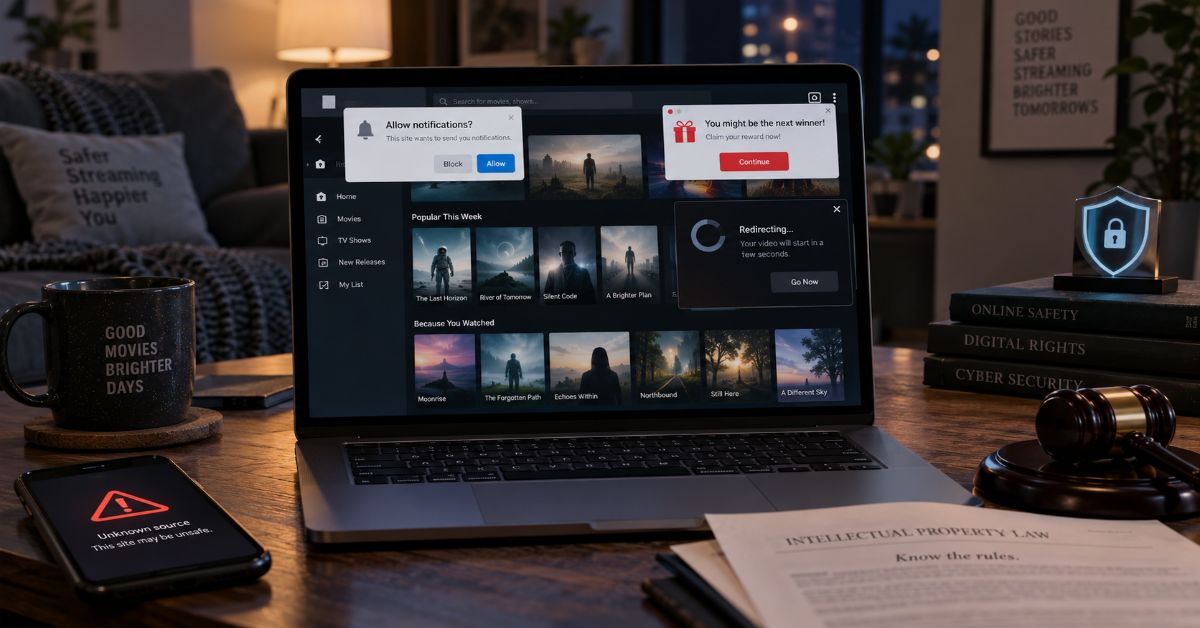
| Advertising / redirects | New tabs, pop-unders, fake play buttons | Third-party ad chains can carry scams or malware lures. | Close the chain; do not install anything. |
| Browser permissions | Requests for notifications or clipboard actions | Permissions can create later spam, fake alerts, or social engineering. | Deny unless there is a clear, trusted need. |
| Downloads | Codec, player, extension, APK, “update” | A video page rarely needs a mystery executable to play content. | Cancel the download; scan if you opened it. |
| Credentials / payment | Login, card, identity, or support prompt after a redirect | Could be phishing or account takeover. | Navigate to the real service independently. |
Is the Service Legal?
The most defensible answer is narrower than many ranking pages suggest. USTR and the Motion Picture Association describe the MyFlixerz/Sflix network as a piracy or infringing-streaming operation, and the U.S. Copyright Office states that unauthorized streaming can implicate a copyright owner’s public-performance right. But legal exposure for an individual viewer depends on jurisdiction, the exact conduct, and local law. I would not turn a U.S. enforcement record into universal legal advice for every country.
A better framework is the one I use in Rubble Magazine’s Futbol Libre enforcement guide: separate the service operator’s alleged conduct, the rights holder’s authorization, blocking or seizure actions, and the viewer’s own behavior. A domain being reachable does not establish licensing, and a site disappearing does not by itself prove why it disappeared.
The practical consumer test is simpler: if a site offers recent commercial films or television without a transparent licensing model, stable corporate identity, or conventional distribution relationship, do not assume the content is authorized merely because playback works. Where copyright status matters to you, check the title through an official distributor or a discovery service that points to licensed providers.
Why “What Is the Working Link?” Is the Wrong Question
This is the largest information gap I found in the current SERP. Many pages answer domain churn by publishing a fresh mirror or by implying that the newest result is the official continuation. That solves today’s click but creates tomorrow’s trust problem.
The safer lesson is visible across other unstable web ecosystems. Rubble Magazine’s Coomer.party status analysis shows why a changing address must be dated and sourced, while the Natomanga migration guide shows how redirects and community reports can establish movement without proving a formal corporate rebrand. The same discipline belongs here.
I could not verify a single canonical consumer domain in September 2026 that readers should treat as a permanent official address. That is not a claim that every page using the name is malicious. It is a finding about provenance: the brand is fragmented enough that a search result, SSL certificate, familiar interface, or “official” label is not sufficient evidence of ownership or licensing.
That leads to three original conclusions that are more useful than another mirror list. First, domain freshness is a risk signal, not a feature: a new address resets the trust decision. Second, the most dangerous part of the session may be monetization infrastructure rather than the video player itself. Third, “free” can shift cost away from subscription fees and toward advertising exposure, privacy loss, troubleshooting time, or security risk. None of those costs appears in the headline price.
What Are Better Legal Alternatives?
There is no licensed service that promises every current movie and television episode for free. The useful replacement is therefore a decision tree, not a one-for-one clone. Choose the access model that matches what you actually wanted from the search.
For a genuinely free starting point, Tubi’s official help center says the service is free and legal, funded by short ad breaks, and does not require credit-card information. Pluto TV and Plex use similar ad-supported models, while Kanopy and hoopla depend on participating libraries or institutions.
| Option | Best fit | Access model | Main trade-off |
| Tubi | Free on-demand browsing | Free with ads | Catalog and country availability change. |
| Pluto TV | Live-channel surfing plus on-demand | Free with ads | Less precise when you want one exact title. |
| Plex | Free viewing plus media discovery | Free with ads; optional account features | Free catalog rotates; some rentals are separate. |
| Kanopy | Curated film, documentaries, education | Participating library/university | Access and ticket rules depend on institution. |
| hoopla | Library-supported movies and mixed media | Participating library card | Borrowing limits vary by library. |
| JustWatch | Finding where one title is legally available | Discovery tool; destination may be free or paid | Usually sends you to another service for playback. |
The trade-off is visible: licensed services give up the fantasy of “everything, immediately, free” in exchange for clearer rights, stable apps, conventional support, and lower exposure to mirror hunting. For most readers, that is the better bargain.
What Do the Current Top 10 Articles Miss?
My competitive sample included current pages from RottenWiFi, PeepsTune, DocumentaryTube, MobileTalk, GeekChamp, TotalMedia, Digital Citizen, Macworld, and two additional DocumentaryTube guides that rank around the same intent cluster. Search order varies by country, device, personalization, and date, so I treat these as ten prominent current informational results rather than a permanent universal top ten.
Their shared strength is clear: most steer readers away from unstable mirror hunting and toward licensed alternatives. The ranking opportunity comes from what they compress or repeat.
- They over-focus on alternative lists. Several current pages use nearly the same Tubi/Pluto/Plex/Hoopla framework, so another longer list adds little information gain.
- They blur “the site” and “the name.” In 2026, the base brand, MyFlixerz, Sflix, historical FMovies links, and unrelated copycats should not be collapsed into one operator without evidence.
- They treat safety as a verdict instead of a stack. Domain reputation, ad delivery, redirect behavior, browser permissions, and downloads are separate risk layers.
- They rarely distinguish source types. A trade-association submission, a government watchlist, a security-research incident, and a user report should not carry the same evidentiary weight.
- They age quickly. Streaming-service names, prices, free tiers, app availability, and mirror status can change within months, so the durable content should teach verification rather than freeze a list.
That is the structure I would preserve for ranking: answer the navigational query immediately, then earn depth through provenance, dated enforcement context, real security mechanics, a legal-risk framework, and an alternatives table that tells the reader what each option actually replaces.
The Future of MyFlixer in 2027
I found no credible first-party roadmap for 2027, so this section is analysis, not a platform forecast. The strongest evidence points toward more fragmentation rather than a stable mainstream service. USTR describes MegaCloud/VidCloud/RapidCloud as “piracy-as-a-service” infrastructure supporting hundreds of streaming sites, while the MPA describes alternative domains and shared backends as a way these networks continue after enforcement.
Enforcement is also becoming more domain-scaled. In July 2026, the U.S. Department of Justice said Operation Offsides had seized more than 1,000 domains used to stream World Cup matches without authorization. That case was sports-focused, not a direct action against this brand, but it demonstrates that authorities can target large domain sets rather than one flagship site at a time.
The consumer-security pressure is moving in parallel. Microsoft’s ClickFix research shows why attackers do not need to compromise a famous streaming homepage if they can monetize the search and redirect path around it. My expectation for 2027 is therefore a noisier search environment: more clones, short-lived domains, search-optimized “official” pages, and monetization chains that are harder for ordinary users to distinguish at a glance. The durable defense is source verification, current browser security, and a willingness to abandon a page the moment it asks for software, unusual permissions, or sensitive information.
Key Takeaways
- Treat the brand name as an identity problem first; a familiar label does not establish a canonical operator or licensed catalog.
- Use dated primary records for status claims. USTR’s March 2026 review and the MPA’s October 2025 submission are stronger evidence than undated mirror directories.
- Separate page safety from redirect safety. A normal-looking catalog can still hand control to risky advertising or social-engineering chains.
- Do not install a player, codec, extension, APK, or “security update” merely because a streaming page says playback requires it.
- Legal analysis should distinguish the operator, rights-holder authorization, jurisdiction, and the viewer’s exact conduct rather than rely on a universal one-line verdict.
- Free licensed services will not reproduce an unauthorized all-in-one catalog, but they trade catalog breadth for clearer rights, stable apps, and lower security friction.
Conclusion
The most useful way to understand this search in 2026 is to stop treating it as a shortcut to one website. The public record instead points to a fragmented brand environment, a large reported piracy network using shared infrastructure, and a browsing model that can expose users to aggressive ads and redirects even before the legal question is settled.
That does not justify claiming every similarly named page is infected, controlled by the same operator, or illegal in exactly the same way everywhere. The stronger conclusion is narrower: provenance is difficult to verify, enforcement is active, and the security risk extends beyond the visible video player. A reader who wants entertainment rather than a research project is usually better served by checking a licensed free service, library platform, rental option, or title-discovery tool first.
For publication, I would keep this page updated around primary-source changes rather than chase every mirror. That gives the article a longer shelf life, avoids turning an editorial guide into an access directory, and creates the kind of information gain missing from much of the current SERP.
Frequently Asked Questions
Is there an official site in 2026?
I could not verify one stable canonical consumer domain that should be treated as the permanent official address. Current records use related names and domains, while search results also contain mirrors and copycats. A page calling itself “official” is not proof of ownership, licensing, or continuity.
Is MyFlixerz the same thing as the older brand?
Current U.S. and MPA records connect MyFlixerz with Sflix and related streaming domains. Historical reporting also links the older brand name to the FMovies ecosystem. That supports a relationship at the network or brand level, but it does not prove every similarly named domain has identical ownership.
Can a streaming site be safe if it has HTTPS?
HTTPS encrypts the connection to the domain; it does not verify that the operator is trustworthy, that the catalog is licensed, or that third-party ads and redirects are harmless. Treat HTTPS as a basic transport-security feature, not a full safety verdict.
What should I do if a free movie page asks me to install a player?
Do not install it. Close the prompt and the page. Modern browser-based streaming normally does not require an unknown codec, extension, APK, or executable from a random site. If you already opened a file, run an up-to-date security scan and review recent browser extensions and permissions.
What are safe sites like MyFlixer for free movies?
Licensed ad-supported services such as Tubi, Pluto TV, and Plex are the closest free browse-and-play substitutes. Kanopy and hoopla can be excellent if your library participates. Availability varies by country and catalog, so no legal service can promise every title.
Why do these streaming domains keep changing?
Unofficial streaming networks can change domains because of enforcement, blocking, hosting disruption, rebranding, or operator decisions. Shared backend infrastructure can also make multiple front-end sites move or fail together. A new domain should therefore restart the trust check rather than inherit credibility from an older name.
Methodology
I researched this article on September 19, 2026. Before drafting, I reviewed ten prominent current informational results for the exact keyword and close safety/alternative variants. The sample included RottenWiFi, PeepsTune, three DocumentaryTube guides, MobileTalk, GeekChamp, TotalMedia, Digital Citizen, and Macworld. Rankings vary by location, device, personalization, and time, so this is a competitive sample rather than a permanent universal ordering.
The recurring strengths were clear definitions, safety warnings, and licensed-alternative lists. The main gaps were provenance, domain history, evidence hierarchy, security mechanics, and overreliance on nearly identical alternative tables. I built this article around those gaps rather than copying competitor structure.
For factual validation, I prioritized the Office of the United States Trade Representative’s 2025 Notorious Markets List published in March 2026, the Motion Picture Association’s October 2025 submission, Microsoft Threat Intelligence’s August 2025 ClickFix research, the U.S. Department of Justice’s July 2026 Operation Offsides release, and official service pages from Tubi, Pluto TV, Plex, Kanopy, and hoopla. I used no mirror or player links as recommendations.
References
Motion Picture Association. (2025, October). MPA Notorious Markets 2025 submission.
Tubi. (2026). Is Tubi really free and legal? Tubi Help Center. Retrieved September 19, 2026.
Pluto TV. (2026). Watch free movies, TV shows and live TV online. Retrieved September 19, 2026.
Plex. (2026). Plex: Free vs paid. Plex Support. Retrieved September 19, 2026.
Kanopy. (2026). Streaming services for libraries and academia. Retrieved September 19, 2026.
hoopla. (2026). Movies and TV with your library card. Retrieved September 19, 2026.
U.S. Copyright Office. (2026). Copyright and digital files (FAQ). Retrieved September 19, 2026.