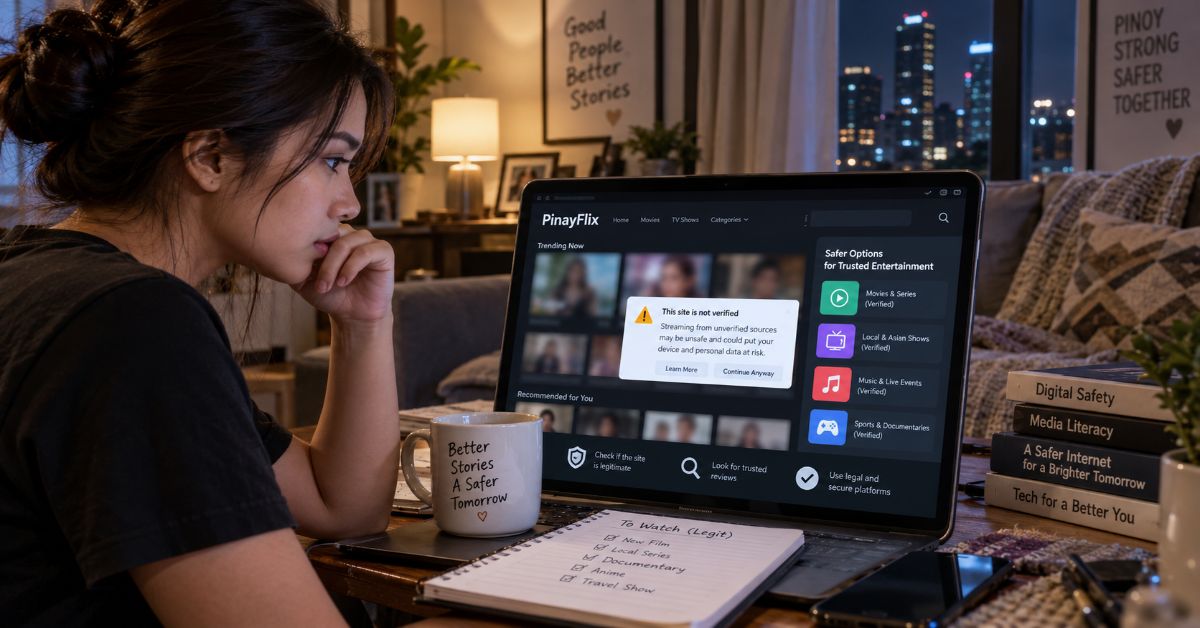
PinayFlix is not verifiable as one licensed Filipino streaming service in 2026; it is a search label attached to conflicting websites, some presenting themselves as family-friendly Filipino entertainment hubs and others associated with adult or allegedly leaked material. That contradiction is the key fact behind the keyword, because the safest answer to “what is pinayflix?” is not a mirror link but a verification problem.
I reviewed ten high-visibility current results before drafting this guide. The older pattern is promotional: pages describe subscriptions, offline downloads, original productions, smart-TV support, and large Filipino catalogs as if a documented company exists. Newer 2026 coverage is more skeptical and points out that the name appears across unrelated domains with no consistently identifiable owner, rights catalog, app-store publisher, or stable official address. I found no public evidence strong enough to collapse all of those pages into one verified platform.
The timing matters. DataReportal counted 98.0 million internet users in the Philippines at the end of 2025, with social-media identities reaching 95.8 million. A brand-like keyword can therefore spread through search, Facebook, TikTok, forums, and link directories long before users establish who operates a destination. That is the same identity problem I use in Rubble Magazine’s KissKH safety and legal-options guide: a familiar name or working stream is not proof of ownership, licensing, or safe handling of user data.
This article separates four questions that competitors often blur together: what the name currently refers to, whether a particular destination is technically trustworthy, whether the content appears authorized, and whether intimate or personal material was shared with consent. It also gives a practical verification workflow and legitimate viewing options, without directing readers to explicit or piracy mirrors.
What Is PinayFlix in 2026?
The most defensible description is that the name is an ambiguous brand-like term rather than a single verified service. Current search results show at least four different identity patterns: entertainment sites claiming Filipino movies and teleseryes, general-purpose blogs using the name, adult-oriented destinations, and secondary articles trying to explain which version is “real.”
The strongest first-party identity signal I found is a Linktree account labeled “Official.” I do not recommend using its outbound destinations because the directory itself describes one linked destination as adult content. That signal is useful for identity analysis, but it does not prove that every similarly named website has the same owner.
Why “official site” is the wrong first question
A searcher normally expects a brand query to resolve to one company and one canonical domain. Here, the evidence does not support that assumption. A better first question is: “Which entity operates this specific domain, and what independent evidence connects it to the content it claims to distribute?”
This distinction matters because a polished logo, HTTPS padlock, mobile-friendly design, or article that repeats the phrase “Filipino Netflix” can be created without proving licensing, consent, corporate ownership, or reliable support.
The competitive review shows why the search results are so easy to misread:
| Common SERP angle | What it does well | Recurring gap | Information gain used here |
| “Filipino streaming platform” explainer | Matches broad informational intent quickly | Often repeats plans, apps, originals, or downloads without first-party proof | Separate claimed features from verified identity |
| “Is this site safe?” guide | Raises pop-up, malware, and privacy concerns | Treats safety as one yes/no verdict | Split operator, browser, credential, copyright, and consent risk |
| “Official site” verification article | Acknowledges domain confusion | May still imply one hidden canonical operator exists | Use evidence hierarchy instead of domain guessing |
| Alternatives list | Helps readers exit risky sites | Can become a generic platform list | Compare alternatives by ownership and verification signals |
| Meme/cultural origin article | Explains why the name feels familiar | Does not resolve current domain or legal questions | Treat origin and current operator identity as separate issues |
Why Is This Name So Confusing in Search?
The keyword has an identity-collision problem: multiple publishers use the same memorable name, and repeated SEO copy can resemble corroboration without providing independent proof.
That can create synthetic legitimacy. Searchers see subscriptions, originals, downloads, and apps, but I could not find the corporate disclosures, rights-holder announcements, app-publisher identity, or support records needed to substantiate them.
A similar verification problem appears in Rubble Magazine’s Coomer.party status guide, where domain history, ownership, terms, and user conduct are analyzed separately rather than reduced to a “working/not working” label.
Three signals are more valuable than repeated SEO copy
- A named legal operator that can be matched across terms, privacy documents, app-store listings, and payment records.
- A rights relationship that can be checked against a broadcaster, studio, distributor, or content owner.
- A stable support and accountability trail: official contact details, refund or complaint procedures, and consistent domains controlled by the same entity.
A popular or polished result can still lack those signals; without them, it has not earned the trust of a documented streaming service.
Is PinayFlix Safe to Use?
A universal safety verdict would be misleading because the label does not resolve to one verified destination. The right question is which risk applies to the exact site encountered. I did not open explicit destinations, create accounts, download files, or run forensic malware scans, so I do not label any specific domain infected or clean.
Rubble Magazine’s ThisVid safety and privacy analysis makes the same distinction: a site can load normally while still presenting redirects, trackers, deceptive prompts, or consent concerns. Technical availability is not a complete safety test.
The strongest Philippine-specific warning comes from the National Privacy Commission’s May 2026 public notice, which advises against viewing, downloading, posting, sharing, or further disseminating files or links that may come from unauthorized access. This matters when snippets use terms such as “leak” or “scandal.”
For creators and people whose intimate material is shared without permission, Rubble Magazine’s OnlyFans leaks protection guide explains why privacy, consent, removal, and account security should be separated from ordinary streaming access.
A layered risk check is more useful than a red/green badge:
| Risk layer | Red flag | What the signal can tell you | What it cannot prove |
| Operator identity | No named company or consistent support | Accountability may be weak | Whether every page is malicious |
| Browser/redirects | Forced notifications, repeated redirects, fake download buttons | Higher interaction risk | Whether the underlying video is licensed |
| Credentials/payment | Requests for phone, card, or reused passwords before basic access | Potential phishing or unwanted billing exposure | Who owns the media rights |
| Content rights | No broadcaster/studio licensing trail | Authorization is uncertain | Whether a user will face legal liability in every jurisdiction |
| Consent/privacy | “Leaked” or “scandal” framing around intimate media | Possible non-consensual or unlawfully distributed material | The exact facts of an individual case |
Is This Streaming Name Legal in the Philippines?
A brand name alone cannot establish legality. Separate questions include whether media is distributed with permission, whether intimate material was recorded or shared with consent, and what a particular viewer or operator did. The answers can differ even on one domain.
On copyright enforcement, the Intellectual Property Office of the Philippines documented site-blocking requests in 2025 against services accused of illegally streaming Filipino films. Its framework shows that unauthorized online distribution is an active enforcement issue.
IPOPHL official Ann Claire C. Cabochan has summarized the policy concern plainly: “Digital piracy undermines the livelihood of our creative industries.” The quote does not prove every similarly branded site infringes; it explains why a verified rights chain matters.
Consent is separate. Republic Act No. 9995, the Anti-Photo and Video Voyeurism Act of 2009, prohibits specified acts involving recording, copying, distributing, publishing, or broadcasting covered intimate material without the required consent. The statute is relevant to pages marketed around “scandal” or leaked intimate videos. This article is informational, not legal advice; real cases require qualified legal review.
Rubble Magazine’s MyFlixer safety and legality guide makes a useful parallel point for streaming names generally: rights-holder authorization and website security are different evidence categories, so a safe-looking page is not automatically a licensed one.
How Can You Verify a Lookalike Streaming Site Before You Click?
I would use a five-part verification workflow before entering credentials, making a payment, accepting browser permissions, or downloading anything. The goal is not to find the “best mirror.” It is to decide whether the destination can establish who it is and why it has the right to offer the content.
- Check the operator, not just the logo. Look for a legal company name, jurisdiction, support contact, terms, and privacy policy that match across pages.
- Look for rights-holder corroboration. A broadcaster, studio, distributor, or creator announcement is stronger evidence than an affiliate article repeating catalog claims.
- Verify the app publisher independently. If a site claims an official mobile app, confirm the publisher name in the Apple App Store or Google Play instead of installing an APK from a page or pop-up.
- Treat payment and identity requests as a higher bar. Do not reuse passwords or submit card, phone, or identity data unless the operator and billing relationship are clear.
- Search the exact domain for enforcement and security history. A domain-specific reputation check can add context, but it should supplement — not replace — operator, rights, and consent verification.
For a service that wants an email address, money, or app installation, the core identity, rights, and support signals should all be present. A trust-score badge cannot compensate for a missing operator or licensing trail.
What Are Safer Alternatives for Filipino Content?
If the goal is Filipino movies, series, news, or entertainment rather than a particular search label, the safer path is to start with platforms whose operators and rights relationships are visible. Availability and pricing change by country, so verify current terms before subscribing.
ABS-CBN describes iWant as its global streaming platform with a library spanning more than 60 years of entertainment, news, documentaries, music, sports, live channels, and originals. That kind of first-party ownership statement is the evidence missing from many unverified streaming claims.
| Option | Best for | Verification signal | Current caveat |
| iWant | ABS-CBN shows, movies, live channels, originals | ABS-CBN-owned platform with official help center and apps | Plan and regional availability can change |
| Netflix Philippines | Broad mix of Filipino and international films and series | Official Philippine catalog with a current Tagalog-movie collection | Catalog rotates and a subscription is required |
| Verified broadcaster YouTube channels | Selected clips, episodes, livestreams, and archives | Channel verification plus links from the broadcaster’s own site | Not every title is available in every country or in full |
Netflix’s Philippine site currently lists a dedicated Tagalog-movie collection and local pricing, but the stronger comparison point is not catalog size. It is accountability: established services make the operator, billing relationship, support path, and content distribution framework visible enough for a consumer to evaluate.
The Future of PinayFlix in 2027
I found no reliable roadmap from a verified operator using this name, so forecasting apps, subscriber growth, or originals would imply a company I cannot document. The defensible 2027 outlook concerns the surrounding search and enforcement environment.
Philippine digital reach is already large: DataReportal counted 98.0 million internet users at the end of 2025, while YouTube advertising tools indicated 59.6 million users. That reach attracts both legitimate publishers and copycats.
Enforcement is also moving toward faster disruption. IPOPHL has used voluntary site-blocking since 2023 and in 2026 described proposals to expand authority against infringing platforms.
Privacy risks are broadening beyond stolen files. In August 2026, the National Privacy Commission said using a real person’s face or likeness in AI-generated media is personal-data processing requiring a lawful basis. By 2027, users may also need to distinguish authentic from synthetic intimate media.
The clearest trend is rising value for provenance. Pages that prove operator identity, rights, consent practices, and stable distribution will be easier to trust than names sustained mainly by SEO repetition and domain churn.
Key Takeaways
- Treat the term as an ambiguous search label, not a verified single company, unless the exact destination can prove common ownership and rights.
- A first-party directory linked to the name points to adult content, while other sites make mainstream streaming claims; shared branding does not establish shared ownership.
- Safety has at least five layers: operator identity, browser behavior, credentials/payment, content rights, and consent/privacy.
- Philippine copyright enforcement and privacy law address different harms, so “legal or illegal” is too broad without facts about the specific content and conduct.
- Repeated feature claims across SEO articles are not independent proof; seek broadcaster, studio, app-store, or company corroboration.
- For Filipino entertainment, established services such as iWant, Netflix Philippines, and verified broadcaster channels provide clearer accountability than anonymous mirrors.
Conclusion
This search term is a useful example of why brand-shaped results need more than a quick definition. The name currently points to conflicting claims and destinations, and I could not verify one company, licensed catalog, app publisher, or official domain that cleanly explains every result. That makes provenance more important than popularity.
A user deciding whether to trust a similarly branded page should separate the questions that many search results merge: Who operates it? Who authorized the content? What data or permissions does it request? Does the material involve consent or privacy concerns? A working video player answers none of those by itself.
The safer approach is not to chase a new mirror whenever a domain changes. It is to use verifiable operator and rights signals, avoid links framed around leaks or scandals, and choose documented services when the goal is Filipino entertainment. As Philippine enforcement, privacy rules, and AI-generated media concerns develop through 2027, that verification-first habit will age better than any list of “working” mirror URLs.
Frequently Asked Questions
What is PinayFlix?
It is best treated as an ambiguous online name used by multiple websites and content pages. I could not verify one company or licensed platform that owns every current similarly branded destination.
Is there an official streaming app?
I found pages that claim app and subscription features, but I did not find enough first-party corporate and app-publisher evidence to verify one official app. Check the app-store publisher independently before installing anything.
Is the site safe?
There is no universal answer because the name maps to multiple destinations. Evaluate the exact domain for operator identity, redirects, credential requests, downloads, content rights, and privacy or consent concerns.
Is the service legal in the Philippines?
A name alone is not legal or illegal. Copyright authorization, non-consensual intimate imagery, data handling, and the conduct of an operator or user are separate legal questions under Philippine law.
What is the official website?
I could not verify one canonical domain that is demonstrably controlled by a single documented company. Search results include conflicting sites and a first-party-labeled directory associated with adult content, so avoid assuming the top domain is official.
What are good alternatives?
For documented Filipino entertainment, start with services whose operators are clear, such as ABS-CBN’s iWant, Netflix Philippines, and verified broadcaster channels on YouTube. Catalogs, prices, and regional availability can change.
Methodology
On September 22, 2026, I reviewed ten prominent results: CloudsPress, DocumentaryTube, RottenWiFi, InsideFame, a UK-branded explainer, ThePinayFlix.com, Pinay-Flix.com, Global Net Bit, Pinayflix.blog, and MeasureTake. Rankings vary, so this is a competitive sample, not a fixed order.
The main gaps were unsupported product claims, weak separation of safety from copyright and consent, overconfidence about an “official” domain, and limited use of current Philippine sources. I built around those gaps.
Validation prioritized the Supreme Court E-Library, National Privacy Commission, IPOPHL, DataReportal, ABS-CBN’s iWant help center, and Netflix Philippines. The “Official” Linktree was treated only as an account-level identity signal, not proof of ownership across domains.
I did not visit explicit destinations, create accounts, download media, submit personal data, or run a forensic scan. With no verifiable 2027 company roadmap, forward-looking analysis is limited to documented enforcement, adoption, and privacy trends. Internal links were verified live.
AI assistance supported research organization, drafting, and document production. Before publication, a human editor must verify live links, APA references, named claims, statistics, and first-person statements; only then should the published version state that human review is complete.
References
ABS-CBN. (2025). What is iWant? iWant Help Center. Modified July 8, 2025.
DataReportal. (2026). Digital 2026: The Philippines. DataReportal.
Intellectual Property Office of the Philippines. (2025, October 7). IPOPHL requests to block several piracy sites, calls for respect of creators’ rights this National Anti-Piracy Month.
Intellectual Property Office of the Philippines. (2026). IPOPHL, Congress push key reforms to IP Code amid rapid tech, economic change.
Linktree. (2026). PinayFlix Official. Account information shows the profile joined in October 2024.
National Privacy Commission. (2026, May 22). Notice to the public.
National Privacy Commission. (2026, August 11). Notice to the public: Use of real persons’ likenesses in AI-generated images.
Netflix. (2026). Tagalog Movies. Netflix Philippines.
Supreme Court E-Library. (2010, February 15). Republic Act No. 9995: Anti-Photo and Video Voyeurism Act of 2009.