Psalm 91 KJV is a 16-verse declaration of trust in God as refuge, fortress, shelter, and deliverer, but its deepest comfort is not a promise that believers will never meet trouble. The psalm itself says God will be “with him in trouble,” which changes how I read every earlier image of plague, arrows, angels, lions, and protection. Psalm 91 offers fearless confidence in God without turning faith into a claim of physical invulnerability.
People usually search this passage because they want the exact King James wording, a prayer of protection, or the meaning of famous lines such as “under the shadow of the Almighty” and “he shall give his angels charge over thee.” I answer all three. I include the complete public-domain KJV text, then read its images as one argument rather than isolated promises.
I also reviewed ten prominent current results, including Bible Gateway, Bible Study Tools, Bible Hub, YouVersion, King James Bible Online, Christianity.com, Enduring Word, Mercy House Ministry, Context Scripture, and BookofPsalms.org. Most offer the text, classic commentary, or a protection-centered devotional reading. The clearest ranking gap is interpretive guardrails: Jesus himself refuses to use Psalm 91:11–12 as a reason to jump from the temple. That New Testament scene lets the psalm remain bold and comforting without turning it into a charm against every form of suffering. That distinction matters because readers often encounter the best-known protection lines as isolated social posts, prayer graphics, or search snippets. Reading the ending beside them preserves the psalm’s tension: danger is real, trust is active, and God’s presence is the controlling promise.
Psalm 91 KJV: Full Text
The King James Version text below is reproduced from the public-domain King James Bible text available through Wikisource. I keep the 16 verses together because the meaning changes when a single protection line is detached from the psalm’s ending.
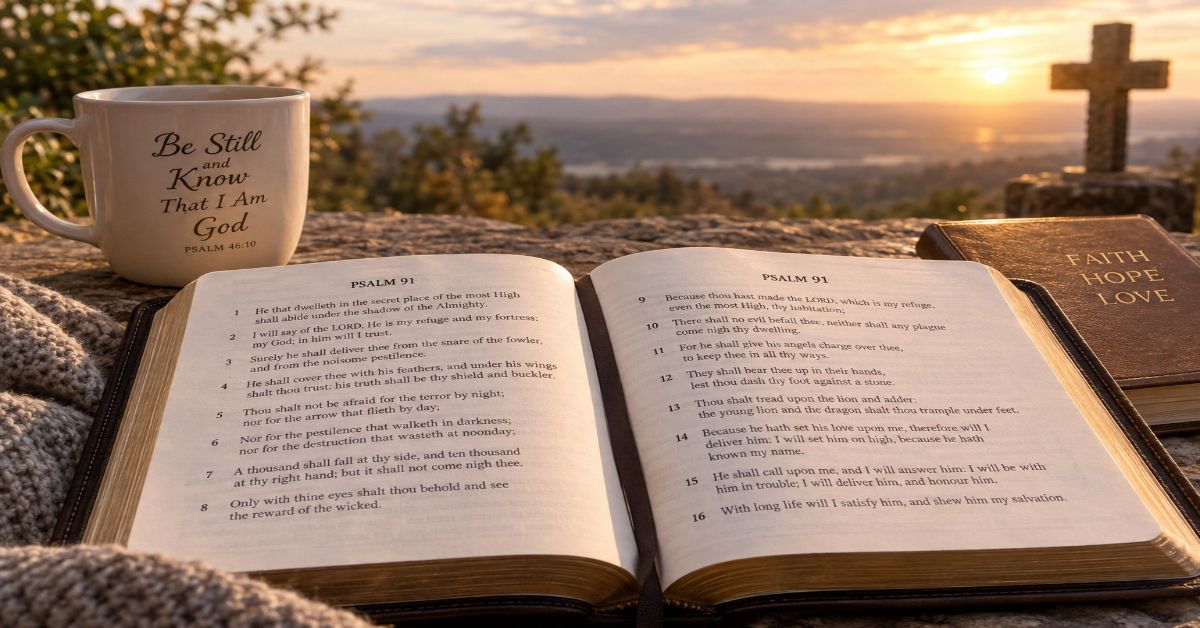
1 He that dwelleth in the secret place of the most High shall abide under the shadow of the Almighty.
2 I will say of the LORD, He is my refuge and my fortress: my God; in him will I trust.
3 Surely he shall deliver thee from the snare of the fowler, and from the noisome pestilence.
4 He shall cover thee with his feathers, and under his wings shalt thou trust: his truth shall be thy shield and buckler.
5 Thou shalt not be afraid for the terror by night; nor for the arrow that flieth by day;
6 Nor for the pestilence that walketh in darkness; nor for the destruction that wasteth at noonday.
7 A thousand shall fall at thy side, and ten thousand at thy right hand; but it shall not come nigh thee.
8 Only with thine eyes shalt thou behold and see the reward of the wicked.
9 Because thou hast made the LORD, which is my refuge, even the most High, thy habitation;
10 There shall no evil befall thee, neither shall any plague come nigh thy dwelling.
11 For he shall give his angels charge over thee, to keep thee in all thy ways.
12 They shall bear thee up in their hands, lest thou dash thy foot against a stone.
13 Thou shalt tread upon the lion and adder: the young lion and the dragon shalt thou trample under feet.
14 Because he hath set his love upon me, therefore will I deliver him: I will set him on high, because he hath known my name.
15 He shall call upon me, and I will answer him: I will be with him in trouble; I will deliver him, and honour him.
16 With long life will I satisfy him, and shew him my salvation.
Source text: Wikisource, King James Bible — Psalms.
What Does Psalm 91 Mean?
Psalm 91 means that the person who makes God a settled refuge can face real danger without making fear the final authority. Its poetry moves from confession, to promised protection, to God’s own closing speech. The decisive line is not “nothing difficult will ever happen,” but “I will be with him in trouble.”
The psalm’s images form a progression. This table is the fastest way to see how the parts work together rather than as disconnected slogans.
| Verses | Main image | What it communicates | Reading guardrail |
| 1–2 | Secret place, shadow, refuge, fortress | Trust begins with dwelling: God is treated as home, not an emergency tool. | The relationship comes before the protection language. |
| 3–8 | Snare, pestilence, wings, shield, terror, arrow | Danger is named from hidden traps to public violence; the response is confidence rather than panic. | Poetic totality should not be reduced to a medical or military warranty. |
| 9–13 | Habitation, angels, stones, lion, adder | God’s care reaches the traveler’s path and the believer’s confrontation with danger. | “In all thy ways” matters; the New Testament rejects deliberately testing God. |
| 14–16 | Love, name, answer, trouble, deliverance, salvation | God speaks directly and promises relationship, presence, rescue, honor, and salvation. | Verse 15 places divine presence inside trouble, not only outside it. |
What does “the secret place of the most High” mean?
The opening language describes settled nearness to God. “Dwelleth” and “abide” are residence words, while “shadow” suggests protection that requires proximity. David Guzik’s Enduring Word commentary makes the pastoral point in a short line: “The secret place of the Most High is not just for mystics.” I read the opening the same way: Psalm 91 is not describing an elite spiritual technique but a life organized around trust.
For wider Psalms context, BibleProject’s guide to the Book of Psalms describes Psalms as a deliberately shaped collection of 150 poems, prayers, and songs from multiple periods and authors.
Why does Psalm 91 name so many dangers?
Night and day, hidden pestilence and visible arrows, thousands falling nearby, wild animals, and stones create a poetic sense of total exposure. The point is not that one danger is imaginary and another literal. The point is that fear has nowhere on the clock to claim uncontested rule. The person under God’s “wings” is also behind God’s “shield and buckler”: tender shelter and military defense sit side by side.
Why is verse 15 the interpretive center?
Because it prevents an easy but damaging conclusion. God does not say, “My faithful person will never enter trouble.” God says, “I will be with him in trouble.” That makes presence, relationship, and final deliverance the controlling promises. It also leaves room for the obvious biblical reality that faithful people can suffer while still being held by God.
Does Psalm 91 Promise That Christians Will Never Suffer?
No. A responsible reading of Psalm 91 does not require the claim that sincere believers are physically immune to disease, accidents, persecution, grief, or death. The psalm uses absolute, confidence-building poetry, but its own conclusion acknowledges trouble. The New Testament then shows exactly how protection language can be misused.
In Luke 4:10–12, the devil quotes Psalm 91:11–12 and challenges Jesus to throw himself down. Jesus answers from Deuteronomy: “Do not put the Lord your God to the test.” That scene does not cancel Psalm 91. It interprets its use. Trust receives God’s care while walking faithfully; presumption manufactures a danger in order to force God to prove the promise.
The cross-reference can be checked directly in Luke 4:10–13 on Bible Gateway.
This distinction matters far beyond theology. If someone treats verse 10 as proof that they can ignore public-safety guidance, refuse ordinary precautions, or substitute a psalm for appropriate medical care, the interpretation has crossed from confidence into avoidable risk. Faith can reject panic without rejecting responsibility.
I use the following test when a protection claim sounds absolute:
| Reading question | Faithful reading | Risky overreach |
| What is promised? | God as refuge, presence, guardian, answerer, deliverer, and savior. | Guaranteed exemption from every form of harm. |
| What does “in all thy ways” imply? | Protection accompanies the path of faithful living. | Any self-created danger becomes a test God must pass. |
| How should fear be handled? | Bring fear under trust, prayer, wisdom, and ordinary responsibility. | Deny danger, shame anxious people, or reject prudent action. |
| What anchors the conclusion? | “I will be with him in trouble.” | A single isolated verse treated as a universal formula. |
Who Wrote Psalm 91, and Why Does Context Matter?
Psalm 91 is anonymous in the Hebrew text because it has no superscription naming an author. Moses is a longstanding Jewish and Christian tradition, helped by its placement after Psalm 90, “A Prayer of Moses,” but tradition is not the same thing as an author line in the text.
Scholarship also studies the psalm within the Psalter. Philippus J. Botha identified wisdom connections with Proverbs 3, while W. Dennis Tucker Jr.’s 2024 Journal of Biblical Literature article examines possible domestic, official, and communal uses, including the Dead Sea Scrolls collection 11Q11. The KJV adds another historical layer: readers today meet the ancient Hebrew poem through early modern English, so words such as “noisome,” “buckler,” and “adder” deserve explanation rather than modern guesses.
How Can You Pray Psalm 91 Today?
I would not use Psalm 91 as a spell or a way to suppress honest fear. I would use it as a structured prayer that moves from refuge, to fear, to trust, to God’s presence in trouble.
- Read all 16 verses before choosing a favorite line. This keeps verse 15 beside verses 10–12 and prevents a protection promise from becoming detached from the psalm’s ending.
- Name the fear in ordinary language. “Terror by night” can become the fear that keeps you awake; “arrow by day” can become the visible problem you know you must face.
- Turn one image into a direct prayer. For example: “Be my refuge and fortress today; keep fear from deciding for me.”
- Keep one responsible action beside the prayer. Make the call, follow the treatment plan, lock the door, ask for help, leave the unsafe situation, or complete the task you have been avoiding.
- End with verse 15, not with a demand for proof. The final posture is not “nothing bad can happen to me,” but “God is with me in trouble, and I will call on him.”
For a consistent reading habit, Rubble Magazine’s personal development system supports a simple approach: choose a small repeatable behavior and tie it to a stable cue.
If starting is the obstacle, the guide to stopping procrastination suggests defining the first visible action — for example, “read Psalm 91:1–2 before opening social media.”
For a family or small-group discussion, the site’s follow-up question framework supports one useful principle: follow the answer instead of racing through a list.
The Future of Psalm 91 KJV in 2027
The future of this KJV psalm is about discovery, not a changing text. American Bible Society’s April 2026 update says digital Bible use is edging out print among Gen Z and Millennial Bible users, while print remains widely used overall. YouVersion reported one billion device installs in October 2025, showing how strongly Scripture discovery now spans print, apps, audio, video, and search.
AI adds a second shift. American Bible Society reported in June 2026 that 58% of Americans use generative AI at least a few times a year, but only 14% agreed that AI can help people understand the Bible more clearly. For 2027, the editorial advantage is context preservation: show the source, distinguish text from interpretation, and keep “I will be with him in trouble” beside the more easily clipped protection lines.
Key Takeaways
- Psalm 91 is a psalm of trust and refuge, not a formula that forces God to prevent every hardship.
- Verse 15 — “I will be with him in trouble” — is the strongest internal guardrail against an immunity reading.
- The angel verses in Psalm 91:11–12 appear in Jesus’s temptation, where Scripture is rejected as a tool for reckless self-testing.
- The Hebrew psalm is anonymous; Moses is an important tradition, not a named author in the canonical heading.
- KJV terms such as “noisome,” “buckler,” and “adder” deserve explanation because modern readers can misread older English.
- A practical Psalm 91 prayer should combine trust with ordinary responsibility, not replace wise action.
- In 2027, digital and AI discovery will make source transparency and contextual interpretation more important, not less.
Conclusion
Psalm 91 remains powerful because it does not pretend danger is unreal. It names terror, arrows, pestilence, destruction, falling bodies, stones, lions, serpents, and trouble — then places each image inside a larger confession that God is refuge, fortress, shelter, and salvation. The KJV intensifies that effect through compact phrases that have stayed memorable for centuries.
The strongest reading keeps the entire movement of the psalm intact. I would not isolate verse 10 into a guarantee of physical immunity, or verse 11 into permission to test divine protection. Jesus’s temptation shows why that matters. Trust is not recklessness with religious vocabulary. The final divine speech is more durable: call, answer, presence in trouble, deliverance, honor, long life, salvation.
For a reader who came looking for Psalm 91 KJV because fear is close, the practical center is simple. Read all 16 verses. Let the images give language to fear. Make God the object of trust rather than making safety the object of faith. Then carry the psalm into responsible action, prayer, and community without asking it to promise something the text itself does not.
Frequently Asked Questions
What is Psalm 91 KJV about?
Psalm 91 in the KJV is about trusting God as refuge, shelter, fortress, and deliverer amid danger. Its images include wings, shields, angels, plague, nighttime terror, and wild animals. “I will be with him in trouble” keeps the focus on divine presence rather than a claim that believers never suffer.
What is the main message of Psalm 91?
The main message is that a person who makes God a dwelling place can face danger without surrendering to fear. The psalm moves from confession to protection imagery and ends with God promising to answer, accompany, deliver, honor, and save the one who calls.
Who wrote Psalm 91 in the KJV?
Psalm 91 has no superscription naming its author. Moses is a longstanding tradition, partly because Psalm 90 is attributed to Moses, but the safest historical statement is that Psalm 91 is anonymous in the Hebrew text.
What does Psalm 91:11 mean about angels?
Psalm 91:11 says God gives angels charge to guard the faithful “in all thy ways.” The New Testament quotes this during Jesus’s temptation. Jesus refuses to turn the promise into a stunt, so angelic protection is not permission to create danger and demand rescue.
Does Psalm 91 protect you from disease?
Psalm 91 uses strong plague and pestilence language, but it is not a medical guarantee or substitute for appropriate care. The psalm’s own final speech acknowledges trouble; its promise of God’s presence does not cancel ordinary health and safety responsibilities.
What does “under the shadow of the Almighty” mean?
The phrase pictures close shelter: a shadow implies nearness to what casts it. Paired with “dwelleth in the secret place,” the metaphor communicates proximity, refuge, dependence, and sustained trust rather than occasional emergency contact.
How should I pray Psalm 91 for my family?
Read the whole psalm, name the specific fear, choose one image such as refuge or wings, and ask for wisdom as well as protection. Verse 15 offers a balanced center: ask God to answer, be present in trouble, and lead your family through it faithfully.
Methodology
I researched this article on September 22, 2026 and reviewed ten prominent results for “psalm 91 kjv” and close variants: Bible Gateway, Bible Study Tools, Bible Hub, YouVersion, King James Bible Online, Christianity.com, Enduring Word, Mercy House Ministry, Context Scripture, and BookofPsalms.org. Rankings vary by user and time, so this is a competitive sample, not a permanent order.
Text was checked against Wikisource’s public-domain KJV and Bible Gateway. Context and scholarship were checked against BibleProject, Philippus J. Botha, W. Dennis Tucker Jr., and Philip Jenkins. Digital trends were checked against American Bible Society and YouVersion. I separate explicit text, later authorship tradition, and editorial synthesis.
AI assistance was used for research organization, drafting, source comparison, and document production. A human editor must review the article before publication, verify quotations and named claims, recheck links, confirm APA references, and ensure first-person wording reflects the human author’s judgment and experience.
References
- American Bible Society. (2026, April 8). America’s relationship with the Bible: It’s complicated. State of the Bible. Source
- American Bible Society. (2026, June 10). Informational or formational—What do people think about AI and the Bible? State of the Bible. Source
- BibleProject. (n.d.). Psalms: Guide with key information and resources. Retrieved September 22, 2026. Source
- Botha, P. J. (2012). Psalm 91 and its wisdom connections. Old Testament Essays, 25(2), 260–276. Source
- Guzik, D. (n.d.). Psalm 91 — The assurance given to those who trust in God. Enduring Word. Retrieved September 22, 2026. Source
- Jenkins, P. (2023). He will save you from the deadly pestilence: The many lives of Psalm 91. Oxford University Press. Source
- Tucker, W. D., Jr. (2024). Revisiting Psalm 91 in light of Rainer Albertz’s model of internal religious pluralism. Journal of Biblical Literature, 143(4), 643–663. Source
- Wikisource contributors. (n.d.). Bible (King James)/Psalms. Wikisource. Retrieved September 22, 2026. Source
- YouVersion. (2025, October 28). YouVersion, creator of the world’s most popular Bible app, reaches one billion installs. Source