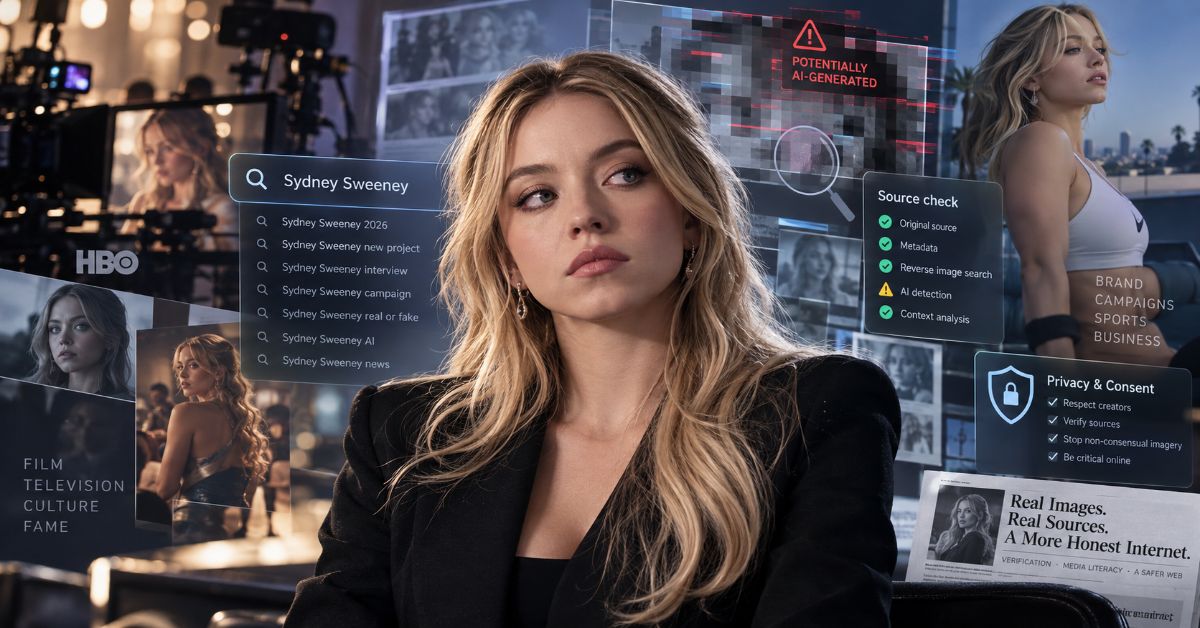
If you searched sydney sweeney nude, the verified answer is more complicated than a gallery page makes it look: some widely circulated material comes from professionally released screen performances or a public 2026 advertising campaign, while other results are reposted out of context, mislabeled, manipulated, or potentially AI-generated. The key question is therefore not simply whether an image exists, but what its original source is, whether it was intentionally released in that form, and whether a search result is presenting it honestly.
I reviewed ten prominent current and close-intent results before drafting this guide. The search landscape splits sharply. Older pages focus on Sweeney’s portrayal of Cassie Howard in Euphoria and her comments about boundaries, performance, and the double standard applied to actresses who appear nude on screen. Newer September 2026 coverage focuses on Novig’s “Just Sports” campaign, which generated a separate public debate about sexualization, sports marketing, and Sweeney’s role as a strategic partner and equity holder. The overlap creates an easy SEO trap: a page can rank for a sensational phrase while giving readers stale or incomplete context.
My approach is different. I separate what can be verified from what cannot, distinguish professional performance from non-consensual redistribution, and explain why deepfakes and misleading thumbnails make visual search less trustworthy than it appears. I also show the evidence hierarchy I would use before believing a claim. This is not a collection of intimate images, and it does not reproduce or direct readers to explicit material. It is a source-checked explanation of the search term, the public record behind it, and the privacy and consent issues that current SERP results often blur together.
What Does the Sydney Sweeney Nude Query Mean in 2026?
In practical search terms, the phrase now points to three different content classes. I treat them separately because authenticity, consent, copyright, and reader risk change from one class to the next. The same distinction is useful in Rubble Magazine’s OnlyFans leak protection guide, where account exposure, copied content, and intimate-image removal are not treated as one problem.
The first class is professionally released performance or campaign material. That includes scenes distributed as part of a film or television production and imagery intentionally published as part of a commercial campaign. The second class is unauthorized redistribution: screenshots, clips, compilations, mirrors, or social posts that copy genuine material but detach it from the original publication context. The third class is synthetic or deceptive material, including edited images, false thumbnails, face swaps, and AI-generated sexualized depictions.
That three-bucket model is the most important information gain in this article. A result can be visually convincing and still belong to the wrong bucket. Search engines index copies, commentary, thumbnails, forum posts, and automated pages alongside original sources, so visual similarity is not proof of provenance.
| Content class | What it looks like | Best verification step | Main risk |
| Official/professional release | Film, TV, campaign, or licensed editorial source | Original distributor, production, or campaign record | Context can still be sensationalized when reposted |
| Unauthorized copy of real material | Screenshot, clip, mirror, repost, compilation | Trace back to the original release; compare dates and framing | Copyright, privacy, and context can be stripped away |
| Manipulated or AI-generated | Face swap, synthetic image, edited thumbnail, fake still | Reverse-source checking plus reliable reporting or original-source absence | Convincing appearance can create false attribution |
What Is Actually Verified About Sweeney’s On-Screen Nudity?
The strongest record comes from Sweeney’s own interviews about Euphoria. In a 2022 interview with The Independent, she said she had been able to tell creator Sam Levinson when she felt particular nudity was unnecessary and that he respected those boundaries. She also distinguished her performance as Cassie from her private identity and described how upsetting it was when people circulated screenshots and tagged family members. That distinction is central: a consensually filmed performance does not create blanket consent for every later use, caption, compilation, or redistribution of the image.
Coverage from Teen Vogue later added an important correction to the way that interview had been summarized online. Sweeney said headlines claiming she had broadly asked for scenes to be cut distorted her point; she was emphasizing the ability to discuss boundaries and the respect she felt on that production. The episode is a useful lesson in search literacy: even reputable articles can be compressed into a headline that loses the nuance of the original statement.
Industry practice supports that emphasis on consent. SAG-AFTRA’s guide for scenes involving nudity and simulated sex says performers should receive appropriate notice, written consent, clear riders describing agreed parameters, and safe working conditions. Its intimacy-coordinator standards also emphasize continuing consent during rehearsal and filming. Those safeguards explain why “it appeared on screen” and “anything can be done with it later” are not equivalent ideas.
What Changed With the September 2026 Novig Campaign?
The current SERP cannot be understood through Euphoria alone. On September 9, 2026, sports prediction company Novig launched its “Just Sports” campaign featuring Sweeney in deliberately provocative sports-themed imagery. Current reporting identifies her not only as the face of the campaign but as a strategic partner and equity holder. That business relationship matters because it shows the imagery was part of an intentional commercial release, not a leak or an unidentified private file.
The campaign also created a separate controversy. ABC News Australia reported that Olympic and elite athletes criticized the advertisement for sexualizing women’s sport and argued that it distracted from athletic performance. Other commentary defended Sweeney’s agency or treated the provocation as deliberate marketing. I do not collapse those positions into a single verdict; what can be verified is that the campaign was public, commercial, intentionally provocative, and a major reason the search term regained freshness in September 2026.
Why Reposts, Thumbnails, and AI Fakes Make the Search Harder
Sensitive celebrity searches reward speed and visual impact, which is exactly where verification tends to weaken. A repost can remove the production name, date, scene context, photographer credit, or campaign label. A thumbnail can imply explicit content that the destination page does not contain. A synthetic image can borrow the visual grammar of a real photoshoot without having any authentic source at all. Rubble Magazine’s Internetchicks risk-verification guide makes a related point: a familiar name or polished presentation is not proof that two web entities, files, or claims share the same provenance.
| Level | Source type | Confidence | How I use it |
| 1 | Original production/campaign | Highest | Use as provenance anchor |
| 2 | Direct interview/on-record statement | High | Use for intent, consent, or quoted context |
| 3 | Reputable dated reporting | Medium-high | Use when it names evidence and distinguishes fact from criticism |
| 4 | Traceable repost or screenshot | Medium-low | Verify against the original before relying on it |
| 5 | Anonymous, cropped, synthetic-looking, or source-free upload | Low | Do not treat as authentic without stronger evidence |
For broader privacy context, Rubble Magazine’s ThisVid safety and privacy guide explains why a file being publicly accessible does not prove that every upload is authorized, consensual, or safe to redistribute. That principle applies beyond any one platform.
What Do Consent and the TAKE IT DOWN Rules Change?
U.S. law changed materially in 2025–2026. The TAKE IT DOWN Act was signed in May 2025, and the Federal Trade Commission began enforcing the platform notice-and-removal provisions on May 19, 2026. The FTC’s compliance guidance says covered platforms must provide a clear process for reporting qualifying non-consensual intimate images, including digital forgeries, and remove validly reported material plus known identical copies within 48 hours.
That rule should not be misread as a blanket deletion right for every professional image someone later dislikes. A commercial film scene, magazine shoot, or advertising campaign is not automatically the same legal category as a private image shared without consent or a sexualized digital forgery. Applicability depends on the facts, jurisdiction, publication context, and the specific law or platform policy involved. This article is general information, not legal advice.
For adults dealing with qualifying non-consensual intimate imagery, StopNCII.org’s hashing process creates a digital fingerprint on the user’s device and shares the hash, not the original image, with participating platforms. Its own eligibility page specifically distinguishes synthetic or fake intimate images from commercial or professional images. That distinction is especially useful for celebrity searches because it prevents the word “nude” from flattening very different consent scenarios into one category.
The same separation appears in Rubble Magazine’s Coomer.party status and creator-rights guide, which treats copyright ownership, platform status, privacy, and consent as related but distinct questions. That is a better framework than assuming one takedown process solves every kind of unwanted distribution.
What Do the Current Top 10 Results Miss?
I reviewed ten prominent current or close-intent editorial results to understand what already ranks and where a stronger page can add information rather than simply becoming longer. The sample is deliberately mixed because the live query itself is mixed: some pages rank through legacy authority around Euphoria, while newer results gain freshness from the September 2026 Novig campaign.
| Result reviewed | Primary angle | What it does well | Gap this article fills |
| The Independent (2022) | Direct Euphoria interview | Best firsthand context | Predates 2026 campaign and new NCII rules |
| Teen Vogue (2022) | Clarifies distorted headlines | Strong nuance | No current verification framework |
| ELLE (2022) | Gender double-standard angle | Clear context | Mostly recap of 2022 interview cycle |
| Glamour (2022) | Euphoria scene context | Readable summary | Heavy overlap with older coverage |
| TVLine (2022) | Fast production summary | Concise answer | Thin on privacy and provenance |
| Washington Post (2022) | Profile and body-image context | Broader reporting | Not built for exact-query verification |
| Variety Australia (2026) | Season 3 production comments | Fresh Euphoria context | Narrow season-specific focus |
| People (2026) | Season 3 celebrity-news recap | Current and accessible | Secondary summary |
| Us Weekly (2026) | Novig campaign details | Fresh campaign coverage | Little fake/repost classification |
| ABC News Australia (2026) | Athlete backlash to Novig | Named critics, timely | Sports angle rather than full explainer |
The Future of Sydney Sweeney Search Results in 2027
The clearest 2027 trend is not about predicting Sweeney’s private choices or future roles. It is about the search environment around public figures. Generative image tools are making source verification more important at the same time regulators and platforms are building faster complaint and removal workflows for non-consensual intimate imagery and digital forgeries.
I expect stronger 2027 pages to show provenance more clearly through original-source links, dates, AI labels, and explicit distinctions between professional releases and unauthorized redistribution. The FTC’s 2026 enforcement regime also pressures covered platforms to make qualifying reporting and removal paths easier to use.
Enforcement will still be uneven. Copied media can move across jurisdictions, small sites, private groups, and changing domains, while hash matching works only where participating platforms can act. Publishers should therefore avoid amplifying source-free intimate imagery and make their verification method visible.
Key Takeaways
- The query combines at least three evidence classes: official professional media, unauthorized copies of real media, and manipulated or AI-generated material.
- Euphoria interviews establish that Sweeney has discussed boundaries, character context, and the harm of family members being dragged into redistributed screenshots.
- The September 2026 Novig campaign is a separate, intentionally public commercial release and explains why the keyword has fresh search demand now.
- A source chain is more reliable than visual confidence; the first publication, date, distributor, and direct statement matter more than a viral thumbnail.
- The TAKE IT DOWN framework covers qualifying non-consensual intimate imagery and digital forgeries, while professional commercial imagery requires different analysis.
- Publishers can add real information gain by classifying media and explaining verification instead of reproducing galleries, rumors, or source-free claims.
Conclusion
The most useful way to answer this search is to resist the shortcut that made the keyword popular. A professionally released performance, a provocative advertisement, a copied screenshot, and an AI-generated sexualized image may appear beside one another in search, but they do not share the same source history, consent context, or legal implications.
For Sydney Sweeney, the public record shows repeated discussion of acting, boundaries on set, and the way images lose context after release. The September 2026 Novig campaign adds another verified public source, but it does not make every result using her name authentic.
I would treat provenance as the deciding filter: start with the original production or campaign, then direct interviews, then reputable dated reporting. Anything that cannot be traced back should remain unverified, especially when it is sexualized, cropped, or unusually polished. That approach gives readers a more accurate answer and gives a publisher what the current SERP often lacks: context without exploitation.
Frequently Asked Questions
What does the sydney sweeney nude search actually include?
No. Current search results can mix official stills, screenshots from licensed performances, campaign imagery, reposted copies, edited thumbnails, and AI-generated material. An image should not be treated as authentic unless its provenance can be traced to an original publication or supported by reliable reporting.
Did Sydney Sweeney say she was forced to film nude scenes for Euphoria?
The public interviews I reviewed do not support that claim. Sweeney said she was able to raise concerns when she felt particular nudity was unnecessary and described Levinson as receptive on Euphoria. She also discussed less comfortable experiences on other productions without identifying them in that interview.
Why did the keyword become timely again in September 2026?
Novig launched a provocative sports-themed campaign featuring Sweeney on September 9, 2026. The campaign drew extensive coverage and criticism from athletes, creating a new wave of search demand separate from older Euphoria-related interest.
Can AI-generated intimate images be reported for removal?
Potentially, yes. The FTC says the TAKE IT DOWN Act covers qualifying digital forgeries as well as real non-consensual intimate images on covered platforms. StopNCII.org also accepts certain synthetic or fake intimate images for adults who meet its eligibility rules.
Is reposting a real scene the same as creating a deepfake?
No. A repost may copy authentic material but remove its original context or violate rights, while a deepfake or synthetic image fabricates or materially alters what appears to have happened. The evidence and possible remedies can differ.
What is the fastest way to check a questionable celebrity image?
Look for the earliest credible source, match the date to a known production or campaign, compare multiple reputable reports, and be skeptical of cropped or source-free files. If no trustworthy provenance appears, do not present the image as authentic.
Methodology
I researched this article on September 24, 2026 and reviewed ten prominent current or close-intent editorial results for the exact keyword and its dominant sub-intents. The sample included The Independent, Teen Vogue, ELLE, Glamour, TVLine, The Washington Post, Variety Australia, People, Us Weekly, and ABC News Australia. Search rankings vary by country, device, personalization, and time, so this is a competitive sample rather than a permanent universal top ten.
The competitive review identified a consistent gap: most pages cover one controversy but do not separate professional releases, unauthorized copies, and synthetic media. I did not browse or reproduce explicit galleries, imageboards, or unverified intimate-media collections.
For validation, I prioritized Sweeney’s direct 2022 interview record as reported by The Independent and clarified by Teen Vogue; 2026 reporting on Euphoria and the Novig campaign; SAG-AFTRA’s performer-consent guidance; FTC material on the TAKE IT DOWN Act; and StopNCII.org documentation on hash-based protection. I verified four live Rubble Magazine pages and linked each once where it adds context. Internal linking can be expanded later if the site publishes a dedicated deepfake, celebrity privacy, or image-verification guide.
References
ABC News Australia. (2026, September 14). Sydney Sweeney’s sport betting ad roasted by Olympians for sexualising women’s sport.
Federal Trade Commission. (2026, May). Complying with the Take It Down Act.
Logan, E. (2022). Sydney Sweeney talks Euphoria, Cassie’s nudity, and owning her narrative. Teen Vogue.
SAG-AFTRA. (n.d.). Quick guide for scenes involving nudity and simulated sex.
The Independent. (2022, January). Sydney Sweeney: ‘I’m very proud of my work on Euphoria – but no one talks about it because I got naked.’
StopNCII.org. (n.d.). How StopNCII.org works.
Variety Australia. (2026, June 2). Sydney Sweeney told Euphoria creator not to cut nude scenes from season 3.