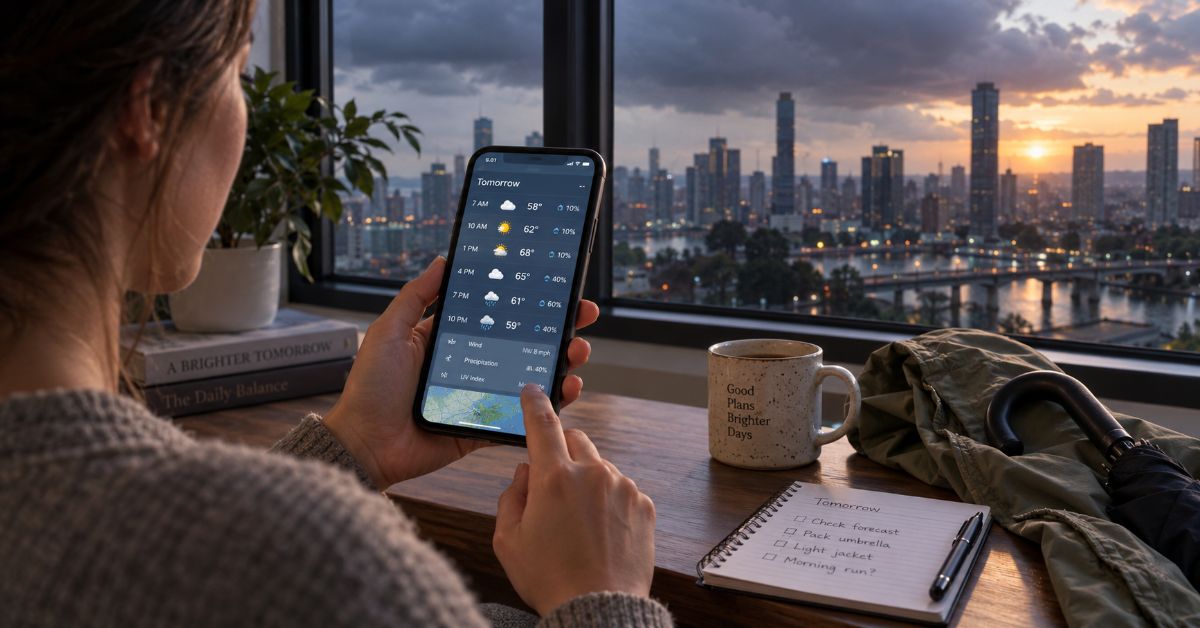
I read Tiempo De Mañana as a request for tomorrow’s weather, but a useful answer is more than a high and low temperature. It should tell you when rain is most likely, how strong gusts may become, whether an official warning is active, and how confident the forecast is for the exact place you care about.
That distinction matters because tomorrow forecasts can look precise while hiding meaningful uncertainty. During my September 15, 2026 research, AEMET’s Madrid forecast showed a 50% precipitation probability for the 12:00 to 18:00 period on September 16, while Meteored showed a 30% afternoon probability. Both services were describing the same city and day, yet they translated model data into different user-facing probabilities. I do not treat that as a reason to distrust weather forecasting. I treat it as a signal to plan with margins.
The strongest pages ranking around this query are excellent at live utility. They show hourly temperatures, icons, wind, rain, radar, warnings, sunrise, UV, and maps. What they often do not explain is how a reader should resolve conflicting numbers, what “30% rain” does and does not mean, when a gust matters more than the average wind, or why a forecast for a municipal center may not represent a mountain, beach, airport, or suburb nearby.
This guide fills that gap. I focus on the next-day decision itself: what to check first, which numbers matter, how to compare sources without obsessing over tiny differences, and when to escalate from a convenient app to an official warning service. If you only remember one rule, make it this: tomorrow’s forecast is a range of plausible conditions tied to a place and time, not a promise represented by one weather icon.
What Does tiempo de mañana Mean in a Useful Forecast?
The phrase literally points to tomorrow’s weather. In search behavior, however, the intent is usually local and immediate: “What will conditions be where I am tomorrow, and will they change what I plan to do?” A page that answers only with a national average or one daily symbol misses that practical intent.
A tomorrow forecast is a location and time question
The AEMET municipal forecast covers 8,124 Spanish municipalities and provides hourly information up to 48 hours after model updates. AEMET also notes that values refer to the municipal capital and can vary with distance or altitude, which is why nearby locations can diverge.
Weather icons are summaries, not the whole forecast
A sun, cloud, or rain icon compresses several variables into one symbol. For planning, I open the hourly view and check the period that matters. A dry morning and a stormy late afternoon can both be accurately represented by a generic “partly cloudy with showers” day icon, yet they lead to completely different choices for a commute, hike, event, or flight connection.
Which Forecast Numbers Matter Most for Tomorrow?
I prioritize the variables that can change a decision, not every number a weather page offers. The table below is the fastest way to translate a forecast into action.
| Forecast field | What it actually tells you | Best planning use |
| Air temperature | Expected measured temperature at a place and time | Clothing, heat or cold timing |
| Feels-like temperature | Estimated human-perceived conditions using provider-specific inputs | Comfort and exposure decisions |
| Rain probability | Chance of measurable precipitation in a defined period or area | Whether to build a rain backup |
| Precipitation amount | Expected liquid-equivalent accumulation | Potential wetness and disruption |
| Average wind | Typical sustained wind for the period | General outdoor comfort |
| Wind gust | Short-lived peak wind | Cycling, exposed travel, temporary structures |
| UV index | Potential ultraviolet exposure | Sun protection and timing |
| Official warning | Hazard threshold and expected impact from the national service | Safety-critical decisions |
Temperature and feels-like temperature
The daily maximum is useful for broad clothing choices, but the hourly curve tells you when heat or cold peaks. Feels-like values add wind, humidity, and other effects depending on the provider. I use them as comfort indicators rather than as replacements for the measured air temperature.
Rain probability and accumulation
Rain probability answers a chance question, not an intensity question. A 40% probability does not mean it will rain for 40% of the day, and it does not tell you whether the outcome is a brief shower or a disruptive downpour. I pair probability with expected accumulation, timing, radar or nowcasting close to the event, and any official warning.
Wind, gusts, UV, humidity, and alerts
Average wind can look harmless while gusts create the real problem for cycling, outdoor dining, temporary structures, ferries, exposed roads, and mountain routes. UV matters even on cooler days. Humidity changes comfort and heat stress. Official alerts sit above all of these because they are designed around hazardous thresholds and expected impacts, not convenience alone.
Why Do Tomorrow Forecasts Disagree Between Websites?
Forecast sites can start from different models, blend several models, update at different times, use different spatial grids, and apply different post-processing. AEMET explicitly notes that automated municipal forecasts come from statistical treatment of numerical-model output and can differ from forecasts produced by human forecasters who interpret and adjust model results.
The Madrid snapshot from September 15, 2026 makes the point concrete. For September 16, AEMET displayed a 50% precipitation probability in the 12:00 to 18:00 block, while Meteored showed 30% for the afternoon. The sensible response is not to average the numbers mechanically. It is to recognize that rain is plausible, check whether your activity is sensitive to it, and recheck closer to the relevant hour.
| Source type | Strength | Limitation | When I use it |
| Official meteorological service | Warnings, public-safety mandate, national observation network | Interface may be less simplified than consumer apps | Safety, severe weather, official reference |
| Specialist consumer weather site | Fast hourly presentation, maps, radar, local details | May blend models and probabilities differently | Everyday planning and second-source check |
| Multi-model or ensemble tool | Makes model spread and predictability visible | Requires more interpretation | When credible sources disagree |
| News or portal weather page | Convenient and familiar | Can prioritize a summary over uncertainty detail | Quick orientation, not sole source for high-stakes plans |
Use disagreement as a planning signal
I use disagreement to set my margin of safety. If two credible sources agree on a dry, calm day, a low-stakes plan needs little extra work. If they disagree on rain timing, wind gusts, or storm risk, I move flexible activities earlier, carry a backup, or choose a plan that is easy to change. Forecast spread is information.
A Better Way to Use Tomorrow’s Forecast for Real Decisions
Instead of refreshing five apps and chasing tiny temperature differences, I use a short decision workflow. It keeps the weather check proportional to what is at stake.
- Fix the location first. Use the exact city, neighborhood, airport, beach, mountain area, or route that matters rather than a country-level forecast.
- Check the official warning layer. For Spain, AEMET should be the safety reference when adverse weather is possible.
- Read the hours that overlap your plan. A daily high, low, or icon can hide a sharp afternoon change.
- Compare one second source when the decision is expensive, outdoor, time-sensitive, or hard to reverse.
- Recheck close to departure when convection, fog, snow, strong wind, or rapidly changing conditions are involved.
For travel, weather works best when it is paired with the rest of the trip context. Rubble Magazine’s Malta travel guide is a good example of planning around heat, walking conditions, transport, and timing rather than using weather as a standalone fact. For an outdoor evening, the same logic applies to date night ideas: a weather check changes which option is sensible, not just what jacket to wear.
| Decision type | Weather sensitivity | Recommended check |
| Short indoor errand | Low | One current local forecast |
| Outdoor meal or date | Medium | Hourly forecast plus rain and wind timing |
| Long drive | Medium to high | Forecast, official warning, and live road status |
| Hike, marine trip, exposed cycling | High | Official warning, hourly detail, second source, recheck near departure |
| Flight connection or nonrefundable outdoor event | High cost | Two forecast sources plus official alerts and operator status |
Road and flight planning also need a status check that is separate from the forecast. The I-41 Kaukauna crash guide shows why an old closure headline can remain visible after conditions change, while the United Airlines Flight UA82 emergency guide shows why timestamps and operational context matter in travel reporting. Weather information has the same freshness problem: a correct forecast from last night may no longer be the best basis for a decision this afternoon.
What Risks and Trade-Offs Do Forecast Pages Commonly Hide?
The biggest risk is false precision. A forecast can show a temperature to one degree, a rain probability to a percentage, and wind to a single unit, but a precise display is not the same as a certain outcome.
Location mismatch is another risk. One municipality can include coast, hills, dense urban areas, open fields, or large altitude changes. Daily summaries can also hide the two hours that matter. A small shift may be irrelevant for a walk but critical for ice, heat stress, marine conditions, or an exposed event.
Consumer apps are fast because they simplify. Multi-model and ensemble products expose more uncertainty but demand more interpretation. I do not think every reader needs ensemble charts for a normal day, but high-impact decisions deserve more than a single icon.
What Do the Top Results Commonly Miss?
I reviewed ten prominent result types and pages around the keyword and close variants. Their shared strength is immediate utility: hourly forecasts, maps, radar, warnings, and concise summaries. The ranking opportunity is not to reproduce those features in prose. It is to explain how to use them.
- Decision cost: most pages show conditions but do not tell readers how much checking is appropriate for a picnic versus a mountain route or nonrefundable event.
- Source disagreement: forecast differences are usually presented side by side only on specialist tools, not translated into a simple planning rule.
- Probability versus impact: a rain percentage is often prominent while expected timing, accumulation, and disruption are less prominent.
- Freshness discipline: update times are visible, but many readers do not connect a forecast’s age to how much confidence they should place in it.
- Location granularity: local pages look precise even when terrain, coastlines, altitude, and urban effects can make nearby conditions different.
My information-gain approach is therefore a three-check rule: warning, timing, and second-source comparison. It is simple enough for everyday use and strict enough to expose when a convenient forecast is not sufficient.
The Future of Tomorrow’s Weather Forecasting in 2027
The clearest 2027 direction is not a single “AI weather app” replacing meteorology. It is a hybrid forecasting stack in which machine-learning models, physics-based models, ensembles, observations, and human forecasting are combined more deliberately. ECMWF launched its first operational Artificial Intelligence Forecasting System in February 2025 and its ensemble version in July 2025.
In its 2025 forecast evaluation, ECMWF reported that AIFS produced medium-range errors about 5% to 15% lower than its physics-based system for many variables. It also reported a precipitation skill gain of roughly half a day to one day of lead time, while retaining the physics-based IFS for higher-resolution and coupled Earth-system work.
That balance matters for tomorrow’s forecast. By 2027, I expect more products to blend models behind the scenes, show uncertainty more clearly, and update local guidance faster as observations arrive. I do not expect local rain, storms, fog, or surface details to become perfectly predictable. The improvement should be better calibration and clearer uncertainty, not the disappearance of uncertainty.
Matthieu Chevallier, ECMWF’s Head of Forecast Evaluation, described forecast evaluation as “an absolutely vital aspect” of the organization’s work. That is the right mindset for readers too: forecasts are useful because they are continuously tested against what actually happens.
Key Takeaways
- Treat tomorrow’s weather as a place-and-time forecast, not one daily icon.
- Use probability of rain together with timing, accumulation, radar, and warnings.
- Check gusts when wind-sensitive activities matter; average wind alone can understate the practical risk.
- When credible sources disagree, increase flexibility instead of forcing a false consensus.
- For high-stakes plans, use an official meteorological service plus one independent forecast source.
- Recheck close to the event when storms, fog, snow, wind, or rapid temperature changes are possible.
Conclusion
A search for tiempo de mañana looks simple, but tomorrow’s weather is most useful when it is read as a decision tool. The high and low temperature are only the beginning. Rain timing, accumulation, wind gusts, UV, official warnings, location detail, and forecast freshness determine whether the information actually helps.
I would not ask a reader to compare every model for an ordinary day. That creates noise. A better standard is proportional checking: one trusted forecast for a low-stakes plan, a second source when uncertainty matters, and the official meteorological service whenever safety, disruption, or an expensive commitment is involved. When sources disagree, the disagreement is not wasted information. It tells you to build more flexibility into the plan.
Weather forecasting is improving, including through operational AI systems, but the value of a forecast still depends on interpretation. The best next-day forecast is not the page with the most numbers. It is the one you can connect to the exact place, time, and consequence of your decision.
Frequently Asked Questions
What does tiempo de mañana mean in English?
It means “tomorrow’s weather” or “the weather tomorrow,” depending on context. In search, it usually signals a local forecast intent, so the location matters as much as the phrase itself.
Is tomorrow’s forecast more accurate in the morning?
A morning update can include newer observations and model cycles. For weather-sensitive plans, I check once the night before and again near departure, especially when rain, fog, storms, snow, or strong wind are possible.
Why do two weather apps show different rain percentages?
They may use different models, update times, grid resolutions, blending methods, or post-processing. Compare timing and expected amount too. For an important plan, check the official warning service and recheck closer to the event.
What does a 30% chance of rain mean for tomorrow?
It is a probability, not a claim that rain will last for 30% of the day. Check the provider’s time window, expected accumulation, radar near the event, and any thunderstorm or severe-weather warning.
Which tomorrow weather source should I trust in Spain?
For safety-critical decisions, I start with AEMET, Spain’s official meteorological agency. A specialist second source is useful for comparison, hourly detail, multi-model views, radar, or a different visualization.
How often should I refresh tomorrow’s forecast?
For stable weather, a night-before check and a morning check are usually enough. For fast-changing or high-impact weather, check closer to the event and follow official warnings. Constant refreshing adds little when no new data cycle has arrived.
Methodology
Competitive review
I researched this guide on September 15, 2026 and reviewed ten prominent current pages or result types surfaced for the exact keyword and close tomorrow-weather variants: Tiempo.es, Meteored, AEMET, meteoblue, AccuWeather, La Vanguardia’s weather service, Tiempo3, Clima.com, Tutiempo.net, and Eltiempo.es. Rankings vary by country, device, personalization, and time, so I treat this as a competitive sample rather than a permanent universal top ten.
The recurring strengths were live local forecasts, hourly breakdowns, maps, wind, precipitation, UV, warnings, and concise summaries. The gap was decision support: interpreting disagreements, connecting probability to impact, adjusting for location granularity, and deciding how much verification a plan deserves.
Validation and limitations
I validated forecast-process claims against AEMET, forecast-performance and AI claims against ECMWF, and verification context against the World Meteorological Organization. The Madrid comparison is a September 15, 2026 snapshot and will change. No general article can replace a current official warning.
I audited Rubble Magazine with site-restricted searches and used four live internal links that fit naturally: Malta travel planning, date night planning, the I-41 current-status guide, and the United Airlines UA82 incident guide.
AI assistance was used for research organization, drafting, and document production. A human editor must verify statistics, APA references, live links, and first-person statements before publishing.
References
- Agencia Estatal de Meteorología. (2026). Predicción por municipios: Madrid. Retrieved September 15, 2026.
- European Centre for Medium-Range Weather Forecasts. (2026, May 8). 2025 forecast evaluation met with positive feedback.
- Haiden, T., Janousek, M., Vitart, F., Prates, F., Maier-Gerber, M., Li, C. W. Y., & Chevallier, M. (2025). Evaluation of ECMWF forecasts (Technical Memorandum No. 931). European Centre for Medium-Range Weather Forecasts. DOI: 10.21957/51e665e5c8
- Meteored. (2026, September 15). El tiempo en Madrid mañana. Retrieved September 15, 2026.
- World Meteorological Organization. (2024, July 2). Advancing weather verification for improved forecast accuracy.