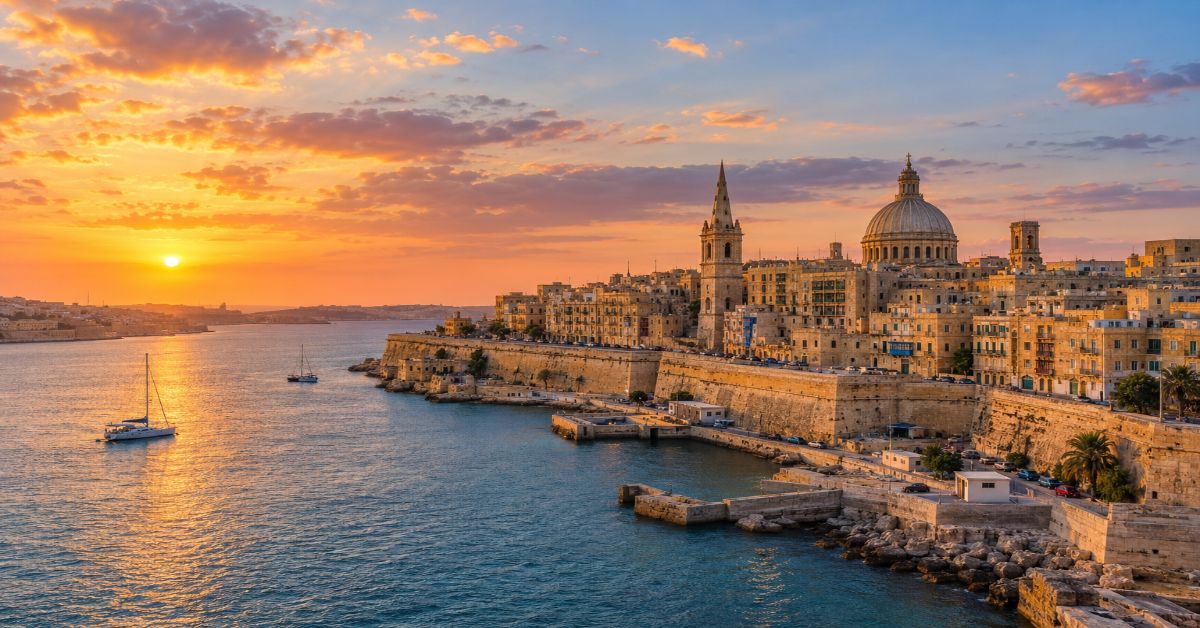
I think the most useful way to understand malta in 2026 is not as a tiny beach destination, but as a country trying to manage success inside extremely limited space. The islands cover only 316 km², yet official data show a resident population of 588,254 at the end of 2025 and more than four million inbound tourists during that year. That combination explains both the appeal and the friction: extraordinary historical density, short travel distances and a strong visitor economy, alongside crowded roads, pressure on housing and tighter management of famous places such as the Blue Lagoon.
For a traveler, the core answer is simple. This is one of Europe’s easiest destinations for combining a UNESCO capital, prehistoric temples, swimming, diving, English-language convenience and island day trips without long transfers. The main inhabited islands are the main island, Gozo and Comino, with Valletta as the capital, Maltese and English as official languages, the euro as currency and left-side driving inherited from British rule.
What many travel guides miss is how quickly the context has changed. Tourism set another record in 2025. Population growth is being driven heavily by migration. New accommodation rules took effect in June 2026. The Blue Lagoon is now controlled through a timed access system. The economy is still expanding faster than the euro-area average, while a high-profile murder trial has again focused international attention on institutions and press freedom.
I have therefore treated this as a decision guide rather than a list of attractions. The goal is to show what the islands are, why they matter, where to spend time, what has changed, and which pressures are likely to shape the experience through 2027.
What Is Malta and Why Does It Matter in 2026?
The Republic of Malta is a parliamentary republic in the central Mediterranean, about 80 km south of Sicily. It joined the European Union in 2004, entered the Schengen Area in 2007 and adopted the euro in 2008. Maltese and English are official languages, which makes daily travel unusually easy for English-speaking visitors.
I use the official end-2025 population figure rather than older estimates still repeated on high-ranking pages. Different institutions publish different reference dates, so the date attached to a population number matters.
The quick facts below provide the baseline.
| Measure | Current context | Why it matters |
| Area | 316 km² | Short distances but limited land for housing, roads and tourism infrastructure |
| Capital | Valletta | UNESCO-listed fortified capital and main cultural base |
| Population | 588,254 at end-2025 | Up 2.4% year on year |
| Official languages | Maltese and English | English is widely usable for visitors and business |
| Currency | Euro | No exchange needed for euro-area visitors |
| EU status | Member since 2004; Schengen since 2007 | Standard EU and Schengen framework |
| 2025 inbound tourism | 4,022,310 visitors | Record demand and crowding pressure |
How Did So Much History Fit Into Such a Small Archipelago?
Its position between Europe and North Africa made the islands strategically valuable for centuries. Phoenicians, Carthaginians, Romans, Arab rulers, Normans, the Knights of St. John, the French and the British all left layers that still shape architecture, language and institutions. Independence came in 1964 and republican status in 1974.
The prehistoric layer is the one I would not skip. UNESCO describes the megalithic temple complexes on the main island and Gozo as among the earliest free-standing stone buildings in the world. Sites such as Ġgantija, Ħaġar Qim, Mnajdra and Tarxien show sophisticated building traditions from the fourth and third millennia BC.
Valletta represents the later strategic story. The Knights developed the fortified city after the Great Siege of 1565, leaving a walkable concentration of bastions, churches, palaces and harbor views. I would treat the capital as a historical landscape rather than a checklist.
Why language and culture matter
Maltese is a Semitic language written in the Latin alphabet and shaped by Sicilian, Italian and English influence. Roman Catholic traditions remain visible through village feasts, processions and fireworks, events that can also affect traffic and opening patterns.
Main Island, Gozo or Comino: Where Should You Spend Your Time?
The three inhabited islands are not interchangeable. The main island carries most urban life and major sights, Gozo is slower and more rural, and Comino is mainly a nature and swimming excursion.
| Island | Best for | Typical highlights | Main trade-off |
| Main island | First-time visits, history, nightlife | Valletta, Mdina, Three Cities, temples, Marsaxlokk | Traffic and denser development |
| Gozo | Slower pace, scenery, diving | Victoria Citadel, Ġgantija, Ramla Bay, villages | Ferry logistics add time |
| Comino | Swimming and short nature visits | Blue Lagoon, coves, coastal paths | Limited facilities and controlled peak access |
The main island works best as the first base
For three to five days, I would usually stay near Valletta, Sliema or another well-connected harbor area and use buses, ferries and ride-hailing. Valletta deserves a full day, while Mdina and Rabat pair well with another historical stop.
Gozo rewards time rather than speed
Gozo works as a day trip, but an overnight stay makes the Citadel, Ġgantija, Ramla Bay and smaller villages easier to enjoy without watching the ferry clock. Its value is strongest as a contrast to the denser main island.
Comino needs more planning than older guides suggest
Visitors arriving by private or commercial vessel who want to go ashore at the Blue Lagoon must use a free timed booking system. The national tourism authority says peak summer 2024 loads reached about 12,000 people at one time; the system caps occupancy at 4,000. Tourism Minister Ian Borg summarized the shift: “Our mindset about Comino needs to change.”
What Changed by 2026?
The defining change is scale. Population and tourism are rising while the land base is fixed, so policy is moving from simple growth toward capacity management.
| Indicator | Latest verified figure | What it signals |
| Resident population | 588,254 at end-2025, up 2.4% | Fast demographic growth |
| Inbound tourists | 4,022,310 in 2025, up 12.9% | Record visitor demand |
| Tourist nights | 25.4 million in 2025 | Pressure extends beyond day trips |
| Tourist spending | €3.9044 billion in 2025 | Higher value as well as volume |
| Real GDP growth | 4.0% in 2025; 3.7% EC forecast for 2026 | Strong growth, but moderating |
| Blue Lagoon capacity | 4,000 people at one time | Direct overtourism control |
The ratio I find most revealing is 4,022,310 inbound tourists divided by 588,254 residents, or about 6.8 visitors per resident in one year. It is not an official indicator, but it makes tourism intensity easier to grasp.
Air access is equally important: official tourism data show 68.4% of inbound visitors in 2025 used low-cost airlines. That supports short-break demand but ties visitor volumes closely to European airline capacity and fares.
Regulation is responding. Tourism Accommodation Regulations effective from June 2026 tightened licensing and operating requirements for short-term rentals and placed more limits on hotel development. I read that as a shift from maximizing room volume toward managing quality and community impact.
How Strong Is the Economy in 2026?
Services dominate the economy, including tourism, finance, professional services, online gaming, aviation, maritime activity and technology. The European Commission estimated real GDP growth at 4.0% in 2025 and forecast 3.7% for 2026 and 3.6% for 2027. The National Statistics Office also reported 4.5% year-on-year real GDP growth in the second quarter of 2026.
Headline growth is only part of the story. PwC’s July 2026 analysis estimated first-quarter GDP-per-capita growth at 1.7%, much lower than total GDP growth. That gap matters because housing, transport and public services respond to population as well as output.
For travelers, the trade-off appears in prices, traffic and construction. For businesses, the same model offers EU market access, a multilingual workforce and strong visitor demand. I would describe it as successful but capacity-constrained.
What Should Travelers Know Before Visiting?
I would keep the plan simple and recheck rules close to departure.
- Choose late spring or early autumn for warm weather with less peak-summer heat and crowding.
- Use buses, harbor ferries and ride-hailing for most urban trips. If you rent a car, remember traffic drives on the left.
- Treat Valletta as a walking city, but allow for steep streets, steps and summer heat.
- Reserve the Blue Lagoon landing slot before a Comino trip if you plan to go ashore.
- Give Gozo enough time. A rushed half-day can become more transport than experience.
- Check Schengen entry rules for your passport and trip length.
Most visitors arrive through the international airport, so a disrupted flight can consume a large share of a short break. My Rubble Magazine analysis of the United Airlines Flight UA82 emergency is a useful companion on how to separate technical incident headlines from passenger-rights questions.
What Are the Biggest Risks and Trade-Offs?
The first risk is over-scheduling. Small geography makes every sight look close, but traffic, ferries, heat and steep streets can turn an ambitious plan into a day of transfers. I would schedule two strong anchors per day.
The second is overtourism. The Blue Lagoon cap is the clearest intervention, but the wider problem includes waste, noise, short-term rentals, congestion and competition for public space. New 2026 accommodation rules explicitly connect tourism policy with residents’ wellbeing.
The third is institutional trust. On September 2, 2026, a jury acquitted businessman Yorgen Fenech of complicity in the 2017 car-bomb murder of investigative journalist Daphne Caruana Galizia. Reuters reported an 8-1 verdict and noted that five other men had already been convicted for carrying out the killing or supplying the bomb. On September 4, Reuters reported that the attorney general was expected to pursue an appeal on points of law, while noting that the office had not yet officially declared it.
That wording matters. The acquittal is confirmed; an appeal was reported as expected, not yet verified as filed in the source available when I researched this article.
The Future of Malta in 2027
I expect 2027 to turn on three connected questions: tourism capacity, population growth and the quality of economic expansion.
Tourism policy is already shifting from raw volume toward managed capacity. The Blue Lagoon system and 2026 accommodation rules suggest that future success will be judged by spending, seasonality, crowd dispersion, environmental condition and resident impact, not arrivals alone.
Demographic pressure will remain central. The end-2025 population was 2.4% higher than a year earlier, so housing, transport and public services must scale in a country whose land area cannot.
Growth should remain positive but slower. The European Commission’s 2027 forecast is 3.6% real GDP growth. I would watch per-capita gains and productivity more closely than the headline figure, because they show whether expansion is improving outcomes without relying indefinitely on more workers, construction and visitor volume.
Key Takeaways
- The 316 km² land area creates exceptional convenience and equally strong capacity constraints.
- The official end-2025 population of 588,254 is more current than figures repeated on many general country pages.
- Record 2025 tourism equaled about 6.8 inbound visitors per resident.
- Blue Lagoon timed access is a test of whether famous natural sites can move from unmanaged volume to controlled capacity.
- Strong GDP growth looks less dramatic on a per-capita basis, making quality of growth a key 2027 issue.
- A better first itinerary combines heritage, one prehistoric site and one island or coastal day instead of chasing every landmark.
Conclusion
I come away from the 2026 picture with a more interesting conclusion than the usual “small island, big history” summary. The Maltese archipelago is compact enough to be easy for a traveler, but dense enough that every success creates pressure somewhere else. More visitors support jobs and spending. More residents support a growing services economy. More development can improve capacity. Each also competes for roads, housing, coastline and public space.
That tension is what makes the destination worth understanding rather than merely consuming. Valletta, Gozo, Comino and the prehistoric temples still deliver the visual and historical reasons people book a trip, but the experience is increasingly shaped by policy choices such as Blue Lagoon access management and accommodation regulation.
For a visitor, the practical answer is straightforward: plan fewer things, choose the right island mix, verify current access rules and leave room for local rhythms. For anyone studying the country more broadly, watch population, per-capita growth, tourism management and institutional reform. Those indicators will reveal more about the next chapter than another record-arrivals headline.
Frequently Asked Questions
Is Malta in the EU and Schengen Area?
Yes. The country joined the European Union in 2004, has been in the Schengen Area since 2007 and has used the euro since 2008. Non-EU visitors should still check passport-specific entry and stay rules.
What language do people speak on the islands?
Maltese and English are official languages. Maltese has Semitic roots with strong Romance and English influence. English is widely used in tourism, business, education and public information.
How many days do I need for a first trip?
Three days can cover Valletta, Mdina and one excursion. Four to five days is more comfortable if you also want Gozo or Comino. A week gives enough time for beaches and slower exploration.
Do I need to book the Blue Lagoon in advance?
If you intend to go ashore, a free timed access booking is required under the current visitor-management system. Confirm the procedure before departure because operational details can change.
Is Gozo worth staying overnight?
Yes, especially for quieter evenings, coastal walks or diving. Staying overnight removes ferry-clock pressure and lets you experience more than the Citadel and a few fast stops.
Is the destination expensive?
Costs vary sharply by season. Low-cost flights can be competitive, while peak-summer accommodation and private boat trips can be expensive. Buses and ferries are useful for keeping transport costs down.
Methodology
I researched this article on September 6, 2026 using current National Statistics Office releases, European Union and European Commission material, UNESCO heritage documentation, national tourism authority rules, OECD tourism analysis, government releases and Reuters reporting for the fast-moving legal story.
I prioritized the official end-2025 population and full-year tourism releases over older figures on general country pages. The 6.8 inbound-visitors-per-resident figure is my calculation from 4,022,310 visitors and 588,254 residents, not an official indicator.
I also reviewed ten recurring high-ranking pages for the broad keyword. The main gap was the split between practical travel advice and current demographic, economic and institutional context, so this article combines those layers. Site-restricted searches found only one Rubble Magazine travel-related page close enough to link without forcing relevance.
Current affairs can change after publication. A human editor should recheck the Fenech appeal status, statistics, references and all live links before publishing. AI assistance was used in research organization, drafting and document production, with human editorial review required before publication.
References
European Commission. (2026, May 21). Economic forecast for Malta.
European Union. (2026). Malta: EU country overview.
Malta Tourism Authority. (2025, May 2). New visitor booking system for Comino’s Blue Lagoon.
Malta Tourism Authority. (2026). Blue Lagoon Strategic Plan.
National Statistics Office. (2026, February 12). Inbound tourism: December 2025.
National Statistics Office. (2026, July 9). World Population Day: 11 July 2026.
Organisation for Economic Co-operation and Development. (2026). Malta: OECD Tourism Trends and Policies 2026.
Government of Malta. (2026, April 15). New regulations for hotels and short-term rentals.
Reuters. (2026, September 2). Malta court clears businessman over murder of journalist Daphne Caruana Galizia.
Reuters. (2026, September 4). Malta attorney general set to appeal acquittal in journalist murder trial.
UNESCO World Heritage Centre. (n.d.). Megalithic Temples of Malta.