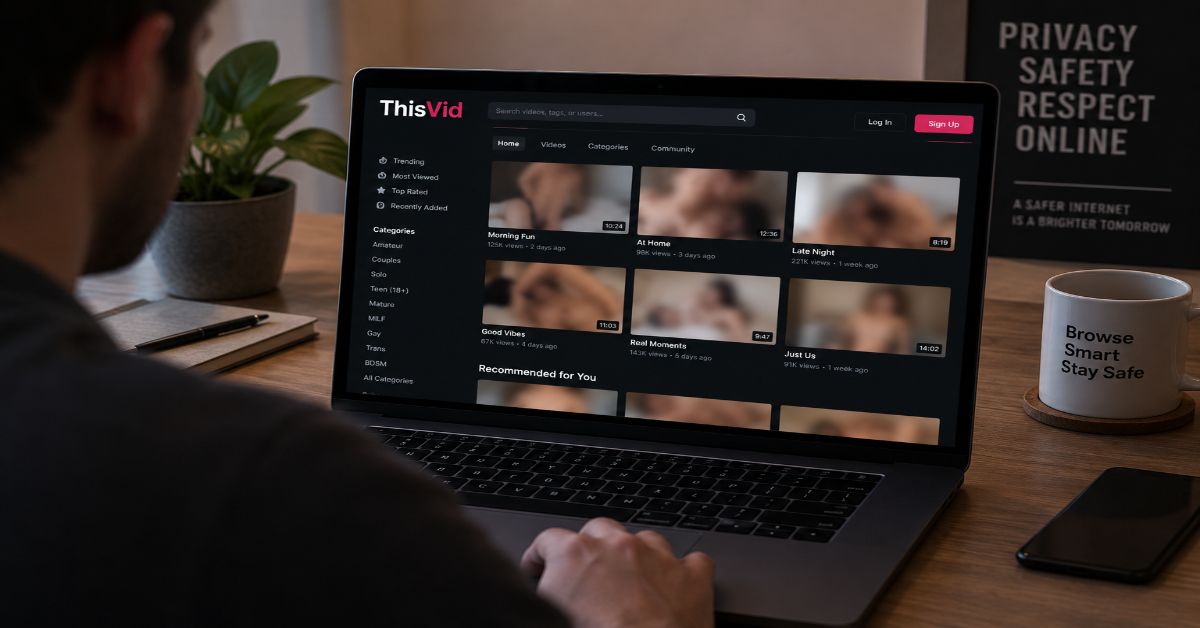
I would describe ThisVid as an adult-oriented, user-uploaded video platform that people usually encounter through search, links, or niche online communities. The important point is not simply what the site hosts. It is that a visitor has to evaluate privacy, consent, account security, advertising behavior, and the reliability of user-uploaded material at the same time. That makes a basic “what is it?” answer incomplete.
The current search results are crowded with articles that repeat a simple formula: define the site, list features, mention pop-ups, and then declare it safe or unsafe. I found that approach too blunt. A site can load normally while still exposing users to tracking or risky third-party redirects, and a reputation score cannot verify whether every uploaded video is lawful, consensual, or authorized. The Federal Trade Commission explains that websites can track activity through cookies, pixels, and device fingerprinting, while CISA warns that malicious advertising can use legitimate ad networks to trigger redirects or malicious payloads.
So my answer is more practical. The service appears to function as a long-running adult video-sharing platform built around user uploads, browsing, tags, profiles, and community interaction. But anyone researching it should separate platform existence from platform trust. Before creating an account, uploading media, clicking ads, or assuming a video was posted with permission, I would check the exact domain, minimize personal data, avoid unexpected downloads, and understand the reporting options available if content is unauthorized or exploitative.
What Is ThisVid, in Plain Terms?
ThisVid is commonly described as an adult-oriented video-sharing platform where users can browse and upload user-generated videos, use tags and profiles, and interact around niche communities. Public search results and domain-monitoring pages indicate the service has existed for many years, but traffic estimates and feature claims vary widely by source. I therefore treat those numbers as third-party estimates rather than verified company disclosures.
The distinction matters because several ranking pages make strong claims about monthly traffic, moderation quality, ownership, monetization, and technical safety without linking to current first-party evidence. The most defensible description is narrower: it is a user-uploaded adult video platform with community features, not a mainstream general-purpose video service.
Why Are People Searching for This Platform in 2026?
The search intent is mixed. Some users want a definition before clicking an unfamiliar result. Others are trying to understand whether an old account still works, whether a domain is legitimate, how private browsing really is, or what to do when a video appears without permission. Recent Reddit discussions also show recurring questions about account creation and password recovery, which suggests that access reliability is part of the real search demand, even though those posts are anecdotal rather than official support data.
| Search intent | What the user really wants | Best evidence to check |
| Definition | What the platform is and who it serves | Current platform pages, domain history, neutral descriptions |
| Safety | Whether browsing creates device or privacy risk | Browser warnings, security guidance, redirect behavior, permissions |
| Account access | Signup, login, password recovery | Current account flow and official support, not old tutorials |
| Content rights | Whether an upload is authorized | Uploader rights, consent, copyright, platform reporting options |
| Removal | How to respond to unauthorized intimate content | Platform report tools, copyright process, StopNCII or Take It Down where appropriate |
How Does the Platform Model Work?
At a structural level, the service follows the same broad pattern as many user-generated media sites: accounts, uploads, profiles, categories or tags, viewing pages, and interaction features. That model reduces publishing friction, but it also pushes a large share of governance onto moderation systems and user reports. The platform model is therefore more important than the interface. A polished player does not tell you how quickly a rights complaint is reviewed, how an uploader was verified, or what data an advertising partner can collect.
This is one reason I would not compare the site directly with YouTube or Vimeo on features alone. Mainstream services operate different advertising, moderation, app-store, identity, and creator-policy systems. A better comparison is by risk surface, not by whether each site has comments and playlists.
| Dimension | ThisVid-style user-upload platform | Mainstream video platform | Why it matters |
| Content scope | Adult and niche user uploads | General audience with stricter adult-content limits | Different moderation and age-access expectations |
| Discovery | Tags, categories, profiles, search | Search, recommendations, subscriptions | Metadata can expose viewing interests |
| Advertising exposure | May include third-party adult ad networks | Usually larger controlled ad ecosystems | Redirect and malvertising risk can differ |
| App distribution | Often browser-first | Official mobile apps common | Third-party “apps” deserve extra verification |
| Rights enforcement | Depends heavily on reports and takedown workflows | Larger formal rights systems | Response speed and documentation matter |
Is the Site Safe to Visit?
I would not reduce the answer to a single score. “Safe” has at least three separate meanings here: device security, privacy, and content safety. A domain can have no active browser warning and still use aggressive tracking. A video can play without malware and still be unauthorized. A site can publish a takedown process and still have inconsistent enforcement.
Device security: focus on redirects, downloads, and permissions
CISA describes malvertising as malicious or hijacked advertising used to spread malware, including forced redirects and malicious payloads. That risk is not unique to adult websites, but ad-heavy environments make the behavior especially relevant. If a page opens new tabs, asks to install a player or extension, requests notification permission, or redirects to an unrelated login or payment page, I would stop interacting with it.
Rubble Magazine has covered the same delivery mechanics in its
Incestflix safety analysis on riskware, redirect chains, and fake-download prompts. The useful lesson is broader than any one domain: the dangerous step is often a redirect or install prompt rather than the initial page view.
Privacy: private browsing is not invisibility
The FTC notes that websites and apps can track users with cookies, pixels, device fingerprinting, and advertising identifiers. Incognito or private mode mainly limits what is stored in the local browser session. It does not automatically hide activity from the website, network provider, employer network, or every third-party tracker.
If privacy matters, I would minimize identifiers rather than rely on one tool. Use a unique email address, a unique password, browser tracking protection, and cautious permission settings. A VPN can obscure an IP address from the destination site, but it does not prevent account-based tracking, browser fingerprinting, cookies, or disclosure through information you type into the site.
What Are the Biggest Privacy and Account Risks?
The most important risk is correlation. A username, reused email address, profile image, password, payment identifier, or linked social account can connect activity across services. That matters more on sensitive-interest websites because a small identifier can reveal a much larger browsing pattern.
I use the same identity-separation principle in Rubble Magazine’s
OnlyFans leaks creator-protection guide where the distinction between account security and content exposure is central. Changing a password can protect an account, but it cannot remove a copied file or erase data already shared with third parties.
- Use a password that is unique to the account and never reused elsewhere.
- Use an email address that does not reveal a real name, employer, or public-facing creator identity.
- Do not grant browser notifications, camera, microphone, or location permissions unless they are essential and clearly explained.
- Avoid downloading “players,” extensions, APK files, or utilities from ads or unofficial mirrors.
- Before uploading, remove unnecessary metadata and assume that anything shared with another account can be copied.
What About Consent, Copyright, and Unauthorized Uploads?
This is the area where many ranking articles become either vague or overconfident. User-generated adult content creates at least three different rights questions: copyright ownership, consent to intimate distribution, and content involving minors. They are not interchangeable, and each can require a different reporting route.
For ordinary copyrighted material, the rights holder may use the site’s copyright or abuse process where available. For non-consensual intimate imagery involving an adult, StopNCII is one external tool that can help participating platforms detect matching material. For explicit imagery taken when a person was under 18, the National Center for Missing & Exploited Children operates Take It Down and the CyberTipline. NCMEC reported that in 2025 it issued more than 172,000 removal notices and that the average removal time for images or videos it tracked was 2.6 days. Those figures describe NCMEC’s broader removal work, not this specific platform.
The practical rule is simple: never assume an upload is authorized merely because it is public. If you recognize yourself or someone else in content that appears non-consensual or exploitative, preserve the page address and basic evidence without redistributing the file, then use the appropriate reporting channel. Rubble Magazine’s
Coomer.party guide makes a similar distinction between copyright, privacy, and platform-access issues when discussing reposted creator content.
How Should You Evaluate a Link Before Opening It?
1. Confirm the exact domain. Similar names, country-code domains, mirrors, and typo domains are not proof of common ownership.
2. Check the address bar before entering credentials. A redirect to a different hostname should reset your trust decision.
3. Keep the browser and operating system updated. Security patches matter more than superficial “site reputation” badges.
4. Reject unexpected downloads and notification requests. A video page should not need a mystery installer.
5. Use unique credentials if you create an account. Reused passwords turn one weak service into a wider account-takeover risk.
6. Leave if the page pressure-escalates. Fake infection warnings, countdowns, urgent payment prompts, and repeated pop-ups are classic social-engineering signals.
The same domain-verification habit appears in Rubble Magazine’s
SoSoActive domain-safety guide which emphasizes that similar branding does not establish shared ownership. That rule is especially useful for niche platforms with multiple lookalikes in search results.
What Do Current Search Results Get Wrong or Leave Out?
After reviewing ten prominent results for the keyword, I found four recurring weaknesses. First, several pages present traffic estimates as if they were audited company figures. Second, some treat third-party reputation scores as a verdict on the entire site. Third, many repeat feature claims such as account deletion, monetization, or privacy controls without showing when those claims were last verified. Fourth, legal sections often blur copyright, consent, and criminal material into one generic “DMCA” problem.
The content gap is not another longer feature list. It is evidence labeling. A reader should be able to tell whether a statement comes from a current first-party source, a security agency, an analytics estimate, a forum report, or editorial inference.
| Claim type | How I treat it | Reason |
| Official policy or live product behavior | Strong current evidence | Directly attributable and date-checkable |
| FTC, CISA, NCMEC guidance | Strong general guidance | Authoritative but not a site-specific audit |
| SEMrush or similar traffic estimate | Directional estimate only | Modelled data, not audited platform disclosure |
| Security reputation score | One signal, not a verdict | Methods, timing, and false positives vary |
| Reddit or forum report | Anecdotal signal | Useful for patterns, not proof of universal behavior |
| Competitor article claim | Lead for verification only | Must be independently checked before publication |
Does a VPN or Ad Blocker Make the Site Safe?
No single tool makes a site “safe.” A VPN can hide your public IP address from the destination and local network observers in some contexts, but it does not erase cookies, account identifiers, device fingerprints, or information you voluntarily submit. An ad blocker can reduce exposure to advertising and pop-ups, but it cannot verify that a video was posted with consent or that an account database is secure.
I would treat browser protections as layers. Updated software, tracking protection, restricted permissions, unique credentials, and cautious clicking work together. This layered approach is more reliable than buying one privacy product and assuming the risk has disappeared. Rubble Magazine’s
Natomanga safety guide uses the same principle when separating domain reputation from the risks introduced by advertising and redirect destinations.
What Should You Do If You Already Entered Personal Information?
The response depends on what happened. Merely viewing a page is different from reusing a password, installing a file, granting browser permissions, or submitting payment data.
1. If you reused a password, change it everywhere it was reused and revoke active sessions where possible.
2. If you downloaded or ran a file, update security software and run a full scan. Remove unfamiliar extensions or applications.
3. If you allowed browser notifications, revoke that permission in browser settings and clear suspicious site permissions.
4. If you submitted card or bank information to an unexpected page, contact the financial institution through its official app or phone number.
5. If intimate content was posted without consent, preserve the URL and report through the appropriate platform, copyright, StopNCII, Take It Down, or law-enforcement channel depending on the facts.
The Future of ThisVid in 2027
I found no verified public roadmap that supports confident predictions about the platform itself. The more defensible 2027 outlook comes from the wider web environment. Browsers, regulators, payment providers, app stores, and advertising networks are all increasing pressure around age assurance, harmful-content reporting, privacy, and deceptive advertising. At the same time, attackers are becoming better at hiding malicious destinations behind legitimate ad infrastructure and short-lived domains.
For a platform in this category, trust will increasingly depend on evidence that outsiders can verify: clear ownership or operator details, responsive abuse channels, transparent privacy disclosures, age and consent safeguards, and fewer risky third-party redirects. If those signals remain hard to verify, searchers will continue relying on third-party reputation sites and forum reports, which is a weak substitute for direct transparency.
Key Takeaways
- The service is best understood as an adult-oriented, user-uploaded video platform with community and discovery features, not as a mainstream general-purpose video service.
- A clean page load or reputation score cannot prove privacy, consent, copyright status, or the safety of every advertisement and redirect.
- The FTC’s tracking guidance shows why private browsing alone does not prevent websites and third parties from collecting identifiers and activity data.
- CISA’s malvertising guidance makes unexpected redirects, fake installers, and browser-permission prompts more important warning signs than superficial design quality.
- Copyright complaints, non-consensual intimate imagery, and material involving minors require different reporting paths and should not be collapsed into one “DMCA” issue.
- The most practical protection is layered: exact-domain verification, unique credentials, restricted permissions, updated software, and refusal of unexpected downloads.
Conclusion
I would approach the service as a real but sensitive user-generated platform that deserves more careful evaluation than most ranking pages give it. The useful question is not simply whether the website “works.” It is whether the exact page, account flow, advertisement, upload, and rights situation in front of you can be trusted. Those are separate judgments.
The current SERP often compresses all of that into a single safety label. I think readers are better served by separating device risk, privacy, and content rights. A browser warning or redirect deserves attention, but a lack of warning is not a guarantee. A public video may be viewable, but that does not establish consent or copyright authorization. A VPN may hide an IP address, but it does not make account activity anonymous.
For anyone researching the platform, the strongest posture is cautious verification: confirm the domain, minimize identifiers, avoid downloads and notification prompts, use unique credentials, and know which reporting route fits the problem if content is unauthorized or exploitative. That approach remains useful even as domains, interfaces, and search rankings change.
Frequently Asked Questions
What is thisvid used for?
It is generally used to browse and share adult-oriented, user-uploaded video content organized through profiles, tags, categories, and community interaction. Specific features can change, so current behavior should be verified rather than relying on old tutorials.
Is the platform legal to visit?
Legality depends on jurisdiction, age, and the specific content involved. Merely describing a platform as adult-oriented does not answer whether every upload is lawful. Copyright infringement, non-consensual intimate imagery, and content involving minors are separate legal issues that can trigger different rules and reporting obligations.
Is the site safe from viruses?
No website can be guaranteed virus-free. The practical risks to watch are forced redirects, deceptive ads, fake update prompts, downloads, and permission requests. Keep software updated and do not install files or extensions from unexpected prompts.
Does private browsing hide activity on the site?
Private or incognito mode mainly reduces local browser history and cookie persistence after the session. It does not automatically hide activity from the website, network provider, employer network, or all third-party trackers.
Can a VPN make browsing anonymous?
A VPN can hide your public IP address from the destination site, but it does not remove cookies, browser fingerprints, account identifiers, or information you submit. Treat it as one privacy layer, not complete anonymity.
What should I do if a video of me was uploaded without permission?
Preserve the page URL and basic evidence without redistributing the file. Use the platform’s reporting process and the legal or removal route that fits the situation. Adults can consider StopNCII for non-consensual intimate imagery, while NCMEC’s Take It Down and CyberTipline support explicit imagery involving people who were under 18 when the material was created.
Methodology
I researched the keyword on September 17, 2026 and reviewed ten prominent current results surfaced for “thisvid” and close variants. The sample included BigWriteHook, Git-HubMagazine, Issamezz, SastranUSA, SD Tech Computer, ElevenLabsMagazine, XPT Magazine, Thinkverse Blog, UpDownToday, and PornVerdict. Search rankings vary by country, device, personalization, and time, so I treated this as a competitive sample rather than a permanent universal top ten.
The recurring SERP strengths were basic definitions, feature summaries, safety sections, platform comparisons, and FAQs. The biggest gaps were evidence quality, overconfident traffic and safety claims, weak separation of privacy from malware risk, and legal sections that failed to distinguish copyright, consent, and child-safety reporting. I built this article around those gaps rather than copying competitor structures.
For validation, I prioritized the Federal Trade Commission on web tracking and privacy, CISA on malvertising, and the National Center for Missing & Exploited Children on Take It Down, CyberTipline, and removal data. I used forum discussions only as anecdotal evidence of account-access questions, not as proof of platform-wide behavior. I also verified five relevant Rubble Magazine pages for internal linking: Incestflix safety, OnlyFans leaks, Coomer.party, Natomanga, and SoSoActive.
I did not create an account, upload content, download files, or conduct a forensic scan of the platform. I also found no reliable current first-party roadmap for 2027 and no first-party audited traffic figures. Those limitations are why I avoid declaring the site universally safe or unsafe based on a single score. AI assistance was used for research organization, drafting, and document production. A human editor must review the content, verify every statistic, link, APA reference, and first-person statement before publishing.
References
National Center for Missing & Exploited Children. (2026). CyberTipline data.
National Center for Missing & Exploited Children. (2026). Take It Down.