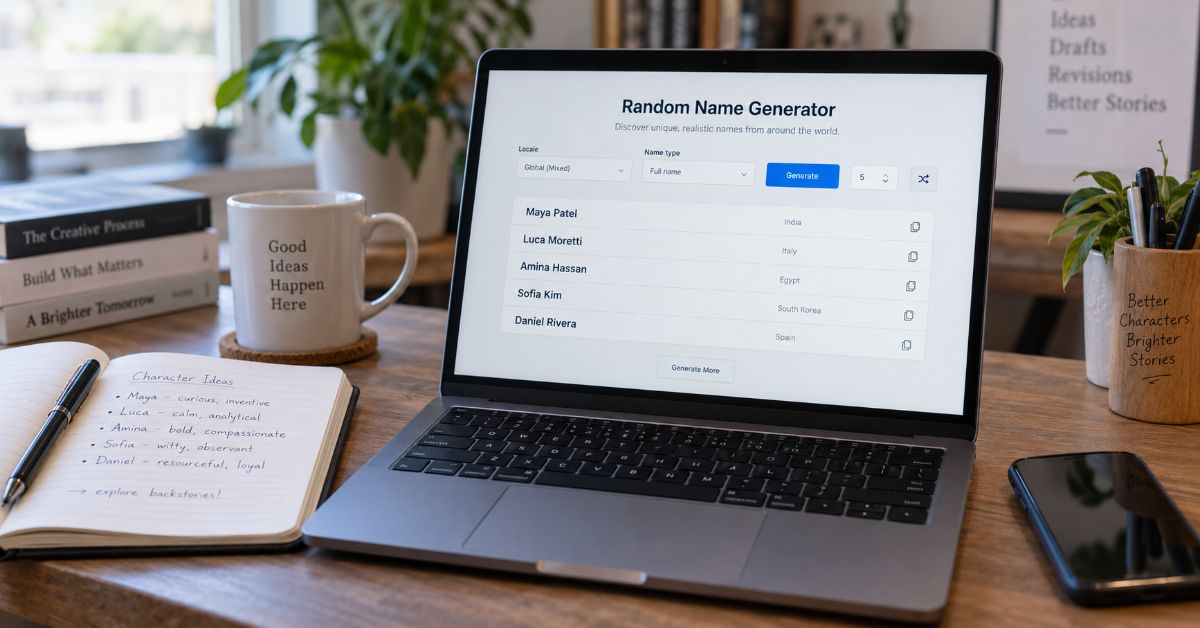
I compared ten prominent current pages for this keyword, and the best answer is straightforward: a random name generator should give you believable names instantly, then give you enough control to make those names fit the job. The strongest tools now offer culture or locale filters, first-name and full-name modes, bulk generation, copy or export controls, and browser-side processing. But instant output is only half the problem. A name can be random and still be culturally awkward, repetitive, unrealistic for a dataset, or accidentally identical to a real person. That gap is where this guide focuses.
The data behind a generator matters more than most interfaces admit. In April 2026, the U.S. Census Bureau published new 2020 Census name tables with 53,615 first names and 156,621 last names occurring at least 100 times. Social Security data also shows a long tail: the top 1,000 baby names represented 71.51% of U.S. names in 2025. A tool built from 100 or 300 popular names may feel familiar, but familiarity is not the same as coverage.
My rule is to match the generator to the decision. Writers need names that fit a setting and remain distinguishable on the page. Designers need realistic lengths and scripts. QA teams need repeatable fixtures and edge cases. Teachers often need harmless examples, not demographic simulation. If a page for this keyword includes a fast interactive tool above the fold, the article below it should explain those choices instead of repeating the button labels.
What Does a Random Name Generator Actually Do?
A generator usually selects a given name, surname, or both from lists. Better systems add locale, ordering, prefixes, suffixes, script, frequency controls, or reproducible seeds. Fantasy tools may instead combine syllables or phonetic patterns.
I separate list pickers, locale-aware generators, and constructed-name systems because each solves a different problem: speed, realism, or creative range.
| Generator approach | Best use | Main strength | Main trade-off |
| Curated list picker | Quick examples, classrooms, simple characters | Fast and familiar | Small pools repeat and underrepresent variation |
| Locale-aware name data | UI, QA, realistic fictional casts | Better cultural structure and formatting | Quality depends on source data and locale design |
| Seeded generator | Test fixtures, demos, shared examples | Same seed can reproduce a batch | Reproducibility is not the same as population realism |
| Syllable or pattern generator | Fantasy, sci-fi, worldbuilding | Large creative name space | Can create awkward or implausible forms |
How Should You Use a Random Name Generator?
I would not use the same settings for every task. Decide whether you need inspiration, realistic display data, repeatable fixtures, or fair selection from an existing roster. A name generator creates new names; it does not fairly shuffle real people.
| Use case | Settings I would prioritize | What to check before keeping a result |
| Fiction or screenwriting | Locale, age or era where available, full name, batches of 10-20 | Pronunciation, character differentiation, real-person collision |
| Games and NPCs | Culture by region or faction, bulk output, favorites | Repeated initials, tonal consistency, duplicate names |
| UI and wireframes | Mixed lengths, multiple scripts, first and full names | Truncation, wrapping, search, sorting, accessibility |
| QA and development | Locale, seed, export, edge cases, de-duplication | Reproducibility, validation failures, unsupported scripts |
| Classroom examples | First names or simple full names, small batch | Age appropriateness, unnecessary stereotypes, privacy |
| Baby-name brainstorming | Current popularity plus broader options | Meaning, family context, pronunciation, local usage |
For interface work, names are useful because they expose layout assumptions that repeated placeholders hide. A card that looks fine with “Amy Lee” may break with a long surname, a suffix, or a non-Latin script. That is why I would pair generated names with the same early-state checks described in Rubble Magazine’s wireframing tools guide rather than treating mock data as decoration.
What Makes Generated Names Feel Realistic?
Source data matters more than database size
A large database claim means little unless I know what is counted. Ten thousand first names plus ten thousand surnames is not the same as ten thousand full-name combinations, and one-country data should not be presented as globally representative.
The 2020 Census public files include 53,615 first names and 156,621 last names above the reporting threshold. A naive cross-product exceeds 8.39 billion combinations, but real generators should preserve cultural and linguistic structure rather than pair everything with everything.
Uniform sampling and realistic sampling are different
Uniform sampling makes every listed name equally likely, so uncommon names appear too often for population realism. Frequency weighting looks more realistic but reduces variety. I prefer diversity for brainstorming and documented weighting for realistic demo data.
Culture is more than a nationality dropdown
A culturally aware generator should handle ordering, scripts, diacritics, multi-part surnames, prefixes, and suffixes. Faker documentation likewise notes that full names vary by locale and are not always simple first-name plus last-name concatenations.
How Random Should a Random Name Generator Be?
For naming characters or populating a mockup, cryptographic randomness is usually unnecessary. For a browser tool that wants an unpredictable seed, however, the Web Crypto API provides cryptographically strong random values. I care less about the label than the purpose: the generator should use enough randomness for its task and explain whether a saved seed can reproduce the results.
Why duplicates appear faster than people expect
Duplicate risk rises with batch size. The table uses the standard birthday-problem model with equally likely full names. Weighting, filters, and de-duplication can change real results.
| Equally likely full-name pool | 10 generated | 50 generated | 100 generated | 500 generated |
| 5,000 | 0.9% | 21.8% | 63.1% | ~100% |
| 10,000 | 0.4% | 11.5% | 39.1% | ~100% |
| 100,000 | 0.04% | 1.2% | 4.8% | 71.3% |
| 1,000,000 | 0.005% | 0.1% | 0.5% | 11.7% |
A tool can advertise thousands of combinations and still repeat quickly in bulk use. For QA, I prefer explicit duplicate handling and a visible pool size.
When Do Random Names Fail as Test Data?
Good test data should reveal broken assumptions. If every generated record is two short ASCII words, an interface can look healthier than it is.
- Length failures: long names, initials, suffixes, and multi-part family names expose clipping and database limits.
- Character failures: diacritics, apostrophes, hyphens, spaces, and non-Latin scripts expose encoding, search, and sorting problems.
- Structure failures: some names use different ordering or do not fit a fixed first-middle-last schema.
- Distribution failures: diverse-looking output can still misrepresent a target population.
- Identity failures: a synthetic name can match a real person and does not prove a record is anonymous.
For machine-learning work, I would be even stricter. Random names can help test ingestion or display layers, but they are not a substitute for a representative evaluation dataset. Rubble Magazine’s machine-learning models guide makes the broader point that leakage, missingness, subgroup failures, and serving conditions matter more than a dataset simply being large.
Privacy also depends on implementation. A browser tool that generates names locally reduces unnecessary data flow, but a page should explain what stays on-device and what is stored. I use the same standard for other small utilities, including the privacy checks in Rubble Magazine’s word counter guide. A privacy badge without a clear data path is not enough.
What Do the Current Top-Ranking Results Still Miss?
The current competitive set is stronger than a one-button randomizer. Several pages already offer locale filters, seeds, browser-side generation, fantasy modes, exports, or source notes. A longer definition alone will not differentiate the page.
- Separate randomness from representativeness. Uniform sampling can be diverse without looking like a real population.
- Use the April 2026 2020 Census name release instead of relying only on older surname data or tiny curated lists.
- Quantify duplicate risk instead of treating pool size as self-explanatory.
- Treat locale as structure: ordering, diacritics, scripts, and multi-part names affect both realism and software behavior.
- Separate synthetic fixtures from anonymization. A plausible fake name does not safely de-identify a real record.
I would also publish the generator’s methodology in plain language. The same trust principle appears in Rubble Magazine’s product reviews guide: readers should be able to understand why a result or verdict exists, not just accept a polished interface.
Which Random Name Generator Features Matter Most?
I would score workflow before database-size claims. Basic generation should be instant, while advanced controls should stay available without overwhelming the page.
- Essential: first, last, and full-name modes; count control; copy all; fast regeneration; source notes.
- For writers and games: culture or style filters, favorites, and batch generation.
- For developers: locale-aware output, seeds, de-duplication, exports, and edge-case modes.
- For trust: clear local-versus-server processing, dated source data, and honest limits.
- Secondary: animations, huge menus, or “millions of names” claims that do not explain how combinations are counted.
For this keyword, put the working generator above the long-form article. The guide should explain settings, output quality, and mistakes the button cannot.
The Future of Random Name Generators in 2027
I expect 2027 tools to compete more on provenance, reproducibility, and structured output. Browser-side execution, shareable seeds, locale-aware formats, and developer exports already point in that direction.
The most useful step would be explicit sampling modes such as diverse brainstorm, frequency weighted, edge-case test, and reproducible fixture. Native-script output with optional transliteration would also improve realism.
I would not assume AI-generated names will replace transparent datasets. Models can tailor style, but they add latency, data-flow questions, and weaker reproducibility for simple generation tasks.
Key Takeaways
- Match the generator to the job: inspiration, display data, fixtures, and worldbuilding need different settings.
- Fresh source data matters; the 2020 Census release exposes the limits of tiny popular-name lists.
- Random and representative are different: uniform sampling favors variety, while weighting favors realism.
- Duplicate risk rises with both pool size and batch size, so bulk generation needs de-duplication.
- Locale support should cover structure and script, not just a country label.
- Generated names are examples, not guaranteed fictional identities or anonymized personal data.
- For the head keyword, an interactive generator is a stronger intent match than text alone.
Conclusion
I would judge a random name generator by what happens after the first click. Fast output is expected. The difference between a disposable tool and a useful one is whether the names fit the context, whether the method is understandable, and whether bulk results hold up when you need diversity, cultural structure, reproducibility, or edge cases.
The fresh 2020 Census tables make one limitation especially visible: real naming variation is far broader than the few hundred entries many lightweight generators can practically curate. That does not make small tools useless. It means their scope should be clear. Writers can use them for inspiration, designers for realistic layouts, teachers for examples, and developers for fixtures, as long as each group understands what the output does not prove.
For a page targeting this keyword, I would keep the tool immediate and the explanation disciplined. Let the generator solve the first task in seconds. Let the article solve the harder questions about realism, randomness, duplicates, culture, privacy, and responsible use.
Frequently Asked Questions
How do I generate random names?
Choose first, last, or full name, add a locale if relevant, set the batch size, and generate several options. Review the result before using it publicly and search a final character name for obvious collisions.
Can a random name generator create a real person’s name by accident?
Yes. Realistic tools often combine real given names and surnames, so a random combination can match a living person. The tool may not have retrieved that person, but the resulting string is not guaranteed unique.
What is the best random full name generator for software testing?
Choose locale-aware patterns, reproducible seeds, de-duplication, bulk export, and edge cases. Testing needs long names, punctuation, multiple scripts, and repeatable reruns more than a huge marketing number.
Is Math.random good enough for a name generator?
Usually, yes for casual naming because names are not security secrets. Web Crypto is useful when stronger unpredictability is wanted, especially for seed creation. Neither method should be used as a password or token generator.
Are random names anonymous test data?
Not automatically. Replacing only a name in a real customer record does not anonymize addresses, dates, IDs, behavior, or other identifying fields. Sensitive datasets need proper de-identification or synthetic-data methods.
How do I make generated character names feel less random?
Generate within a setting, then edit. Keep a consistent cultural or phonetic logic, vary lengths, avoid similar initials among major characters, and say names aloud. Batches of 10 to 20 usually give enough contrast.
Can I use a random name generator for baby names?
Yes, for brainstorming. Follow up with popularity, pronunciation, meaning, family context, and local usage. A random result is a prompt, not a recommendation.
Methodology
I researched this article on September 12, 2026 and reviewed ten prominent current results for the exact keyword: faker.tools, induwara.lk, RandomBasis, SomeTools, Behind the Name, MyRandomNameGenerator, LetsRandomize, Boneyard Tools, Servinza Tools, and Absurd Tools. Rankings vary by location, device, personalization, and time, so this is a competitive sample, not a universal Google order.
The common strengths were instant generation, culture or gender filters, bulk output, local-browser processing, fantasy modes, and seeded reproducibility. I used the review to find gaps, then built around fresh 2020 Census data, sampling trade-offs, collision risk, locale structure, testing edge cases, and the distinction between fixtures and anonymization.
Name-data claims were checked against the U.S. Census Bureau and Social Security Administration. Browser randomness was checked against MDN, and reproducibility and locale behavior against current Faker documentation. The collision table is my birthday-problem calculation under equal-probability assumptions.
I audited Rubble Magazine with site-restricted searches and used four live internal links that fit naturally: Word Counter Guide, Wireframing Tools, Machine Learning Models, and Product Reviews. I did not force a fifth link where relevance was weak.
I did not run controlled tests across every competitor interface, so I do not claim a universal speed or quality winner. Naming conventions vary by place and time. AI assistance was used for research organization, drafting, calculations, and document production. A human editor must verify claims, references, links, and first-person judgments before publishing.
References
Mozilla Developer Network. (2025). Crypto.getRandomValues() method.
Mozilla Developer Network. (2025). Math.random().
Social Security Administration. (2026). Popular baby names: Beyond the top 1000 names.
U.S. Census Bureau. (2026, April 14). Most common first names and last names in the 2020 Census.