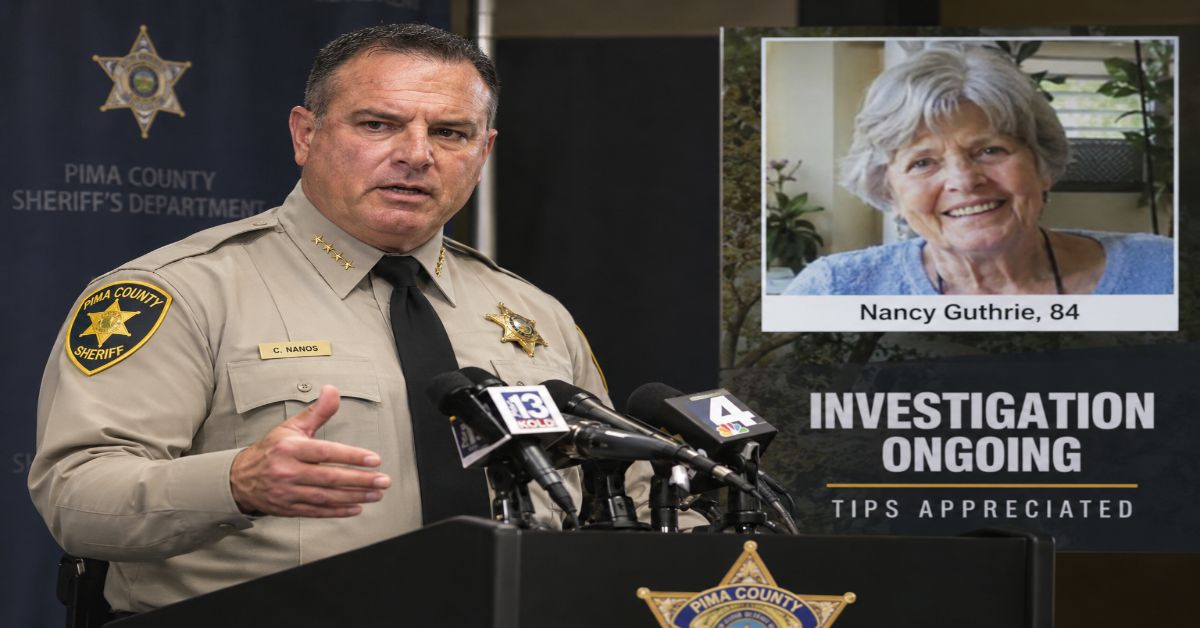
I found that the core search claim needs a careful correction: sheriff expects an arrest soon regarding the nancy guthrie case is not what Pima County Sheriff Chris Nanos actually said. His public statement was more measured. At the 100-day mark in May, Nanos said he believed investigators would make an arrest “at some point in time,” while stressing that forensic and digital work was moving slowly because the case had to be built correctly (KOLD News 13, 2026a).
That distinction matters because “soon” implies a timetable that law enforcement has not announced. As of September 4, 2026, I found no public announcement from the Pima County Sheriff’s Department or FBI naming a suspect or confirming an arrest. The most recent substantive local update I verified, published September 1 by KOLD, said the case was active, DNA and video analysis were ongoing, tips were still being reviewed, and the department had no additional information to release (KOLD News 13, 2026c).
Nancy Guthrie, 84, was last seen at her Catalina Foothills home on the evening of January 31 and was reported missing on February 1. Investigators believe she was taken against her will. The public case file includes an armed masked individual captured near her doorbell camera, biological evidence, thousands of pieces of digital material, ransom communications, and a continuing partnership between county detectives and the FBI.
I have separated confirmed facts from interpretations throughout this article. That is especially important in a case where silence can be mistaken for inactivity, recycled headlines can distort dates, and social-media claims can move faster than law-enforcement verification.
What Did Sheriff Chris Nanos Actually Say About an Arrest?
The strongest source for the arrest claim is KOLD News 13’s May 11 interview, updated May 12. The timing is important. It was roughly 100 days after Guthrie was reported missing, not a mid-August statement. In that interview, Nanos described continued work by his detectives, the FBI, Arizona Department of Public Safety, and several laboratories (KOLD News 13, 2026a).
Source link: KOLD’s May 12 interview
On the question of an arrest, Nanos said, “I believe, at some point in time, we will make an arrest on this case.” I read that as confidence in the direction of the investigation, not a prediction that an arrest was days or weeks away.
He also explained why investigators were moving cautiously. DNA from the home had to be separated and analyzed, digital evidence had to be catalogued and connected, and detectives wanted to avoid a false arrest while preserving a prosecutable case. That is why the more precise headline is that the sheriff expects an eventual arrest, not that he announced one as imminent.
Why Does the Word “Soon” Change the Meaning?
I see three consequences when “at some point in time” becomes “soon.” First, it creates a false deadline in the reader’s mind. Second, it can make routine periods of investigative silence look like broken promises. Third, it encourages speculation about unnamed suspects even though law enforcement has not publicly identified one.
The September 1 update reinforces that distinction. PCSD said the investigation remained active and ongoing, that DNA and video analyses were still being supported by laboratories nationwide, and that tips continued to be received and reviewed. The department also said it would not hold another news conference until it had something major to share (KOLD News 13, 2026c).
So when readers search sheriff expects an arrest soon regarding the nancy guthrie case, the answer is narrower than the search phrase suggests: Nanos has publicly expressed confidence in a future arrest, but there is no verified near-term timetable.
What Is the Current Status of the Nancy Guthrie Case?
As of September 4, 2026, the public status is unresolved. No suspect has been publicly named in the abduction, no arrest has been announced in the underlying disappearance, and Guthrie has not been publicly located. That remains true even though other people have been prosecuted for unrelated fraudulent communications around the case.
I would not describe the case as cold. PCSD’s September 1 statement called it active and ongoing, and retired FBI agent Scott Augenbaum told KOLD that a lack of public briefings does not reveal whether investigators have few leads or are quietly building a case around stronger information (KOLD News 13, 2026c).
| Date | Verified event | Why it matters |
| Jan. 31-Feb. 1, 2026 | Nancy Guthrie was last seen at home and reported missing the next day. | Start of the active disappearance and suspected abduction investigation. |
| Feb. 10 | FBI and PCSD released recovered doorbell footage of an armed individual. | Created the clearest publicly released suspect image and behavior clue. |
| Feb. 16 | Sheriff Nanos said all Guthrie siblings and spouses were cleared as possible suspects. | Officially rejected family-suspect speculation. |
| May 11-12 | Nanos said he believed an arrest would happen “at some point in time.” | Source of the arrest-expectation claim, but not a near-term promise. |
| July 31-Aug. 1 | PCSD released two ransom communications and said video may show the same unidentified male on two days. | Renewed public appeal and suggested planning before the abduction. |
| Aug. 17-18 | Human remains found about 15 miles away were said to have no indicated link to the case. | Closed off a major line of public speculation. |
| Sept. 1 | PCSD said the case remained active, with DNA and video analysis ongoing and no suspect publicly named. | Best verified status immediately before this September 4 article. |
What Role Is the FBI Playing in the Nancy Guthrie Investigation?
The FBI is not a late add-on. Nanos said federal agents were involved from day one and remained involved every day at the 100-day mark. The latest PCSD statement also says the department continues to work closely with the FBI while laboratories around the country support DNA and video analysis (KOLD News 13, 2026a; 2026c).
Source link: FBI’s Nancy Guthrie video notice
The FBI’s public role includes seeking tips, releasing or hosting recovered surveillance footage, offering a reward, receiving digital media, and supporting the broader investigative and forensic effort. Its current video notice offers up to $100,000 for information leading to Guthrie’s location or the arrest and conviction of anyone involved and says the Bureau is seeking the identity of the armed individual seen near her front door (Federal Bureau of Investigation, 2026).
For the public, that means useful evidence does not need to be a complete theory. Original doorbell clips, photographs, timestamps, vehicle observations, or other digital records can be submitted directly. I would prioritize original material over edited social-media reposts because investigators need source data, context, and timing.
What Video Surveillance or Suspect Clues Have Investigators Released?
The clearest public clue remains the masked person recorded around Guthrie’s home. The FBI says the individual was armed and appeared to tamper with the front-door camera. Public descriptions have placed the person at about 5 feet 9 inches to 5 feet 10 inches tall with an average build, and investigators have highlighted clothing and a black Ozark Trail Hiker backpack as useful identifiers (Federal Bureau of Investigation, 2026).
The July 31 PCSD update added a more important behavioral detail: investigators said two recovered videos may be from two separate days, indicating the unidentified male took steps to prepare before the night Guthrie disappeared. Authorities also asked the public to think about acquaintances who showed unusual changes around that period, such as sudden appearance changes, unexplained injuries, schedule disruptions, vehicle cleaning, or unusual interest in the case (KOLD News 13, 2026b).
That does not prove premeditation by a named person. It does mean the public appeal has moved beyond “recognize this face” to “recognize this behavior, language, or routine change.”
| Evidence or claim | What is publicly verified | What remains unknown |
| Doorbell video | An armed masked male appears at the home; PCSD says recovered videos may be from two separate days. | Identity, vehicle, accomplices, and exact sequence of events. |
| DNA and biological evidence | Investigators continue lab analysis and have discussed separating DNA found at the home. | Whether a usable profile will identify a suspect or connect to other evidence. |
| Ransom communications | Two communications were released publicly in late July; authorities say their wording may be recognizable. | Authorship, whether one person wrote both, and how directly each maps to the crime. |
| Family involvement | Sheriff Nanos publicly cleared siblings and spouses as possible suspects. | No public evidence reverses that clearance. |
| Human remains near Tucson | Authorities said remains found Aug. 17 had no indication of a connection to Guthrie. | Identity of those remains is a separate investigation unless authorities say otherwise. |
Why Was the Guthrie Family Cleared as Suspects by the Sheriff?
On February 16, Sheriff Nanos said the Guthrie family, including all siblings and spouses, had been cleared as possible suspects. He described the family as cooperative and as victims in the case (Arizona’s Family, 2026).
I include that point because online true-crime discussion often treats absence of public evidence as permission to speculate about relatives. In this case, the sheriff made the opposite public statement. Unless law enforcement changes that position, responsible coverage should not revive cleared-family theories as though they are active investigative findings.
This is also a practical trust issue. Unfounded accusations can bury useful information under rumor, harm people who are cooperating with investigators, and make it harder for readers to distinguish verified developments from engagement-driven speculation.
What Details Were Shared About the Human Remains Found Near Tucson?
On August 17, human remains were found in a desert area near West Ajo Way and South La Cholla Boulevard, roughly 15 miles from Guthrie’s home. PCSD said the remains appeared to have been at the location for an extended period and that there was no indication they were connected to the Nancy Guthrie investigation (PEOPLE, 2026).
That wording is important. “No indication” does not mean authorities solved every question about the remains; it means the sheriff’s department publicly separated that discovery from the Guthrie case. I would not use the remains as evidence about Guthrie unless law enforcement later announces a connection.
The episode shows why careful status checks matter in a high-interest missing-person case. A geographically nearby discovery can produce instant online assumptions, but proximity alone is not forensic linkage.
How Has Savannah Guthrie Responded to the Ongoing Search for Her Mother?
Savannah Guthrie has repeatedly used her public platform to ask for information and for those responsible to reveal where her mother is. In late July, she again urged anyone involved to “do the right thing” and tell the family where to look, while saying the family would never stop searching (The Guardian, 2026).
The family has also offered a $1 million reward, alongside law-enforcement rewards that bring the widely reported combined total to about $1.2 million. The emotional visibility of the case has kept public attention high, but it also creates a difficult information environment in which genuine tips, hoaxes, recycled claims, and amateur investigations can circulate together.
I think the most useful way to respect those appeals is to preserve the distinction between awareness and speculation. Sharing an official suspect image or tip line can help. Naming uncharged people based on online theories can do the opposite.
What Could Actually Move the Case Toward an Arrest?
I see three evidence-convergence points that matter more than headline predictions. The first is identity. A credible tip that connects the masked individual to a name, vehicle, location, purchase, communication pattern, or sudden behavior change could turn a visual clue into a person investigators can lawfully examine.
The second is forensic linkage. DNA is powerful only when a usable profile can be separated, interpreted, compared, and connected to a person or scene. Nanos has repeatedly described the task as slow because investigators are trying to distinguish different DNA sources and tie biological evidence to digital evidence.
The third is corroboration across independent sources. A tip becomes stronger when it matches video timing, location data, purchase records, communications, physical evidence, or another witness. That is why the sheriff’s confidence in an eventual arrest should be read as a statement about continued investigative work, not as a countdown clock.
| Public-information choice | Potential benefit | Risk or trade-off |
| Release more evidence quickly | May generate recognition and new tips. | Can reveal investigative knowledge, contaminate witnesses, or help an offender adapt. |
| Hold evidence closely | Protects case theory, testing, and future prosecution. | Creates public frustration and a vacuum that rumors may fill. |
| Use broad public appeals | Reaches acquaintances who may notice behavior or language patterns. | Produces large tip volumes that require time to triage. |
| Wait for forensic confirmation | Reduces false identification and supports admissible evidence. | Lab work can be slow, especially with mixed or limited samples. |
What Are the Risks and Trade-Offs in an Active Investigation?
The central trade-off is transparency versus case integrity. Nanos has acknowledged that information is being withheld, while saying the reason is to protect the case. That can frustrate the public, but it is consistent with the basic reality that investigators may need to preserve unknown facts for interviews, warrants, forensic comparisons, and a future trial.
A second trade-off is speed versus accuracy. The public wants closure. Investigators need enough reliable evidence to justify legal action and survive courtroom scrutiny. A premature arrest can harm an innocent person and weaken the case against the real offender.
The third risk is information pollution. False ransom demands, self-appointed investigators, and viral theories can consume attention without producing evidence. I would treat official PCSD and FBI releases, on-record local reporting, and clearly sourced national reporting as the strongest public record.
The Future of the Nancy Guthrie Investigation in 2027
I found no public 2027 roadmap from PCSD or the FBI, so any forward-looking discussion has to be scenario analysis rather than a prediction. If the case remains unresolved into 2027, the most credible pressure points are continued re-analysis of biological evidence, improved cross-referencing of video and digital records, renewed public appeals, and fresh review of earlier tips as technology or context changes.
PCSD said in its September statement that advances in technology are already aiding the investigation. That matters because old evidence can gain new value when a better comparison method, a new database entry, a newly identified device, or a fresh witness gives investigators something to connect it to (KOLD News 13, 2026c).
The other realistic possibility is that the case breaks through human information rather than a laboratory result. The July public appeal was specifically designed to trigger recognition of behavior and writing style. If a friend, coworker, relative, or acquaintance links those patterns to a person and that information can be corroborated, the case could change quickly. But there is no responsible basis today for putting a date on that possibility.
Key Takeaways
- The sheriff’s arrest statement dates to May 11-12, 2026, around the 100-day mark, not mid-August.
- Nanos said he believed an arrest would happen “at some point in time”; he did not publicly promise a near-term arrest date.
- As of September 4, no suspect or arrest in the underlying abduction has been publicly announced in the verified sources I reviewed.
- PCSD and the FBI continue to work together on DNA, video, tips, and other digital evidence.
- The family has been publicly cleared as possible suspects, and the August desert-remains discovery was publicly described as unrelated to the Guthrie investigation.
- The strongest public-help pathway is credible, original information that can be matched against video, timing, behavior, communications, or forensic evidence.
Conclusion
I would treat the phrase sheriff expects an arrest soon regarding the nancy guthrie case as a search-driven simplification, not as a faithful summary of what Sheriff Chris Nanos said. The verified record supports something more restrained: he believes the investigation can ultimately produce an arrest, and he has repeatedly defended the slow pace as necessary to connect forensic and digital evidence without making a false accusation.
Seven months after Nancy Guthrie disappeared, that confidence has not turned into a publicly named suspect or an announced arrest. The latest verified PCSD statement still describes an active investigation with DNA and video analysis underway and tips being reviewed.
For readers, the most useful standard is precision. Dates matter. Exact wording matters. A sheriff’s belief in an eventual arrest is not the same as a promise that an arrest is imminent. Keeping that distinction clear respects both the uncertainty of the investigation and the people affected by it.
Frequently Asked Questions
Did Sheriff Chris Nanos say an arrest is coming soon in the Nancy Guthrie case?
No specific near-term timetable has been announced. In May, Nanos said he believed investigators would make an arrest “at some point in time.” That expresses confidence in an eventual arrest, not a promise that one is imminent.
Has anyone been arrested for Nancy Guthrie’s disappearance?
As of September 4, 2026, I found no verified public announcement of an arrest for the underlying abduction or disappearance. Separate cases involving fraudulent or harassing ransom communications should not be confused with an arrest of the person responsible for Guthrie’s disappearance.
Has a suspect been named in the Nancy Guthrie case?
No suspect has been publicly named in the verified September 1 status update. Authorities continue to seek the identity of the masked armed individual captured in recovered doorbell footage.
What is the FBI doing in the Nancy Guthrie investigation?
The FBI has worked with PCSD since the beginning. Its public role includes collecting tips and digital media, publishing suspect footage, offering a reward, and supporting the broader forensic and investigative effort alongside laboratories and local detectives.
Were Nancy Guthrie’s relatives cleared?
Yes. Sheriff Chris Nanos said on February 16 that the Guthrie family, including siblings and spouses, had been cleared as possible suspects. I found no later official statement reversing that public clearance.
Were the human remains found near Tucson connected to Nancy Guthrie?
Authorities said there was no indication that the remains found on August 17, about 15 miles from Guthrie’s home, were connected to her disappearance. The remains should be treated as a separate matter unless law enforcement announces otherwise.
What should someone do if they have information?
People with credible information should contact the Pima County Sheriff’s Department or FBI and preserve original files, timestamps, photographs, video, or other records. Direct evidence is more useful to investigators than social-media speculation or edited reposts.
Methodology
I researched this article on September 4, 2026 using recent local reporting, federal law-enforcement material, and corroborating national coverage. The arrest quote was checked against KOLD’s May 11 interview, updated May 12. Current status was checked against KOLD’s September 1 report quoting PCSD. Video, reward, and FBI participation were cross-checked against the FBI’s public Nancy Guthrie material. Ransom-note context was checked against PCSD reporting and Reuters. Family clearance, Savannah Guthrie’s public appeals, and the August human-remains update were checked against dated reporting from Arizona’s Family, The Guardian, and PEOPLE.
AI assistance was used to organize research and draft this article. This file has not yet received an independent human editorial review, so a human editor must verify named claims, references, links, keyword usage, and publication wording before it goes live.