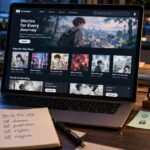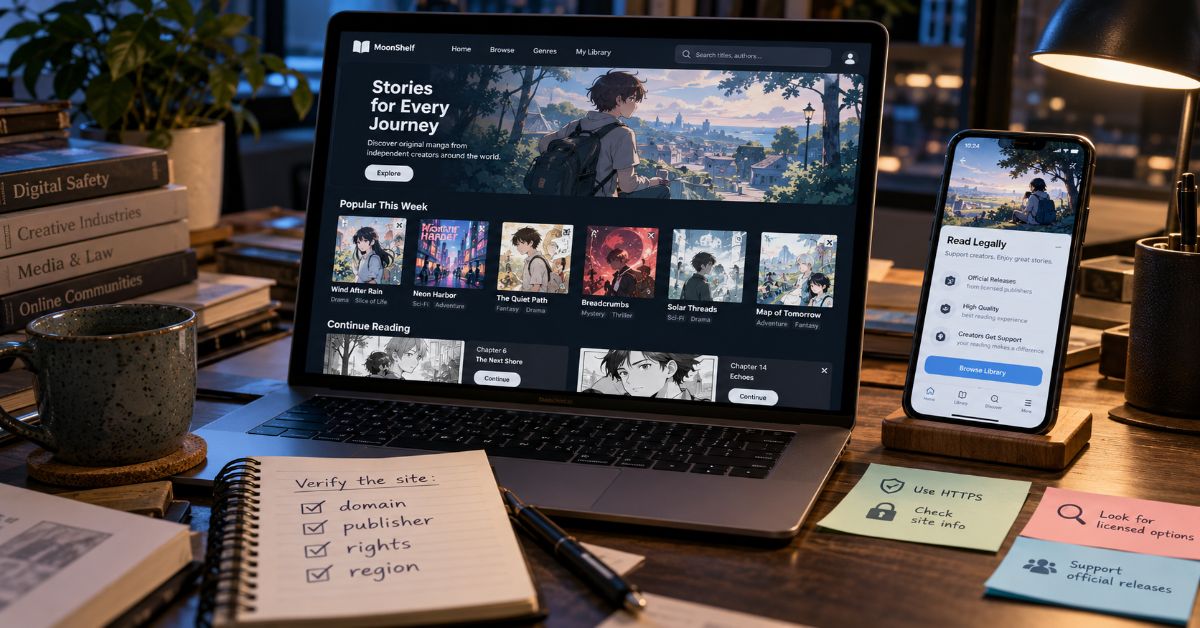
My reading manga is best treated in 2026 as a search for a web brand and a reading use case, not as proof that one current domain is official, safe or licensed. That distinction matters in a market where the Content Overseas Distribution Association estimated 2025 online-piracy losses for Japan-origin digital content at 5.7 trillion yen—about three times its comparable 2022 estimate. The scale does not prove anything about one specific site, but it explains why manga publishers, readers and search engines now treat authorization and provenance as first-order questions.
Current ranking pages usually tell a simple story: MyReadingManga is a free archive associated with BL, yaoi, bara, doujinshi and fan translations; it carries copyright and security risks; and readers should use alternatives. Parts of that framing are plausible, but the evidence quality varies sharply. Some pages cite no operator statement, no dated security report and no rights-holder notice, yet still make categorical claims about malware, official domains, shutdown causes or legal exposure.
This guide uses a narrower standard. It separates what search results consistently describe from what can be verified through current primary sources. It also avoids mirror hunting or access instructions. The useful questions are: what does the term identify, what can a reader verify about a destination, how should copyright status be assessed, what browser behavior should trigger an exit, and which licensed services can replace the actual reading need?
What “My Reading Manga” Means in the Current SERP
The phrase has two overlapping intents. One is navigational: readers are trying to locate or identify MyReadingManga. The other is informational: readers want to know what the site is, whether it is safe, whether its material is authorized, and what alternatives exist. That split is visible across current results, which include MyReadingManga-branded libraries, safety guides, traffic tools and pages targeting misspellings of the name.
The important editorial point is that a name is not an identity credential. A search result can use familiar branding without proving common ownership with an earlier site. Rubble Magazine’s Natomanga safety and history guide makes the same distinction for another manga ecosystem: redirects, branding continuity and reader reports can show a migration pattern without proving a formal corporate rebrand.
What Can Be Verified—and What Cannot
Current search results consistently associate the name with user-shared manga, doujinshi, fan translations and a strong concentration of Boys’ Love and other LGBTQ+ material. That recurring description is useful for understanding search intent. It is not, by itself, proof of who currently operates a particular domain, which titles are licensed, or whether one page is the canonical continuation of an older service.
| Signal | What it can support | What it cannot prove |
| Familiar name or copied interface | Brand resemblance or continuity of presentation | Common ownership, licensing, or safe code |
| HTTPS / padlock | Encrypted connection between browser and that server | Honest operator, safe ads, or authorized manga |
| High traffic or search rank | Popularity and discoverability | Security review or publisher approval |
| Stable company, terms and support | A more accountable operator may exist | Rights to every title in every territory |
| Publisher or rights-holder listing | Authorization for a title, territory and time window | Permanent global availability |
What the Current Top 10 Results Commonly Miss
I reviewed ten prominent current pages surfaced for the exact phrase and close MyReadingManga variants in October 2026. Search order changes by country, device, personalization and time, so this is a competitive sample rather than a permanent universal Google order. The sample included MyReadingsManga, Teach Me First Toon, Tribute Most Haunted, Magazine Meme, Teach Me First Manga, Numberlina, TheHentai.co.uk, Eopis, Wheon and Content Ideators.
| Recurring SERP angle | Strength | Ranking gap |
| Basic definition and genre list | Answers the immediate “what is it?” question | Often repeats platform claims without identifying a first-party operator |
| Safety verdict | Gives readers a quick warning | Frequently turns pop-up anecdotes or generic piracy risks into site-specific malware claims |
| Legality section | Correctly raises copyright authorization | Often collapses provider liability, uploader conduct and reader behavior into one yes/no statement |
| Domain-change explanation | Acknowledges instability | Commonly asserts DMCA shutdowns or ownership continuity without dated primary evidence |
| Alternatives list | Gives readers an exit path | Can be stale; some 2026 pages still recommend services whose status has changed |
| VPN/ad-block advice | Addresses privacy and annoyance | Can imply that privacy tools authenticate a site or change copyright status |
The ranking opportunity is therefore not “more words.” It is stronger evidence discipline. A durable page should label uncertainty, date-stamp fast-moving facts, distinguish site identity from browser behavior, and verify every alternative before recommending it. Rubble Magazine’s KissKH analysis uses the same principle for unstable streaming brands: availability, ownership and authorization are separate claims.
Is MyReadingManga Legal?
The clean legal question is not whether a website is free. It is whether the service has permission to reproduce or distribute the works it makes available. The U.S. Copyright Office explains that Section 512 of the Digital Millennium Copyright Act creates safe-harbor rules and a notice-and-takedown system for qualifying online service providers; it does not grant a blanket license to distribute copyrighted works.
For MyReadingManga specifically, I could not verify a current operator statement, licensing catalogue or publisher-backed authorization program that would justify treating the broad catalog described by ranking pages as officially licensed. That does not allow a responsible article to declare the legal status of every file, upload or jurisdiction from a distance. It does support a practical rule: when authorization matters, verify the title through the publisher or an acknowledged licensed distributor.
The larger enforcement context is not theoretical. CODA reported in January 2026 that its survey estimated 5.7 trillion yen in 2025 losses from online piracy of Japan-origin digital content. In another 2026 case, CODA said a BATO.TO operator investigation involved more than 1,000 titles from five major publishers and at least 60 related sites. These are industry-level facts, not evidence that the same operator runs MyReadingManga.
For readers who want a broader explanation of how unauthorized entertainment brands can persist while domains and ownership signals change, Rubble Magazine’s HiAnime shutdown and safety guide shows why a government watch-list entry, a shutdown event and a later lookalike domain should not be merged into one unsupported causal story.
Is My Reading Manga Safe?
A single “safe” or “unsafe” label is too crude unless it is tied to a specific domain, date, browser session and evidence source. The current SERP contains repeated warnings about redirects, fake download buttons, pop-ups and malicious advertising, but many pages do not cite a site-specific security report. Those warnings are credible as a general threat model for ad-supported unofficial media sites; they should not be presented as proof that every MyReadingManga page serves malware.
The Five-Layer Safety Test
- Identity: confirm the exact domain before entering a password, email address or payment detail. A misspelling or sudden hostname change resets the trust decision.
- Browser behavior: repeated new tabs, fake CAPTCHA steps, “player updates,” forced extensions, APKs or executable downloads are exit signals, not normal reading requirements.
- Advertising: the page itself and the third-party ad destination are different risk surfaces. A clean domain reputation score cannot certify every ad auction or redirect.
- Permissions: deny notification, camera, microphone, clipboard or extension requests that are unnecessary for simply reading an image-based chapter.
- Account hygiene: do not reuse an important password on an unofficial or ambiguously owned service. Keep reading progress in an independent tracker if continuity matters.
The same layered approach appears in Rubble Magazine’s MyFlixer safety and legality guide: the highest-risk event can happen after the initial click, through monetization infrastructure, redirects or credential prompts rather than through the visible content itself.
Why the Niche Catalog Created Real Demand
The popularity of the search term is not difficult to understand. Ranking pages consistently emphasize niche BL, yaoi, bara, doujinshi and fan-translated material—categories that historically had uneven English licensing and regional availability. Unofficial archives often became discovery engines because they combined works from many publishers and communities in one searchable place.
That convenience creates a structural advantage that legal services still struggle to match: cross-publisher breadth. A licensed platform usually has rights to a defined catalogue, region and time window. The trade-off is accountability. Official services can identify the publisher, payment model, content rights and support channel, while an unofficial aggregator may offer broader discovery but weaker provenance and continuity.
Legal Alternatives: Match the Service to the Title
There is no single licensed replacement for every series associated with the MyReadingManga search. The strongest workflow is title-first: identify the exact work and creator, then check the publisher or a recognized licensed platform in the reader’s region.
| Service | Best fit | Current verified signal | Main limitation |
| MANGA Plus by SHUEISHA | Shueisha series, simulpubs and large Jump catalog | Shueisha says the service is official and proceeds support artists; U.S. MAX plans currently start at $1.99/month | Limited to Shueisha rights; availability varies by title and region |
| MangaPlaza | Broad Japanese catalog including BL, yaoi, yuri and mature romance | Current site lists 170,000+ chapters and a dedicated Boys’ Love category | Per-title pricing and catalogue availability vary |
| Renta! / publisher storefronts | BL and romance readers who want licensed chapter or volume access | Use the official store or publisher page to confirm title rights before purchase | Not every niche or fan-created work is licensed |
| Digital ebook stores | Permanent-purchase style access across many publishers | Useful when the exact licensed volume exists on major ebook storefronts | Can cost more for heavy readers |
| Library-backed digital services | Readers seeking legal access without a new subscription | Availability depends on participating library and catalogue | Regional and borrowing limits can be restrictive |
For a directly verifiable example, the MANGA Plus official FAQ states that the service is official and that proceeds are passed on to artists. MangaPlaza’s current catalogue lists more than 170,000 chapters and includes Boys’ Love as a first-class category, making it a more relevant 2026 comparison than stale lists that assume niche legal options are scarce.
Three Original Insights the SERP Needs
1. The keyword is partly an entity-verification query now
Readers are not only looking for manga. They are trying to decide whether a name, domain or mirror is the thing they remember. That means provenance belongs near the top of the article, not buried in a safety FAQ.
2. “Free versus paid” is no longer the useful comparison
Official services increasingly compete with low monthly prices, free chapters, rotating access and broad digital catalogues. The real comparison is breadth versus accountability: one unofficial archive may span many rights holders, while a licensed service offers clearer provenance, professional localization, payment support and creator compensation.
3. The biggest risk may be continuity, not malware
Many current pages focus on viruses because that is easy to headline. For regular readers, the more common long-term cost can be broken bookmarks, changing domains, lost reading history, removed chapters and the repeated need to verify a new destination. Keeping a separate reading list turns that hidden dependency into a manageable inconvenience.
The Future of My Reading Manga in 2027
The safest forecast for 2027 is not a shutdown prediction. It is a continuation of two measurable trends: stronger anti-piracy enforcement and better licensed digital distribution. CODA’s 2026 reporting shows that rights holders and enforcement partners are treating large-scale manga piracy as a major economic problem, while publisher-run services continue to lower access friction with subscriptions, free chapters and multilingual distribution.
That does not mean unofficial aggregators will disappear. Their cross-publisher breadth and niche discovery remain hard to reproduce legally in one place. But the reader’s decision is likely to become more title-specific. Instead of asking “Which site has everything?”, more users can verify one work against a publisher, use an official reader when available, and keep discovery or tracking separate from distribution.
A 2027 article should therefore be updated around evidence that can actually change: active domains, rights-holder notices, publisher catalogues, service pricing, regional availability and dated security detections. Predicting a permanent official MyReadingManga domain or a specific enforcement outcome without first-party evidence would be speculation.
Key Takeaways
- The phrase “my reading manga” mixes navigational and informational intent, so a strong guide must explain both the web identity and the reading decision.
- Current search results agree on the site’s niche reputation but often overstate what can be proven about operator identity, malware, domain history and legal status.
- Copyright analysis should focus on authorization for a specific work, not on whether access is free or whether a site calls itself community-driven.
- Browser safety is layered: domain identity, ads, redirects, permissions, downloads and credential handling should be evaluated separately.
- MANGA Plus and MangaPlaza show that legal digital manga access is broader and cheaper than many older “alternatives” articles imply.
- A separate reading tracker reduces the continuity cost of any service that changes domains, removes chapters or loses account history.
Conclusion
My Reading Manga is a useful case study in why search visibility and platform trust are different things. The keyword points to a recognizable reading niche, especially around BL, yaoi, bara, doujinshi and fan-translated material, but a familiar name does not verify the operator behind every current domain. The strongest 2026 answer is therefore evidence-first rather than access-first.
Readers should separate four decisions: identity, browser safety, copyright authorization and catalogue fit. If a destination cannot establish who runs it, asks for unnecessary permissions, triggers suspicious redirects or cannot show rights to a title, that uncertainty matters. When an official edition exists, publisher-backed services offer clearer provenance and more stable access. When it does not, the absence of a license is a market gap—not proof that an unofficial copy is authorized. That distinction is what most current ranking pages still fail to make clearly.
Frequently Asked Questions
What is MyReadingManga?
The name is commonly associated in current search results with a user-shared manga and doujinshi archive, especially BL, yaoi, bara and LGBTQ+ material. I could not verify a current operator statement that authenticates every domain using the name, so treat the brand and any specific hostname as separate verification questions.
Is my reading manga legal?
The key issue is whether the service has permission to distribute a specific copyrighted work. I could not verify a current licensing programme covering the broad catalogue attributed to MyReadingManga. Laws and reader liability vary by jurisdiction, so this article does not give individual legal advice.
Is MyReadingManga safe to use?
There is no responsible universal yes/no answer without a specific domain and dated security evidence. Avoid pages that trigger fake verification steps, downloads, extensions, repeated redirects or unusual credential and payment requests. A padlock or trust score alone does not certify the whole browsing session.
Why does MyReadingManga appear under different domains or lookalikes?
Current search results and commentary discuss domain instability, but I did not find primary evidence proving the ownership chain or cause of every change. Treat a new hostname as a fresh trust decision instead of assuming it is the official continuation.
What are the best legal alternatives to MyReadingManga?
Use the exact title and publisher to choose. MANGA Plus is strong for Shueisha titles, MangaPlaza has a large Japanese catalogue including BL, and publisher storefronts or digital ebook stores may carry licensed niche releases. Availability varies by region.
Does a VPN make an unofficial manga site legal or safe?
No. A VPN changes network routing and can improve some aspects of privacy, but it does not authenticate a website, verify manga licenses, block every malicious redirect, or make a risky download harmless.
How can readers support manga creators directly?
Buy or read through publisher-backed services, licensed ebook stores, official subscriptions and creator-authorized channels. When a title is not licensed locally, follow the creator or publisher for release announcements rather than assuming an unofficial upload has permission.
Methodology
Competitive review
Research was conducted on October 7, 2026. Ten prominent current pages targeting “my reading manga,” “MyReadingManga,” and close safety/legal variants were reviewed as a competitive sample: MyReadingsManga, Teach Me First Toon, Tribute Most Haunted, Magazine Meme, Teach Me First Manga, Numberlina, TheHentai.co.uk, Eopis, Wheon and Content Ideators. Rankings vary by country, device, personalization and time, so the sample is not presented as a permanent universal Google top ten.
The strongest recurring coverage was definition, niche-content categories, generic safety warnings, legality summaries and alternative lists. The main weaknesses were weak operator verification, site-specific malware claims without site-specific evidence, causal stories about domain changes without primary sourcing, and stale legal-alternative recommendations. This article was structured independently around provenance, evidence hierarchy, browser-risk layers, authorization and title-first migration.
Source validation, internal linking and limitations
Industry piracy context was validated against the Content Overseas Distribution Association and the U.S. Copyright Office. Legal-service claims were checked against current first-party pages from MANGA Plus by SHUEISHA and MangaPlaza. The article does not claim direct testing of MyReadingManga, does not provide mirror links, and does not treat competitor repetition as proof of operator identity, malware or licensing status.
References
Content Overseas Distribution Association. (2026, January 26). Survey on losses from online piracy of Japan-origin content in 2025.
Content Overseas Distribution Association. (2026). Operator of the world’s largest manga piracy site BATO.TO criminally investigated in China.
MANGA Plus by SHUEISHA. (2026). FAQ: Service status, official licensing and access model. Retrieved October 7, 2026.
MangaPlaza. (2026). MangaPlaza: Your one-stop manga website. Retrieved October 7, 2026.
U.S. Copyright Office. (2026). The Digital Millennium Copyright Act and Section 512 resources. Retrieved October 7, 2026.