Morrisons is trying to win a modern price battle with a business built around making food itself. That is the defining contradiction of its 2026 turnaround: the grocer wants the low-price credibility of a discounter, while protecting its more labour-intensive fresh-food counters, factories and British sourcing network. Those strengths can help it stand apart, but they must earn their cost every day.
The latest company trading update, published on 16 September 2026, shows a business moving forward rather than standing still. Group like-for-like sales rose 3.2% in the 13 weeks ending 26 July, total quarterly sales reached £4.1 billion, and management reported year-on-year share gains. These are useful signs of recovery; they are not proof that the financial strain inherited from the private-equity takeover has vanished (Morrisons, 2026c).
For shoppers, the question is whether a wider choice of properly prepared food can also be affordable. For franchise partners, it is whether access to the grocer’s buying and wholesale network makes a local shop profitable. For lenders and owners, it is whether extra sales and cost savings turn into durable cash flow. The same strategy must answer all three groups.
A simple company history misses that tension. This analysis follows the links between production, counters, convenience distribution, digital delivery, pricing and financing, and separates confirmed figures from management targets and press reports.
A market-stall heritage that still shapes the costs
William Morrison began selling eggs and butter in Bradford in 1899. The first self-service shop opened in 1958, and Market Street arrived in 1985. The 2004 Safeway acquisition changed the group’s national footprint; Clayton, Dubilier & Rice (CD&R) acquired it in 2021 and took it private. The dates matter because the food-making identity predates the current recovery plan (Morrisons, n.d.).
That legacy makes the business unlike a pure retailer that simply buys packaged goods from suppliers. Its distinctive promise is visible at a butcher’s counter, in a fresh bakery, and in the logistics behind them. The downside is complexity: specialist workers, processing equipment, chilled transport and food waste do not disappear when demand weakens.
The overlooked advantage: owning part of the food chain
What Myton actually changes
Morrisons calls its approach vertically integrated: it sources significant volumes directly, processes food at owned facilities and distributes through its network. Its modern-slavery statement identifies 18 Myton Food Group manufacturing sites covering meat, seafood, chilled products, bakery, produce, flowers and plants (Morrisons, 2025). The business says it sources and processes approximately half of its fresh food in its own facilities and stores; the boundary of that claim matters because “half of fresh food” does not mean half of every product the retailer sells.
Direct production can improve visibility into ingredients, animal welfare and consistency. It may shorten the time between a change in customer preference and a product adjustment. It can also reduce dependence on an outside producer’s schedule. But ownership shifts operational responsibility inward. If volumes fall, manufacturing overhead, maintenance, energy bills and specialist staff remain. Any claim that integration automatically makes a retailer cheaper is therefore too broad.
A trade-off that most company profiles ignore
The economic test is utilisation. A factory running near efficient capacity can spread its fixed costs across many units; one with excess capacity can become expensive quickly. There is also a forecasting cost: a grocer making perishable goods carries spoilage risk when forecasts miss. The benefit of control is real, but it should be measured against waste, throughput and gross margin—not simply celebrated as heritage.
The company announced commitments exceeding £1.6 billion to British farming and food production for 2026, supporting more than 2,500 UK farmers. That points to purchasing scale and long-term relationships, although a commitment is not the same thing as independently audited farmer income or guaranteed shelf-price savings (Morrisons, 2026a).
The following table shows why the manufacturing story needs a two-sided reading.
| Strategic lever | Potential advantage | Economic constraint |
| Owned food processing | Better traceability and product control | Capital, energy, maintenance and plant utilisation |
| Direct farm relationships | Supply visibility and seasonal planning | Exposure to weather, costs and harvest volatility |
| In-store fresh preparation | Differentiation and customer service | Labour and shrink in low-volume stores |
| Own-label products | Control over recipes and range | Forecasting errors and slow-moving stock |
Market Street: the cost-cutting reversal with a lesson
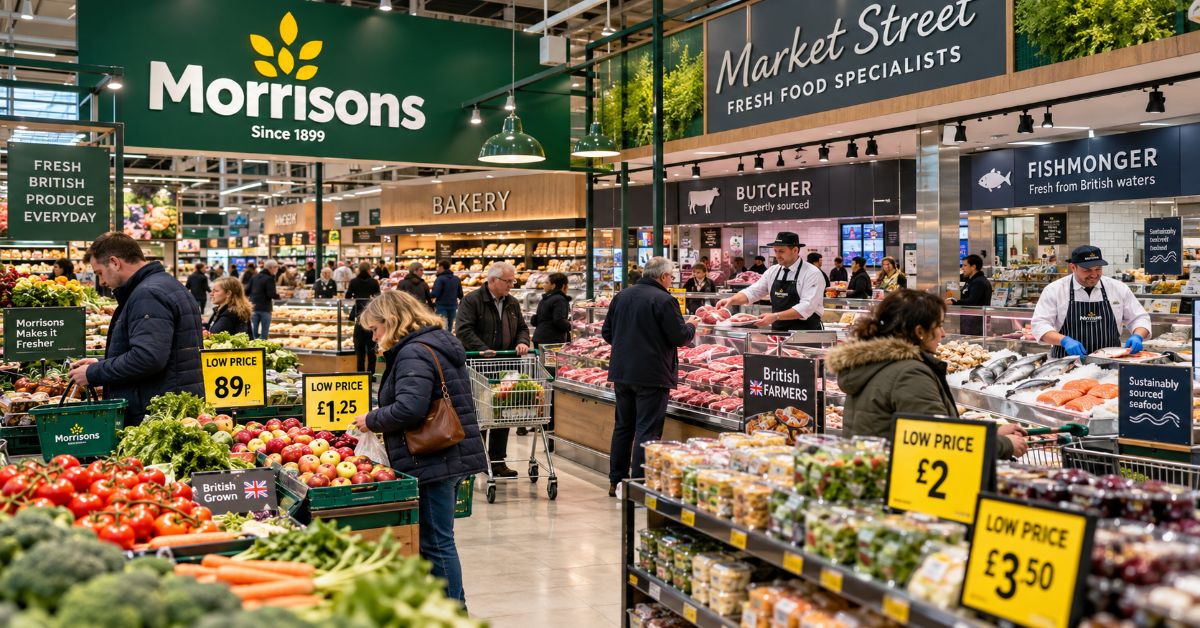
Market Street is the part of the format a shopper can actually see: staffed counters, skilled food preparation and service rather than only packaged self-selection. In 2025, the company reduced a number of meat and fish counters amid a wider cost review. In July 2026, reports said it was restoring or reopening counters after customer feedback (Retail Gazette, 2026). This is not evidence that every counter in every store is returning.
The reversal illustrates a basic retail danger. Closing a service that appears costly in isolation may lower labour costs, but it can weaken the reason shoppers choose the whole store. A customer who comes for a butcher may buy vegetables, household goods and lunch while there. Remove the service and the impact can exceed the counter’s direct sales. Conversely, keeping every counter regardless of demand would be economically reckless.
The sensible measure is incremental store-wide contribution: does the counter improve total basket value, retention and trip frequency enough to cover its costs? That is a stronger question than either “counters are tradition” or “counters cost money.” Local availability should be checked before travelling specifically for staffed services.
Daily shops: expanding the brand without owning every site
Why the McColl’s chapter matters
Morrisons acquired the troubled McColl’s convenience business in 2022. In the years that followed, inherited company-operated sites faced profitability problems and closures, while Morrisons promoted a franchise-led approach. Those actions are not inherently contradictory. Closing a weak store while adding independently operated shops may reduce operating exposure while preserving wholesale sales and brand reach.
The company’s September 2026 update reported 71 new Morrisons Daily franchise outlets opened so far in its financial year, and plans for hundreds more over coming years. Its Morrisons Daily website describes an estate exceeding 1,700 convenience locations, of which around 700 are franchise stores. These figures represent different reporting dates and definitions; they should not be combined into a fabricated current total (Morrisons, 2026c; Morrisons Daily, n.d.).
The unit economics of a franchise shop
A branded neighborhood shop can buy products and services from a wholesale supplier while a local operator bears much of the day-to-day retail burden. For the supplier, this can convert some capital-intensive store growth into a distribution relationship. For the operator, brand recognition and a consistent fresh range can help, but franchise fees, supply terms, rent, energy, wage rates and wastage determine actual profit.
A retailer considering a franchise should examine contract duration, renewal and exit obligations before treating marketing projections as profit. Rubble Magazine’s contract-lawyer guide offers a separate framework for examining commercial terms and risks; it is not Morrisons-specific legal advice.
This is the strategic asymmetry: a network can grow in store count while shifting who carries its fixed costs. For shoppers that can mean a closer store. For Morrisons it may mean additional wholesale volume. For partners, however, it is not a risk-free opportunity. Supplier dependence, inventory rules and local competition deserve the same scrutiny as the brand sign.
The distinction between formats is important:
| Format | Who runs the shop? | What to watch |
| Large Morrisons supermarket | Company-operated | Fresh counters, full-range basket and nearby alternatives |
| Company-operated Daily | Morrisons entity | Sales per store, occupancy and staffing costs |
| Franchised Daily | Independent retailer under agreement | Wholesale economics, operator obligations, local demand |
| Online / rapid fulfilment | Morrisons or delivery partner, depending on route | Fees, substitutions, assortment and fulfilment cost |
Price promises: persuasive, but not a basket audit
Morrisons launched the Unbeatables promise in 2026 to position hundreds of everyday products against named major supermarket rivals. The September update says the initiative had already positively affected performance, according to management (Morrisons, 2026c). That is a statement about management’s assessment, not a controlled independent comparison.
A matching promise may exclude some formats, pack sizes or loyalty-linked prices depending on its terms. Even when the listed items are competitive, a complete weekly basket includes products outside the promotional set. A lower price on milk or pasta does not establish a lower total than Aldi, Lidl, Tesco or Sainsbury’s for a particular household.
The useful shopper test is modest: build the same basket at two shops, compare price per unit, include travel and delivery charges, and consider substitution costs. An offer that saves £3 but requires an extra trip may not be a saving after transport and time. Loyalty discounts can also change the result, so compare the price actually available to the person buying.
Rubble Magazine’s product-reviews guide explains why evidence, comparison conditions and limitations matter more than a seller’s headline rating. The same discipline applies to supermarket price claims.
Online delivery turns stores into local infrastructure
The retailer has multiple digital routes: its own online grocery service, rapid Morrisons Now delivery, and partnerships including Amazon, Deliveroo and Just Eat, alongside some local convenience delivery partnerships. Company reporting described double-digit online growth in the 2025 financial year and again in the 2026 third quarter (Morrisons, 2026b; Morrisons, 2026c). Growth rates alone, however, do not reveal delivery profitability.
A small basket arriving quickly is convenient but can be expensive to assemble, pick and deliver. Store-based fulfilment uses existing premises, yet staff must split attention between shelf shoppers and couriers. The relevant operating metrics are order density, picking time, substitution rate, average order value and delivery contribution after fees. The advantage of a nearby convenience shop depends on how efficiently it fulfils orders.
For shoppers evaluating unfamiliar marketplace-style or partner checkout experiences, Rubble Magazine’s Facebook Marketplace safety guide offers a broader reminder to check who takes payment and who resolves a dispute. Grocery partner-app terms differ, so customers should confirm the retailer and platform handling each order.
A second-order effect is possible: a popular hot-food or fresh-food range can support both walk-in trade and delivery. But online demand can also cannibalise larger supermarket trips. The strategic goal should be profitable extra occasions, not merely a growing count of orders.
Debt, cash flow and the ownership pressure
Private equity ownership is a significant part of this story, but debt statistics require careful definitions. Morrisons said in January 2026 that debt had fallen 46% from its 2022 peak. Separately, August reporting on the ultimate parent, Market Topco, described total net debt including lease-related and other obligations of about £7.52 billion. Those numbers measure different things at different corporate levels and should not be presented as a single comparable series (Morrisons, 2026b; Retail Gazette, 2026).
The core issue is not whether debt can be described with one frightening headline. It is whether operating cash flow can finance competitive prices, new stores, refurbishments, employee costs and interest obligations without continually shrinking assets. Sale-and-leaseback transactions may provide upfront cash but replace ownership economics with future rental commitments. A strong price campaign that drives traffic but erodes cash margin can increase rather than resolve pressure.
Investment debates have expanded into speculation about sector consolidation. In October, reporting discussed earlier Sainsbury’s–Morrisons talks and possible future mergers, but no transaction should be treated as agreed on the basis of that speculation (The Guardian, 2026). For now, the reported operational recovery and the capital structure are separate tests.
A useful scorecard separates four statements that often get blurred:
| Reported signal | What it supports | What it cannot prove |
| 3.2% Q3 like-for-like sales growth | Comparable-store sales momentum | Net profit or free-cash-flow growth |
| £995m cumulative cost savings by Q3 | Programme execution versus its baseline | That all savings are recurring or customer-visible |
| 71 franchise shops opened year-to-date | Convenience rollout activity | Profitability of each individual partner |
| Debt down 46% from 2022 peak, company basis | Progress on a stated debt measure | Absence of other parent or lease obligations |
What shoppers and suppliers should actually watch
For a shopper, the winning retailer is not the one with the best narrative. It is the one that delivers the right food, at an acceptable total price, consistently. Monitor three things: whether essential items remain competitive after offers expire, whether staffed fresh services are genuinely available locally, and whether online deliveries meet expectations without costly substitutions.
For farmers and manufacturers, longer purchasing commitments can improve planning, yet commercial health also depends on transparent specifications, prompt payment and demand visibility. For a franchise candidate, a store-count announcement is less relevant than a realistic store-level profit and loss statement. The people affected by the turnaround do not all judge success using the same numbers.
The Future of Morrisons in 2027
The 2027 outlook is more about execution than a dramatic invention. The company has laid the foundation for a multi-channel model: more franchise-led neighborhood access, food preparation under its own control, online convenience and tightly communicated prices. If trading growth persists while waste and cost per unit fall, the parts can reinforce one another.
Three uncertainties are decisive. First, can its fresh-food proposition keep customers loyal when promotions become less generous? Second, will franchise operators retain attractive economics while the wholesale network scales? Third, can cash generation keep pace with financing and lease commitments? Public trading updates cannot settle all three because they do not disclose a full store-by-store or franchise-level profitability picture.
Regulatory scrutiny and consolidation could change the competitive landscape, but there is no basis to forecast a particular merger or guarantee a change of owner. The sensible 2027 expectation is measurable gradual improvement—or setbacks—rather than a simple comeback storyline. Watch comparable sales volume, market share, operating margin, free cash flow, partner retention and store-service consistency.
Key Takeaways
- Owning factories creates operational control, but only efficient volumes can support low prices.
- Market Street counters should be judged by whole-store customer economics, not nostalgia alone.
- Franchised Daily growth can expand distribution while reallocating risk to local operators.
- A price promise for selected goods is not proof of the cheapest complete shopping basket.
- Online growth matters most when delivery economics and repeat purchases work.
- The company’s debt-reduction claim and broader parent-level liabilities use different measures.
- In 2027, cash generation and customer retention are stronger tests than store-count headlines.
Conclusion
Morrisons has reasons to be distinctive that cannot be copied overnight. Its fresh-food facilities, ties to British producers, staffed counters and growing convenience network give it capabilities beyond a conventional shelf-and-checkout retailer. Its recent like-for-like gains suggest those assets can still attract shoppers when supported by clearer value messages.
But the recovery is not complete merely because sales are rising. Making food, reopening services and expanding delivery all consume resources. A private-equity-owned supermarket must continually choose where to invest and where to cut, while customers compare price, quality and convenience on every visit. The return of some Market Street counters shows how difficult those choices can become when cost savings weaken a key reason to shop.
The fairest assessment in October 2026 is measured progress with meaningful financial and operational risks. The next stage will be decided less by the number of announcements than by whether its factories, franchise partners, supermarkets and digital channels create enough customer value and cash to sustain the model.
Frequently Asked Questions
Who owns Morrisons in 2026?
Morrisons is privately owned following its 2021 acquisition by Clayton, Dubilier & Rice. Reports about potential mergers are speculation until a transaction is formally announced.
Does Morrisons make its own fresh food?
Yes. Through Myton Food Group and in-store preparation, the retailer makes or processes a substantial share of its fresh foods. The company has identified 18 manufacturing locations. This does not mean it makes every item on sale.
How many Morrisons Daily stores are there?
Its Daily website describes more than 1,700 convenience sites, including around 700 franchises. These are a dated company description, not an independently confirmed live store count for every day of 2026.
Why is Morrisons closing some stores while opening new ones?
Some inherited or weaker company-operated sites have faced closures, while new franchise locations can expand the network with a different allocation of operating costs and risk. Each store’s circumstances differ.
What is the Morrisons Unbeatables promise?
It is a 2026 price-value commitment on hundreds of selected everyday products against named supermarket competitors. Check the current item list and terms; the promise does not establish the cheapest possible entire basket.
Is Morrisons cheaper than Aldi?
Not reliably for every household. Price depends on the exact basket, pack sizes, offers, dates, loyalty eligibility and travel or delivery costs. Compare like-for-like unit prices before deciding.
Will Morrisons merge with Sainsbury’s?
The press reported past talks and ongoing industry speculation in 2026. No confirmed merger is established by that reporting, and future ownership decisions remain uncertain.
Methodology
Research was conducted on 15 October 2026 using Morrisons corporate trading updates, its company history and supply-chain documentation, Morrisons Daily’s published business description, and independent reporting on store counters, liabilities and industry speculation. Operational figures are dated to their respective reporting periods. Management claims are attributed and are not treated as independent audits.
For competitive context, a sample of prominent indexed pages and search-result types covering the broad Morrisons query and 2026 strategic variants was reviewed, including Morrisons corporate, Morrisons Daily, IGD, Reuters Breakingviews, The Guardian, The Times, Retail Gazette, LBC, Bdaily and sector retail reporting. This was not a verifiable universal Google top-ten ranking: positions change by location, device and query wording. Most pages either provide brand history, shopper navigation, breaking news or isolated financial facts. This article instead connects manufacturing economics, counter-service retention, franchise risk, price-basket verification and leverage.
References
Morrisons. (n.d.). Company history. Morrisons Corporate. https://www.morrisons-corporate.com/about-us/company-history/
Morrisons. (2025). Modern slavery statement 2023/24: Structure, business & supply chains. Morrisons Corporate. https://www.morrisons-corporate.com/globalassets/corporatesite/corporate-responsibility/ethical-trading/morrisons_msr2024-12-25.pdf
Morrisons. (2026a, February 19). Morrisons backs British farming with £1.6 billion commitment for 2026. Morrisons Corporate. https://www.morrisons-corporate.com/media-centre/corporate-news/morrisons-backs-british-farming-with-1.6-billion-commitment-for-2026/
Morrisons. (2026b, January 21). Full year 2024/25 results and Christmas 2025 trading update. Morrisons Corporate. https://www.morrisons-corporate.com/media-centre/corporate-news/morrisons-full-year-202425-results-and-christmas-2025-trading-update/
Morrisons. (2026c, September 16). Trading update for Q3 2025/26. Morrisons Corporate. https://morrisons-corporate.com/media-centre/corporate-news/morrisons-trading-update-for-q3-202526/index.html
Morrisons Daily. (n.d.). About us. https://www.morrisonsdaily.co.uk/about-us
Retail Gazette. (2026, July 3). Morrisons relaunches Market Street counters after customer outpouring. https://www.retailgazette.co.uk/blog/2026/07/morrisons-fish-meat-counters/
Retail Gazette. (2026, August 13). Morrisons debt pile swells to £7.5bn as lease liabilities climb. https://www.retailgazette.co.uk/blog/2026/08/morrisons-debt-pile-swells-to-7-5bn-as-lease-liabilities-climb/
The Guardian. (2026, October 8). Supermarket shake-up: Why Asda or Morrisons could vanish within a decade. https://www.theguardian.com/business/2026/oct/08/supermarket-shakeup-big-brands-ripe-merger