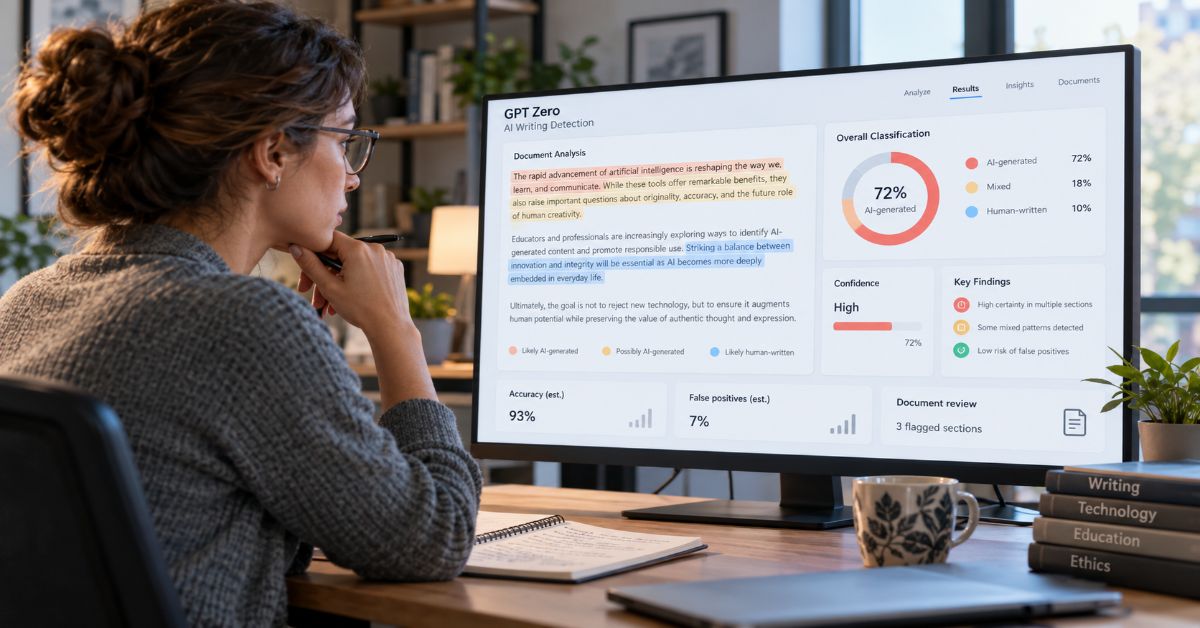
GPT zero is an AI-writing detector, not a lie detector, and that distinction matters more in 2026 because the same tool can look extremely accurate in a controlled benchmark and far less reliable on edited, hybrid, or newer-model text. The sharpest current evidence is the gap itself: GPTZero reported 99.5% accuracy on one 2026 benchmark, while an independent peer-reviewed study found that GPTZero substantially underestimated AI content in several realistic academic-document conditions.
That does not make the product useless. It changes the job it is qualified to do. A detector can help a teacher decide which submission deserves a closer look, help an editor identify a suspicious shift in voice, or help a writer understand why polished prose resembles common model patterns. The mistake is converting a probabilistic pattern score into a factual claim about who wrote the text.
This guide focuses on that decision boundary. It explains what GPTZero measures, what its current benchmark claims do and do not show, how independent 2026 research changes the picture, where false positives and false negatives come from, what users actually get from the product, and how its Superhuman acquisition could change the category. It also compares the tool with the evidence that institutions should use alongside it, because authorship is ultimately a process question as much as a text-pattern question.
What GPTZero Actually Measures
GPTZero analyzes statistical patterns in text associated with human and machine writing. Its public explanations emphasize signals such as predictability, variation in sentence structure, and patterns across an entire passage. Older discussions often reduce this to “perplexity” and “burstiness,” but a modern commercial detector is better understood as a classifier that combines multiple learned signals rather than a two-metric formula.
That distinction matters because predictable writing is not automatically AI writing. Technical documentation, heavily edited prose, translated English, formulaic business copy, and student writing shaped by rigid rubrics can all become statistically regular. Conversely, AI text can become more varied after human editing, paraphrasing, or mixing with original writing.
The Score Is a Classification Signal, Not Authorship Proof
A detector has access to the finished text, not the writer’s full process. It generally cannot see whether a student drafted from notes, whether an editor rewrote a paragraph, whether a model generated a first draft that was later rebuilt, or whether a human simply writes in a highly regular style. This is why GPTZero’s own guidance warns against using a score as the sole basis for punishment or accusation.
Rubble Magazine’s guide to machine learning models provides useful context here: model performance depends on the task, data, error costs, and deployment conditions. AI detection is no exception.
The table below separates what a detector can reasonably contribute from what still requires human evidence.
| Question | Detector can help | Detector cannot prove |
| Does this passage resemble known AI-writing patterns? | Yes — as a probability or classification signal. | Who physically typed or authored the text. |
| Which passages deserve closer review? | Often, especially with sentence-level highlighting. | Why the pattern appears or whether misconduct occurred. |
| Is a document partly AI-assisted? | Sometimes, but mixed text is harder than clean text. | The exact percentage of human versus AI contribution. |
| Which model wrote it? | Usually not reliably. | A definitive source model or account. |
| Should someone be penalized? | No — the score can inform review. | Intent, policy violation, or fair disciplinary outcome. |
Accuracy in 2026: Why the Numbers Conflict
The most important fact about GPTZero accuracy is that there is no single accuracy number that transfers cleanly across every use case. Accuracy changes with the dataset, model generation settings, document length, language, editing, threshold choice, and the proportion of AI material inside the text.
GPTZero’s Controlled Benchmark
In February 2026, GPTZero published a re-evaluation of a Chicago Booth benchmark and reported 99.5% overall accuracy, a 0.05% false-positive rate, and 99.3% recall. The benchmark included output from models such as GPT-4.1, Claude Opus 4, Claude Sonnet 4, and Gemini 2.0 Flash. Those results are meaningful evidence that the detector can perform very strongly under the benchmark’s conditions.
Independent Higher-Education Testing
A peer-reviewed 2026 study in the International Journal for Educational Integrity tested GPTZero, Pangram, Copyleaks, and Turnitin on 160 papers split across fully human, fully AI-generated, hybrid, and humanised categories. The study found that GPTZero substantially underestimated AI content in the fully generated set and performed poorly on hybrid and humanised documents in that dataset. The authors concluded that detector reliability varied considerably by condition and warned against high-stakes reliance on a single tool.
These results do not “disprove” the vendor benchmark. They expose a deployment problem: a detector can be excellent on one distribution and weak on another. That is the information most ranking articles fail to make operational.
| Evidence set | What was tested | Headline result | What it means |
| GPTZero 2026 benchmark | Controlled human and AI document dataset across several major models | 99.5% reported accuracy | Strong evidence for performance under the benchmark conditions, not a universal field rate. |
| 2026 peer-reviewed higher-education study | 160 fully human, fully AI, hybrid and humanised papers | GPTZero underestimated AI content in several categories | Realistic mixed and newer-generation conditions can behave very differently. |
| 2025 randomized essay study | 28 AI essays and 50 human essays across different lengths | AI essays mostly detected; human essays produced some false positives | Useful on pure AI samples, but human-text reliability remained imperfect. |
| 2024 education study | Human, AI and disguised student writing across detectors | GPTZero had false positives and disguised AI reduced detectability | Editing and student context can shift scores materially. |
Five Conditions That Change a GPTZero Result
1. Clean AI output is easier than mixed authorship
A document copied directly from a model usually preserves more machine-like regularities than a draft that a person reorganized, rewrote, sourced, and edited. Hybrid text therefore tests a detector’s ability to localize weak signals rather than classify one clean distribution.
2. Newer models change the distribution
Detectors are trained against known model behaviors, but generation systems keep changing. A model with more natural sentence variation or deeper reasoning can produce text that falls outside the patterns a detector saw during earlier training.
3. Short passages remove statistical context
A few sentences provide less evidence than several paragraphs. Small samples also make sentence-level quirks disproportionately influential, which is why users should avoid treating a tiny excerpt as a robust authorship test.
4. Human editing can look like evasion even when it is legitimate
Grammar tools, copy editing, translation, and style normalization can make human writing more regular. The reverse also happens: a person can revise AI output until it looks far less machine-like. Both cases weaken the simple human-versus-AI binary.
5. Error cost changes what “good enough” means
A publisher using detection as one quality-control signal can tolerate more uncertainty than a university using the same score in a misconduct process. The higher the consequence, the more evidence the institution needs beyond the detector.
For educators, this is increasingly relevant because products such as Google Classroom are adding deeper generative-AI layers to everyday learning workflows. Detection policy now sits beside AI-access policy, assignment design, and evidence of how work was produced.
What the Product Offers Beyond a Basic Detector
GPTZero has expanded from a paste-and-scan detector into a broader authenticity product. Current materials describe sentence-level analysis, document and batch workflows, plagiarism-related tools, writing-process or replay features, hallucination checking, API access, and education integrations. Plan packaging changes, so current limits and prices should be verified on GPTZero’s live subscription page before purchase rather than copied from an old review.
The practical value of paid access is therefore not simply “better AI detection.” GPTZero’s support documentation states that free and paid plans do not have major general-use differences in the core concept; paid tiers mainly expand capacity and workflow features, while educator plans can use education-specific data and thresholds. That means buyers should calculate their actual scanning volume and workflow needs before paying.
| Use case | Useful GPTZero capability | Evidence to add before acting |
| Teacher reviewing an essay | Document score, sentence highlights, writing replay where available | Version history, sources, drafts, oral discussion, course AI policy |
| Publisher screening submissions | Batch scanning and highlighted passages | Source verification, plagiarism check, editorial review, contributor history |
| Student checking own draft | Self-scan to identify passages that may trigger a detector | Draft history and original notes; do not rewrite only to chase a score |
| Hiring or HR screening | Possible signal on templated/generated writing | Work sample context, interview verification, role-relevant evidence |
| SEO/editorial workflow | Can flag generic or over-regular passages | Usefulness, originality, fact accuracy and editorial quality matter more than an AI score |
For writing workflows, Rubble Magazine’s current Grammarly review is relevant because grammar correction, generative assistance, authorship signals, and AI detection increasingly overlap inside the same tools. The important editorial question is not “Was AI involved?” but “Is the final work accurate, original, useful, sourced, and compliant with the policy that applies?”
False Positives Are the High-Stakes Risk
A false positive happens when human-written text is classified as AI-generated. The cost is asymmetric. A false negative may let some AI text pass; a false positive can wrongly place a real person under suspicion. That is why institutional use should be designed around due process rather than confidence percentages.
The safest workflow is sequential: first identify the flagged passage, then compare it with prior writing, drafts, citations, document history, and the assignment process. Ask the writer to explain choices or sources. Only then decide whether there is a policy issue. A detector score should trigger a question, not supply the answer.
Writers also should not “optimize for human score” as if the detector were an SEO metric. Rubble Magazine’s word counter guide makes the same broader point about writing utilities: a visible number can be useful for workflow control without becoming the goal itself.
GPTZero, ZeroGPT and the Name Confusion
GPTZero and ZeroGPT are separate products. Search results frequently mix “GPTZero,” “GPT Zero,” and “ZeroGPT,” which creates a navigational problem for readers comparing reviews or looking for an official site. A ranking page should make this distinction explicit because accuracy claims, pricing, privacy policies, and feature sets from one service do not transfer to the other.
The Superhuman Acquisition Changes the Strategic Context
Superhuman announced an agreement to acquire GPTZero on June 23, 2026, and announced on September 28 that GPTZero had become part of Superhuman. The company positioned the deal around an “authenticity layer” that combines AI detection with authorship and provenance-oriented tools. TechCrunch reported that GPTZero had more than 19 million registered users and about $30 million in annual recurring revenue when the deal was announced, although transaction terms were not disclosed.
That matters because the long-term category may move beyond after-the-fact text classification. Writing-process evidence, provenance, document history, source verification, and platform-level signals can answer questions that a finished-text detector cannot. The acquisition therefore points toward a broader competitive frame: proving how work was created, not merely predicting whether a paragraph resembles model output.
Rubble Magazine’s guide to trustworthy product reviews offers a useful parallel: a credible verdict depends on method, evidence conditions, version identity, and limitations, not a single score stripped of context.
How to Use GPTZero Responsibly
Start with enough text
Use several paragraphs where possible. Very short samples are structurally weak evidence.
Read the sentence-level pattern
Do not stop at the document percentage. Look for where the signal changes and whether the flagged language is formulaic for legitimate reasons.
Check the writing process
Use drafts, version history, notes, citations, source trails, or writing replay. Process evidence is often more probative than a style score.
Ask before accusing
Give the writer a chance to explain sources, phrasing, edits, and tools used. High-stakes review requires human context.
Separate policy from detection
An institution must first define what AI use is allowed. A detector cannot decide whether permitted brainstorming, grammar correction, translation, or editing violates a rule.
Audit your own false-positive rate
Before deployment, test known human and known AI documents from the exact population you will review. Generic benchmark performance is not a substitute for local validation.
The Future of GPTZero in 2027
The most credible 2027 direction is not a detector that becomes infallible. It is a broader authenticity workflow. GPTZero’s move into Superhuman, the rise of writing replay and authorship tooling, and continued independent evidence about detector fragility all push the market toward combining text classification with provenance and process signals.
For education, that could mean assignments designed around visible drafting, source use, oral defense, and allowed-AI disclosure rather than a final-score threshold. For publishers, it could mean connecting detection with plagiarism review, fact checking, source validation, contributor history, and editorial audit trails. For enterprise buyers, API-level integration may matter more than a standalone web checker.
The uncertainty is technical. Generative models will keep changing, and human editing will keep blurring the boundary. That makes a permanent “99% accurate” interpretation unlikely to remain meaningful across all content types. The stronger 2027 product will be the one that explains uncertainty, preserves evidence, and fits a fair decision process.
Key Takeaways
- GPTZero is useful for screening text patterns, but a score does not prove authorship or misconduct.
- Controlled benchmark performance and field performance can diverge sharply because text distributions differ.
- Hybrid, humanised, short, translated, or heavily edited writing deserves more caution than clean long-form model output.
- False positives matter most when the score can affect grades, jobs, reputation, or disciplinary action.
- Paid plans mainly add scale and workflow value; buyers should verify current limits and test their own document types before committing.
- The Superhuman acquisition points toward provenance and authorship evidence becoming as important as text classification.
- A defensible workflow combines detector output with writing-process evidence, source checks, policy context, and human judgment.
Conclusion
GPTZero remains one of the most visible AI-writing detectors, but the useful question in 2026 is no longer whether it “works.” It clearly can detect many forms of generated text. The harder question is what decision a particular score is strong enough to support.
The evidence says the answer depends on document type, model generation, editing, length, threshold, and consequence. GPTZero’s own benchmark shows very strong controlled performance, while independent academic studies demonstrate how much results can shift on hybrid, humanised, or newer-model writing. Both facts belong in the same review.
For low-stakes screening, that can still be valuable. For high-stakes judgments, the detector should be one input among several. Draft history, sources, writing process, policy clarity, and human review remain the evidence that turns a suspicious pattern into a fair conclusion—or prevents an incorrect accusation from going further.
Frequently Asked Questions
What is GPTZero?
GPTZero is an AI-writing detection platform that analyzes language patterns and estimates whether text appears human-written, AI-generated, or mixed. It also offers broader authenticity tools and education workflows. Its result is probabilistic, so it should be interpreted as a review signal rather than proof of authorship.
Is gpt zero accurate?
It can be highly accurate under some benchmark conditions, but independent studies show that performance changes with model type, editing, mixed authorship, language, and document length. There is no single accuracy rate that applies safely to every real-world use case.
Can GPTZero falsely flag human writing?
Yes. False positives are possible. That is why high-stakes users should check drafts, version history, sources, prior writing, and the writer’s explanation before making a decision.
Can GPTZero detect ChatGPT, Claude and Gemini?
GPTZero is designed to detect patterns associated with major model families, including GPT, Claude and Gemini. Detection quality can differ across models and changes as those systems evolve.
Is GPTZero the same as ZeroGPT?
No. GPTZero and ZeroGPT are separate services from different companies. Their accuracy claims, privacy practices, pricing, and features should be evaluated independently.
Should teachers use GPTZero to accuse students of cheating?
No detector score should be the sole basis for an accusation. A fair process should combine the result with the assignment’s AI policy, drafts, document history, sources, and a conversation with the student.
Is GPTZero useful for SEO content?
It can help an editor identify generic or highly regular passages, but an AI score is not a Google ranking factor. SEO quality depends on usefulness, originality, evidence, relevance, site quality, and other search signals.
Methodology
Research was conducted on October 7, 2026. I reviewed a competitive sample of ten prominent current pages ranking for GPTZero and close-intent accuracy/review searches, including Eyesift, Quetext, YourAIPick, Fast.io, ToolChase, ProofreaderPro, HumanizerPRO, Aidetectors.io, FelloAI, and AI Detector 360. Rankings vary by country, device, personalization, and time, so this is a competitive sample rather than a permanent universal top-ten order.
The recurring competitor strengths were quick definitions, feature lists, pricing snapshots, pros and cons, and single-number accuracy claims. The recurring gaps were weak separation between vendor benchmarks and independent evidence, limited explanation of dataset shift, too little attention to mixed-authorship documents, and insufficient guidance on what evidence should follow a detector flag. The structure here was built around those gaps rather than copied from a competitor’s section order.
Validation prioritized GPTZero’s 2026 benchmark and support documentation, the peer-reviewed 2026 International Journal for Educational Integrity study, a 2025 randomized essay study, Frontiers research on student writing and detectors, and Superhuman’s acquisition announcements. Pricing is intentionally described without fixed plan prices because subscription packaging can change and the current official pricing page should be checked immediately before publication.
References
- Dik, S., Erdem, O., & Dik, M. (2025). Assessing GPTZero’s accuracy in identifying AI vs. human-written essays. arXiv.
- GPTZero. (2026, February 5). GPTZero AI detection benchmarking: The industry standard in accuracy, transparency and fairness.
- International Journal for Educational Integrity. (2026). Who wrote this? Evaluating the reliability of AI detection tools in higher education.
- Superhuman. (2026, June 23). Superhuman to acquire GPTZero, AI authenticity platform.
- Superhuman. (2026, September 28). GPTZero is now part of Superhuman: What it means for signals of authentic work.
- Frontiers in Education. (2024). Students are using large language models and AI detectors can often detect their use.
- GPTZero Support. (2026, September 4). What is the difference between the free and paid for plans?