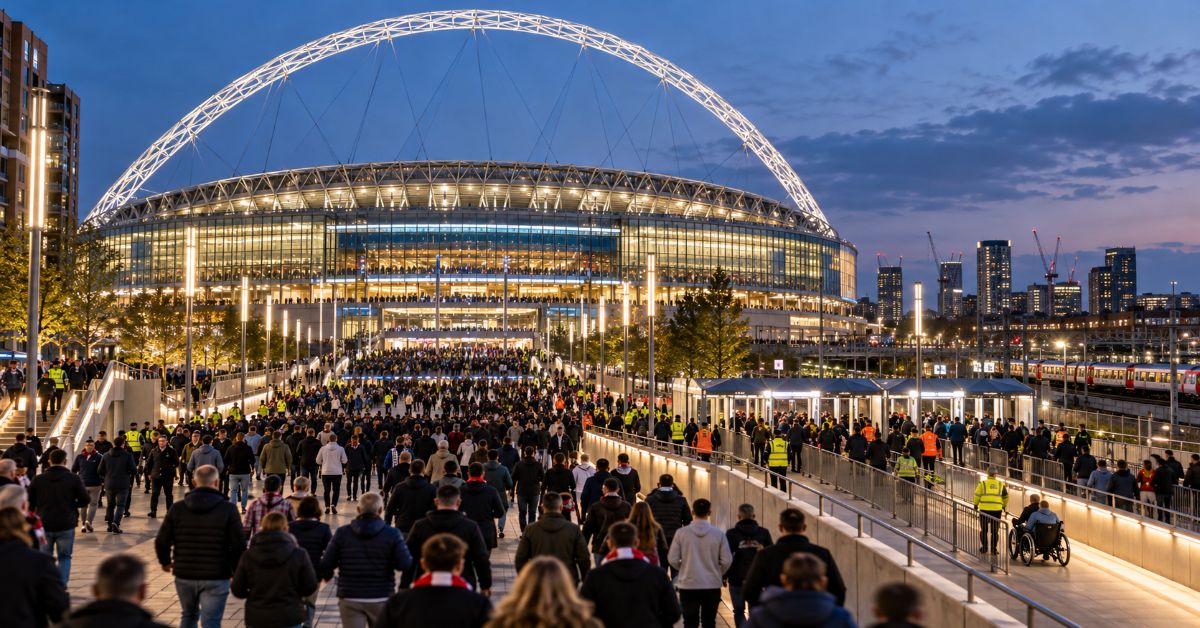
Wembley Stadium holds up to 90,000 spectators, yet its hardest job is not simply fitting them into seats: it is turning the same London site into a football final, a concert venue or an NFL arena without treating those crowds as identical. The famous arch is visible from afar, but the less visible systems—turf care, ticket zoning, accessible routes, screening and rail dispersal—often decide whether the experience feels smooth or exhausting.
A football supporter wants to see the entire pitch and leave after the final whistle. A concertgoer may want a clear stage view, may stand for hours and may encounter an entirely different entrance plan. An NFL attendee faces longer stoppages and an event format unlike an England international. The geometry is shared; the operating problem is not.
That distinction matters because a good stadium guide should help people make decisions. The largest venue in the United Kingdom is impressive on paper, but its size amplifies ordinary mistakes. A bag that fails screening or an incorrectly assumed accessible station route can consume the time saved by a fast train journey. A ticket sold as a desirable seat for football might be poor for a stage built at one end of the field.
This guide examines the engineering and operational choices behind the venue, then translates those choices into concrete planning advice. Stable historical facts come from stadium and tourism records; event policies and transport advice should always be checked again on the relevant date.
The operating facts behind the landmark
The modern stadium reopened in 2007 on the site of the original 1923 ground. It is England’s national football stadium, hosts major domestic finals, and has also staged international American football and large-scale music events. Its location in Brent, northwest London, makes public transport central to the experience.
| Feature | Verified context | Why it changes the visit |
| Capacity | 90,000 seats | Exit flow and travel planning are major considerations |
| Modern stadium | Opened in 2007 | Purpose-built multi-event operation, not a preserved old ground |
| Arch | 133 metres high | Primary engineering component of roof support |
| Nearest rail choices | Wembley Park, Wembley Stadium, Wembley Central | Different networks, approaches and post-event paths |
| Event policies | Event-level ticket, bag and access instructions | General advice never overrides the individual event notice |
The architecture earns its keep
An arch that supports a roof
The arch is structural, not merely decorative. Wembley’s own engineering account says it carries the north side of the roof and a significant part of the southern roof structure. That enables a large, relatively open bowl beneath an enormous span. It is a visual emblem because it first solves an engineering problem.
The roof shelters spectator areas but does not seal the field into an indoor arena. As a result, visitors should distinguish between covered seating and a completely weatherproof journey: open approaches, entrances and some event positions can still be exposed. Wind, rain and the temperature at the end of a late show matter even if the ticket says seated.
Why clear sightlines are not a universal promise
Football geometry is relatively fixed: touchlines, goals and midfield remain in the same places. Concert geometry is different. A stage structure, camera tower or sound-mixing platform can make one seat less attractive than another. The correct question is not “Which Wembley tier is best?” but “Which block is best for this specific event plan?”
Official seat-view tools can aid a choice, but visitors should compare them with the actual organiser’s stage diagram. A rendered sample view does not promise that every temporary structure will be absent.
Inside the conversion: what the audience does not see
Football turf under a concert footprint
A concert needs a working floor: a stage, rigging, cables and, where sold, standing room. Football needs a consistent grass surface. Temporary floor-protection systems are one way major stadiums reconcile those needs; the exact Wembley protection design, permitted loads and turnaround duration vary by production and are not fully disclosed in the public visitor sources reviewed here. Claims that every conversion takes exactly 48 hours or supports a fixed number of floor-standing fans should therefore be treated cautiously.
The turf work is tangible rather than theoretical. In April 2026, The Guardian reported on Wembley grounds staff preparing roughly 7,140 square metres of grass between major football matches. Head of grounds and surface transitions Karl Standley was identified in the reporting, which described a closely managed programme of mowing, irrigation and repairs. That is evidence of the specialist care behind the apparently effortless green surface.
Four event types, four operating priorities
| Event type | Most visible change | The visitor’s best check |
| Football final | Two-team sections, fixed pitch sightlines, concentrated finish | Allocated end and planned departure station |
| Concert | Stage orientation, possible pitch standing, show-specific screening | Seated versus standing ticket and restricted-view wording |
| NFL game | Longer game rhythm and event-specific presentation | Event guide, bag rule and likely finish time |
| Rugby league final | Different competition audience and on-field format | Assigned block, entry gate and competition instructions |
Security screening is the common constraint. Wembley limits ordinary bags to an A4 footprint with a maximum depth of 210 mm, according to the stadium policy updated in February 2026. Some event owners, including the NFL, can apply different rules. Medical exemptions must be arranged in advance. A concert visitor cannot assume that a policy used for a recent football game applies without modification.
For dimensions, exemptions and changing event rules, consult the official Wembley bag-policy guidance before packing.
Getting there is not the same as getting home
Wembley has three practical rail gateways, but a station name alone is not a journey plan. Wembley Park serves the Jubilee and Metropolitan lines; Wembley Stadium station connects with Chiltern Railways towards London Marylebone; Wembley Central offers Bakerloo and London Overground routes. Walking distance, platform access and the route back to the hotel should carry as much weight as the inbound train time.
| Station | Network advantage | Watch-out |
| Wembley Park | Jubilee and Metropolitan connections | Crowds on Olympic Way and event-controlled exit flow |
| Wembley Stadium | Chiltern Railways and Marylebone route | Check event-day train frequency and station access |
| Wembley Central | Bakerloo and Overground alternatives | Longer approach for many fans; step-free train boarding is not guaranteed |
A particularly important distinction concerns step-free access. Wembley’s travel guidance describes access to station platforms but warns that Wembley Central is not step-free from platform to train. Some published Wembley Park lift notices refer to replacement works ending in September 2026; because that date is now past, its current operational status needs a live TfL check rather than repetition of an old notice.
Post-event movement is deliberately slower than an empty-station walk. Queues, crowd-control barriers and one-way pedestrian routes may redirect people. Book homeward connections with margin, especially if travelling with children, using a wheelchair or catching the last train.
Check your arrival and return route against Wembley’s official transport guidance and the operator’s day-of-travel service status.
London offers other similarly named destinations that are unrelated to Wembley. For a separate example of why verifying the exact place and station matters, see Rubble Magazine’s guide to the
different meanings of Seven Sisters, including the London interchange.
A visitor’s decision framework before buying tickets
Choose the view for the event, not the reputation of the block
For football, seats low in the bowl give proximity and atmosphere, while higher positions can show team shape more clearly. Neither is categorically better. For concerts, stage-end orientation changes the trade-off completely: side views may feel close but cut off screens or production elements. Read any restricted-view warning and check the event-specific map.
Accessibility is a journey, not a seat category
The stadium publishes information about wheelchair positions, companion seating, lifts, accessible toilets, sensory services and a shuttle from Wembley Park. However, temporary pitch-level events do not necessarily use the same step-free routes as the main seating tiers. A visitor with access needs should confirm the whole chain: station exit, approach, turnstile, assigned level, facilities and return journey.
One overlooked risk is treating the existence of a lift as proof that it serves every event area. Wembley’s accessible-entry notice explicitly says pitch access for some concerts and boxing events is at level B1 and cannot be reached via lift. An accessible ticketing conversation is therefore more useful before purchase than a generic venue accessibility claim.
Food, payment, weather and personal items
Published 2026 stadium event guidance describes the venue as cashless for kiosks, so a working contactless payment method is a sensible default. Outside food is generally restricted, and permitted water containers can depend on the event and the standing area. Check the actual event notice rather than a social-media packing list.
For weather planning, forecast uncertainty is more useful than a single predicted temperature. A cool evening after several hours standing is different from the conditions at lunchtime. Rubble Magazine’s
guide to interpreting tomorrow’s weather forecast explains why a time-specific outlook needs checking close to departure.
A workable event-day timeline
The following schedule is a planning framework, not an official promise about gate times. Always replace its estimates with those printed on the event ticket.
| When | Practical action | Why it matters |
| Before departure | Check ticket, route, access notice, bag and water rules | Fixes errors before joining a queue |
| Around 3 hours before | Travel towards the area if dining, collecting tickets or buying merchandise | Leaves room for rail disruptions and pre-event crowds |
| About 90 minutes before | Aim to be at the correct entry zone if event gates permit | Creates screening and navigation buffer |
| Event start | Remain in the allocated seating or standing zone | Layouts and movements differ by event |
| Final whistle / encore | Follow steward directions; check live service updates | Managed dispersal may change the obvious route |
The most expensive mistake may be the cheapest one to prevent: finding out at the turnstile that a bag is too large, that the ticket is for a different entry zone, or that the last practical train departs earlier than expected.
The old stadium still shapes the new one
The first ground was built in 1923 for the British Empire Exhibition, although the original national stadium’s official royal opening came in 1924. It hosted the 1948 Olympics, England’s 1966 World Cup final victory, and the 1985 Live Aid concert. Redevelopment removed its Twin Towers and replaced them with the present arch. Heritage therefore survives in the site and collective memories rather than in the original facade.
There is also a physical afterlife. Reports about Northala Fields in west London describe demolition material from the original stadium being used in the park’s artificial hills. Londonist reports a 2005 capsule beneath the modern pitch containing sketches of the arch, a signed England shirt and a fragment of the towers; this is an attributed secondary report, not a detail independently confirmed by Wembley’s current public visitor guidance. These details help show the difference between a building that disappears and a place whose story persists.
The Future of Wembley Stadium in 2027
For 2027, the most credible outlook is not a speculative enlargement or a fully automated stadium. Wembley already faces a harder, ongoing task: fitting more different productions into one calendar while meeting increasingly exacting accessibility, transport and surface-quality expectations. The operational gains are likely to be incremental—clearer ticket information, better event-specific travel messaging, refined access services and improvements to the way temporary installations interact with the pitch.
One verified external milestone is UEFA EURO 2028, for which Wembley is set to host the final. That later event provides a concrete reason for venue operators and transport partners to pay attention to major-tournament readiness in 2027. However, no unpublished 2027 construction timetable, exact project budget or new visitor facility should be asserted as confirmed without a dated stadium or organising-body announcement.
The main strategic trade-off remains unchanged. A national stadium depends on variety: football creates cultural relevance, while concerts and international sport broaden the event portfolio. Every conversion consumes time, labour and surface-recovery capacity. Greater calendar utilisation is valuable only if it does not undermine the next fixture or the visitor’s ability to enter and leave safely.
Key takeaways
- Wembley’s engineering is useful because the arch supports an immense roof, not simply because it makes a skyline photograph.
- Seating quality depends on the event configuration; football and stage layouts require different decisions.
- Pitch conversion is a specialist operational task; public sources do not support universal turnaround-time claims.
- Three useful stations serve the stadium, but a viable homeward connection beats the shortest advertised inward trip.
- Bag dimensions, water rules and some accessible routes depend on official, sometimes event-specific guidance.
- Historical claims about the time capsule and reused old-stadium rubble should be attributed to their reporting sources.
Conclusion
Wembley’s reputation comes from famous occasions, but its real achievement is making very different occasions possible within one enormous physical envelope. The arch, grass surface, concourses, entrances and surrounding railway network all contribute to that task. Their value becomes easiest to see when the event changes: a football final needs a different plan from a concert with pitch standing, and a wheelchair user may need different access details again.
For visitors, the best approach is selective rather than exhaustive. Confirm the ticket’s view, locate the correct gate, check the event’s restrictions, and plan the journey home as carefully as the arrival. Pay particular attention to accessibility and temporary event configurations. Much of the site’s history is settled; its operational instructions can change from one event to the next. That is the distinction a genuinely useful stadium guide needs to preserve.
Frequently asked questions
Is Wembley Stadium the largest stadium in the UK?
Yes. Its 90,000-seat capacity makes it the United Kingdom’s largest stadium by permanent seating capacity. Concert attendance can differ because layouts, production space and standing allocation vary.
Why does Wembley Stadium have an arch?
The 133-metre arch is a structural roof-support element. Wembley’s own engineering description says it carries the north portion of the roof and a substantial element of the southern roof.
Is the entire stadium covered?
No. The roof shelters seating areas, but the playing field and venue are not fully enclosed. Some approaches and event positions remain exposed to the weather.
Can Wembley host concerts without destroying the football pitch?
Major stadium events use staging and pitch-management procedures to reduce damage and manage conversion. The specific protection system and the recovery time vary by event and are not confirmed as one universal process.
Which station is best for Wembley?
Wembley Park, Wembley Stadium and Wembley Central each serve different lines. The best choice depends on your starting point, required step-free access, event management and how you will travel home.
What bag can I take into Wembley?
The venue’s general rule permits one bag no larger than 297 × 210 × 210 mm. Some organisers, including NFL events, can impose different rules. Check your event page and seek medical exemptions in advance.
Is the old Wembley Stadium still there?
No. The original ground and its Twin Towers were demolished as part of redevelopment. The current stadium reopened in 2007 on the same site.
Methodology and limitations
Research reviewed stadium-operated support pages, official transport and accessibility information, Visit London history, engineering statements and selected reporting on surface operations and heritage, accessed 15 October 2026. A sample of prominent search-visible guides was also compared for common topics and missing visitor decisions; search results vary by geography and time, and this is not a certified universal top-ten ranking.
No direct visit, private operational interview, event-conversion timing study or unpublished commercial figures are claimed. The time capsule and rubble-reuse details are attributed secondary reports. Exact gate opening, merchandise arrangements, weather, rail access, and access services can change per event.
Only two closely relevant live Rubble Magazine editorial links were established for this article; unrelated pages were not used to inflate internal-link counts. Internal linking can expand when the publication adds directly relevant London transport, entertainment or sporting-venue coverage.
AI-assisted draft: a human editor must independently verify all figures, links, citations and policies before publishing. Human review has not yet been completed or certified.
References
Wembley Stadium. (2008, October 20). Wembley Stadium wins top awards at the LABC National Built in Quality Awards.
Wembley Stadium. (n.d.). Our story.
Wembley Stadium Support Portal. (2026, February 10). Bag policy.
Wembley Stadium Support Portal. (2026, March 23). Getting here.
Wembley Stadium Support Portal. (2026, March 23). Accessible entry and stadium navigation.
Wembley Stadium. (2026). Disabled services.
Visit London. (n.d.). Wembley Stadium.
The Guardian. (2026, April 27). One weekend, two games and 7,140 sq metres of grass: A week with the Wembley ground staff.
Londonist. (n.d.). The time capsules buried beneath London.