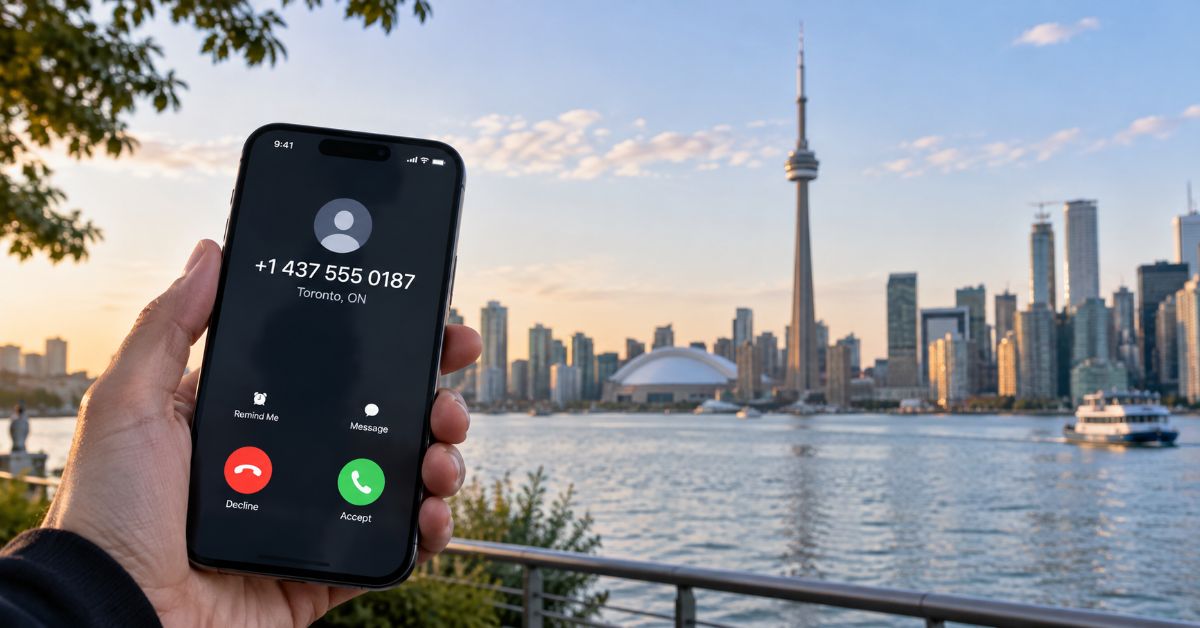
The 437 Area Code is a legitimate Toronto, Ontario telephone code, but the number on your screen is not proof that the person calling is physically in Toronto. I checked the current Canadian numbering and CRTC records because that distinction is where many quick area-code guides become misleading: 437 is local to Toronto’s numbering plan, while caller ID can still be portable, internet-based, or spoofed.
For most readers, the search starts with a practical question. You saw a missed call or text beginning with 437, you need to call a Toronto number, or you are comparing 416, 647, 437, and the newer 942 code. The answer is simpler than the overlay history sounds. All four codes cover the same Toronto service area. A 437 number is not assigned to one special borough, and it is not automatically less local than a 416 number.
The code entered service on March 25, 2013 after regulators determined that the existing 416 and 647 numbering resources needed relief. Toronto later added 942 on April 26, 2025, again as an overlay rather than a geographic split. That design preserves existing numbers, but it also means callers must use all 10 digits for local calls.
I also reviewed the current search results for this keyword before writing. Most ranking pages answer location and time zone well, while several either omit 942, focus heavily on selling virtual numbers, or turn a legitimate area code into a generalized scam warning. This guide takes a narrower evidence standard: I separate what the numbering system tells you from what caller ID cannot verify, then give you the dialing, history, safety, and Ontario comparison details in one place.
Where Is Area Code 437 Used in Toronto?
437 is one of four active area codes in the Metro Toronto numbering complex. The Canadian Numbering Administrator currently identifies the complex as 416/437/647/942, with central-office codes assigned for Toronto. That means the codes overlap rather than divide Toronto into separate territories.
The quickest facts are below.
| Detail | Current answer |
| Country | Canada (+1 country code) |
| Province | Ontario |
| Primary service area | City of Toronto |
| Time zone | Eastern Time, EST in standard time and EDT during daylight saving time |
| 437 in service | March 25, 2013 |
| Current overlay complex | 416 / 647 / 437 / 942 |
| Local dialing | 10 digits required |
| Toll-free status | No. 437 is a geographic area code, not a toll-free code. |
The key point I would keep in mind is that an overlay changes number availability, not neighborhood identity. A person in North York, Scarborough, Etobicoke, York, East York, or downtown Toronto can have any currently available Toronto overlay code depending on carrier inventory and number assignment.
Why Does Toronto Have 416, 647, 437 and 942?
Toronto did not receive four codes because the city was split into four phone regions. It received overlays because a single numbering plan area has a finite supply of assignable central-office codes and subscriber numbers. Overlay relief adds another area code across the same geography without forcing existing customers to change numbers.
The regulatory record is unusually clear. In Telecom Decision CRTC 2011-436, the Commission approved 437 as a distributed overlay of 416 and 647 effective March 25, 2013. More than a decade later, Telecom Decision CRTC 2023-135 approved 942 for the same Toronto complex effective April 26, 2025.
This timeline shows how the Toronto numbering system reached its current form.
| Year | Area-code event | What changed |
| 1947 | 416 assigned | 416 was one of the original North American area codes and initially covered a much larger part of southern Ontario. |
| 2001 | 647 overlay introduced | Toronto kept existing 416 numbers while 647 added new numbering capacity across the same area. |
| 2013 | 437 overlay introduced | 437 entered service on March 25 as additional relief for the 416/647 complex. |
| 2025 | 942 overlay introduced | 942 entered service on April 26 and now shares the Toronto footprint with 416, 647, and 437. |
One useful information-gain point is that the visible area code has become a weaker clue to age, neighborhood, and carrier over time. Overlays, number portability, wireless service, and VoIP all reduce the value of treating the first three digits as a precise identity marker.
What Does a 437 Number Tell You, and What Does It Not Tell You?
A 437 number tells you that the telephone number belongs to the Toronto numbering complex. It does not prove the caller’s current physical location, the owner’s identity, the neighborhood, or even the current service provider.
That distinction matters for three reasons:
- Number portability: people and businesses can keep numbers when changing providers, so old carrier assumptions can become stale.
- Internet calling: VoIP and cloud-phone services can let a user answer a Toronto number while physically located elsewhere.
- Caller ID spoofing: the displayed number can be altered, so an incoming 437 number may not be the true originating number.
I use the same verification principle elsewhere on the site when separating a familiar-looking identity from a verified one. Rubble Magazine’s SoSoActive domain-safety guide makes the broader point that a recognizable label is only a starting signal. For phone calls, the equivalent rule is simple: treat the displayed number as routing information, not identity proof.
How Do You Dial a 437 Toronto Number?
Toronto’s overlay system uses 10-digit local dialing. You should save the full area code and seven-digit number in contacts rather than relying on a seven-digit local format.
| Calling situation | Dialing format | Example pattern |
| Within Toronto or another Canadian location | Area code + seven-digit number | 437-XXX-XXXX |
| From the United States | 1 + area code + seven-digit number | 1-437-XXX-XXXX |
| From a country outside the NANP | International exit code + 1 + area code + number | Exit code + 1-437-XXX-XXXX |
The +1 can also be saved in international format as +1 437 XXX XXXX. This is often the cleanest contact format for mobile phones because Canada and the United States participate in the North American Numbering Plan.
What Time Zone Is Area Code 437 In?
Toronto is in Eastern Time. It uses Eastern Standard Time, UTC-5, during standard time and Eastern Daylight Time, UTC-4, while daylight saving time is in effect. For callers in much of the U.S. East Coast, Toronto is normally on the same clock as New York.
For business calls, I would still check the local date when daylight-saving rules differ in another country. The area code itself does not encode time, but its Toronto service area does give you the relevant local time zone.
Is the 437 Area Code a Scam?
No. The area code itself is legitimate. The safer question is whether a specific call or text is authentic. A real Toronto number can belong to a resident, business, mobile subscriber, VoIP user, or service provider, and a fraudster can also spoof a 437 caller ID.
The CRTC’s current caller ID spoofing guidance explains that callers can alter the displayed identity, including making a call look local. That is why I would not label every unfamiliar 437 message a scam, but I would not trust it simply because the number looks Canadian or local.
The Canadian Anti-Fraud Centre reported more than 112,000 fraud reports and over C$704 million in reported losses in 2025. Those national figures cover many fraud types, but they show why an unexpected request for money or credentials deserves independent verification.
Canada also tightened nuisance-call enforcement in 2026. CRTC Decision 2026-52 made call-traceback participation mandatory for voice providers after their first traceback request, effective June 25, 2026. The process helps investigators trace unwanted calls even when displayed caller ID has been altered.
Former CRTC Chairperson Ian Scott said caller-ID authentication should help Canadians decide which calls deserve trust and which require caution. Authentication adds evidence; the area code alone does not.
How Should You Verify an Unexpected 437 Call or Text?
I would verify the claim, not the prefix. This works for bank alerts, delivery notices, government impersonation, job offers, and wrong-number texts.
- Do not act on urgency. A demand for immediate payment, a password, a one-time code, or personal information is a reason to stop and verify.
- Do not use the contact details supplied in the suspicious message. Open the company’s official app or type its known website address yourself, then use the published phone or support channel.
- Check the exact claim. If the caller says there is a bank hold, delivery problem, tax issue, or account suspension, verify that event independently.
- Avoid unsolicited links and attachments. A local-looking number does not make a link safe.
- Report confirmed or suspected fraud. In Canada, suspected fraud can be reported to local police and the Canadian Anti-Fraud Centre. Unwanted telemarketing can also be addressed through CRTC and National Do Not Call List channels.
If a suspicious text pushes you to a login page, the risk becomes phishing. See the site’s guide to phishing and redirect risks for the link-verification side of the problem.
For identity exposure, the OnlyFans creator protection guide shows why small pieces of accurate data become more useful when correlated across services.
For a broader source-checking method, the Bumpdots.com trust analysis separates public identity signals from claims that remain unverified.
What Are the Other Area Codes in Ontario Outside Toronto?
Ontario has several overlay complexes outside Toronto. The exact boundaries are easier to understand as regional groups than as a flat list of codes.
| Ontario region | Area-code complex | Common examples |
| Southern Ontario around Toronto | 289 / 365 / 742 / 905 | Hamilton, Mississauga, Oshawa and surrounding communities |
| Southwestern Ontario | 226 / 382 / 519 / 548 | London, Windsor, Kitchener-Waterloo and nearby areas |
| Eastern Ontario | 343 / 613 / 753 | Ottawa, Kingston and surrounding eastern communities |
| Central and northern Ontario | 249 / 683 / 705 | Barrie, Sudbury, North Bay and surrounding areas |
| Northwestern Ontario | 807 | Thunder Bay and much of northwestern Ontario |
The practical distinction is that 437 is a Toronto overlay, not a general Ontario code. A caller elsewhere in the province will normally use the area-code complex assigned to that region, although number portability and internet calling can still separate a number’s assignment from a person’s current physical location.
Why Does 437 Still Matter After the 942 Overlay?
942 did not replace 437. It added numbering capacity to the same Toronto complex, while existing 416, 647, and 437 numbers stayed valid.
That leads to three practical insights that many short guides miss.
The area code is now a weak status signal
A 416 number may feel older, but it is not stronger proof that a business is local. A new Toronto company can receive 437 or 942 and still be fully local.
A prefix database is useful, but not a live identity database
Canadian Numbering Administrator records can show which carrier received a number block. Because numbers are portable, that is assignment context, not guaranteed current-subscriber data.
The safest verification path bypasses caller ID
For banks, government offices, delivery companies, employers, or telecom providers, verify through an independently found contact channel. The more sensitive the request, the less weight I give the displayed prefix.
The Future of Toronto’s 437 Code in 2027
I do not expect a geographic change to 437 in 2027 based on the current public record. The more important trend is that Toronto now has four overlays, and 942 is actively receiving assignments.
On fraud, Canada is leaning more on network tools. Mandatory traceback participation took effect in June 2026, while authentication and blocking measures continue to develop. These systems improve evidence about call origin without making every displayed number trustworthy.
For readers, the rule stays simple: use the area code to understand the numbering region, then verify identity independently. As 942 becomes more common, the social distinction between older and newer Toronto overlays should keep fading.
Key Takeaways
- 437 is a Toronto area code that shares one geographic service area with 416, 647, and 942.
- The code entered service on March 25, 2013, while 942 joined the Toronto overlay complex on April 26, 2025.
- A displayed 437 number can be legitimate without proving the caller is physically in Toronto or that the caller ID is authentic.
- Ten-digit dialing is standard for Toronto local calls; callers from the United States normally use 1 + 437 + the seven-digit number.
- A carrier or prefix lookup can provide assignment context, but number portability limits what it proves about a current subscriber.
- For suspicious calls, independent verification through an official website, app, statement, or known number is more reliable than caller ID familiarity.
- The newer 942 overlay expands number capacity; it does not make existing 437 numbers obsolete.
Conclusion
The 437 area code is best understood as one layer of Toronto’s modern phone-number system, not as a separate part of the city and not as a warning label. It entered service in 2013 to add numbering capacity, and it now sits alongside 416, 647, and 942 across the same Toronto footprint. For normal calling, the practical rules are easy: use all 10 digits locally, use +1 or 1 before the number when the calling context requires it, and remember that Toronto operates on Eastern Time.
The more important lesson appears when an unfamiliar call or text arrives. A 437 number can be completely legitimate, but caller ID does not establish who is behind a call. Portability, VoIP, and spoofing all weaken the idea that a familiar area code proves identity or location. I would use 437 as a clue about number assignment, then verify any sensitive request through an independent channel. That approach preserves the useful geographic information in the area code without giving it more trust than the telephone network can actually support.
Frequently Asked Questions
Where is area code 437 located?
It is assigned to Toronto, Ontario, Canada. It overlays the same Toronto service area as 416, 647, and 942, so it does not identify a specific borough or neighborhood inside the city.
When was 942 added to Toronto?
Area code 942 entered service on April 26, 2025 as a distributed overlay for the existing 416/437/647 Toronto complex. Existing numbers were not replaced.
Is a 437 phone number from Canada or the United States?
437 is a Canadian area code for Toronto, Ontario. Canada and the United States both use country code +1 under the North American Numbering Plan, which is why the international prefix alone does not distinguish the two countries.
Can a 437 call be spoofed?
Yes. The CRTC explains that caller ID can be altered to display a local-looking or recognizable number. A 437 display therefore does not prove the true origin or identity of the caller.
How do I call a Toronto 437 number from the United States?
Use 1 + 437 + the seven-digit local number. On a mobile phone, saving it as +1 437 XXX XXXX also works in international format.
What year was the original 416 area code created?
416 dates to 1947 and was one of the original North American area codes. Its geographic coverage was later reduced, and Toronto eventually added overlays rather than replacing existing 416 numbers.
Is 437 the same area as 647?
Yes. In Toronto, 437 and 647 are overlays covering the same geographic numbering area, along with 416 and 942. The area code does not divide the city into separate local calling zones.
Methodology
I researched this article on September 6, 2026 after reviewing 10 prominent current pages for the keyword, including area-code databases, time-zone pages, scam guides, and virtual-number providers. The main gaps were outdated overlay lists, weak sourcing, and claims that a displayed number proves physical origin.
I prioritized primary Canadian sources: CRTC Decision 2011-436 for the 2013 launch of 437, CRTC Decision 2023-135 and Canadian Numbering Administrator records for the 2025 launch of 942, plus current CRTC spoofing and traceback guidance and Canadian Anti-Fraud Centre 2025 fraud data. Carrier records are treated as block-assignment context because numbers are portable.
I audited rubblemagazine.org for live internal links and used four pages only where the sentence concerned identity verification, phishing, correlation risk, or source trust. I found no directly related indexed Toronto area-code article, so internal linking can expand as the site publishes more telecom coverage.
Limitations: number assignment does not prove real-time location, ownership, or current carrier, and fraud statistics do not predict whether one call is fraudulent. AI assistance was used for research organization, drafting, and document production. A human editor must verify statistics, APA references, live links, and first-person wording before publication.
References
- Canadian Anti-Fraud Centre. (2026). Fraud Prevention Month 2026: Top 10 frauds in 2025.
- Canadian Numbering Administrator. (2026). Canadian Numbering Administrator site and current area-code records.
- Canadian Radio-television and Telecommunications Commission. (2011, July 20). Telecom Decision CRTC 2011-436: Area code relief for area codes 416 and 647 in Toronto, Ontario.
- Canadian Radio-television and Telecommunications Commission. (2023, May 10). Telecom Decision CRTC 2023-135: Relief for area code complexes 416/437/647 in Toronto, Ontario and 236/250/604/672/778 in British Columbia.
- Canadian Radio-television and Telecommunications Commission. (2026, March 27). Compliance and Enforcement and Telecom Decision CRTC 2026-52: Mandatory call traceback participation for all providers of voice telecommunications services.
- Canadian Radio-television and Telecommunications Commission. (2023). Caller ID spoofing.
- Canadian Radio-television and Telecommunications Commission. (2021, November 30). Canadians to benefit from new caller ID technology to combat spoofed calls.