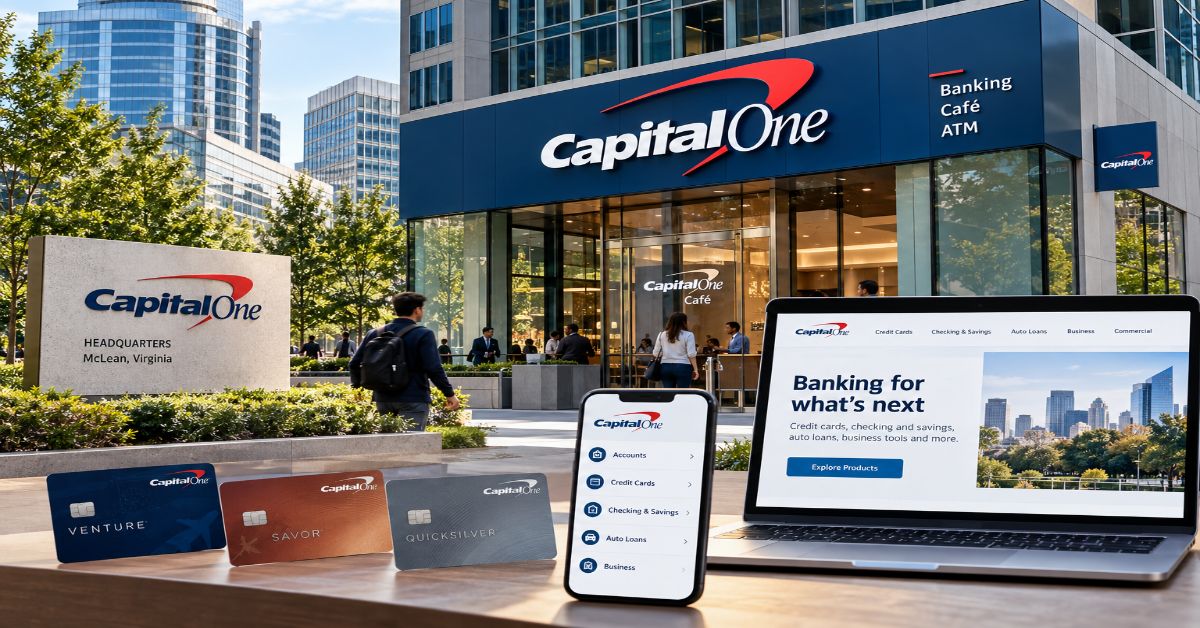
Capital One is a diversified U.S. financial-services company, but calling it simply a credit-card company misses how much its business has changed. The most consequential shift is recent: Capital One completed its acquisition of Discover on May 18, 2025, bringing Discover’s card portfolio, payment networks and banking operations into the combined company. Then, on April 7, 2026, Capital One completed its acquisition of Brex, adding a business-finance platform built around corporate cards, expense management and payments. The result is a company that now sits across consumer cards, deposits, auto finance, commercial banking and business payments.
For a person searching capital one, however, the corporate story is only useful if it explains what changes at the customer level. I reviewed the current Capital One product pages, its 2025 annual reporting, second-quarter 2026 financial results, the Discover transition information, and current independent banking coverage. The practical picture is more nuanced than a simple “online bank” label: Capital One combines digital-first accounts with selected branches and Cafés, a large ATM network, rewards cards, auto financing and business products. At the same time, its physical footprint is narrower than a traditional national branch bank, and product terms vary substantially by account and card.
That distinction matters because the brand now covers several different financial jobs. A savings customer is evaluating yield, access and fees. A credit-card customer may care more about rewards, annual fees, travel benefits and payment-network acceptance. A business owner may be evaluating corporate spend controls rather than personal banking. This guide separates those layers so the name does not do the thinking for you.
What the Current Top 10 Results Commonly Cover
I reviewed ten prominent current results and close-intent pages for the broad Capital One query and related bank-review intent. Because Google results vary by location, device, personalization and time, this is a competitive sample rather than a permanent ranking order.
| SERP angle | Common strength | Opportunity for this article |
| Capital One official pages | Primary product and company facts | Connect the separate product pages into one current 2026 picture |
| Bank reviews | Rates, fees, pros and cons | Explain how the post-Discover structure changes the overall offering |
| Savings-rate pages | Current APYs and account details | Treat rates as dated snapshots rather than permanent facts |
| Company profiles | History and corporate identity | Add the 2025 Discover and 2026 Brex milestones |
| Credit-card coverage | Rewards and card features | Explain issuer vs. payment network and the three networks now used |
| Consumer FAQs | Fast answers | Cover migration, branches, fees, ATM access and product boundaries |
| Comparison content | Alternatives and trade-offs | Separate product fit from broad “best bank” claims |
| Financial news | Acquisitions and earnings | Translate corporate events into customer-level implications |
| Wikipedia/company summaries | Fast orientation | Use dated primary-source figures instead of static summaries |
| Search snippets | Quick definitions | Answer the broad query while giving deeper decision context |
What Is Capital One?
Capital One Financial Corporation is a financial holding company headquartered in McLean, Virginia. Its operating businesses include credit cards, consumer banking and commercial banking, with auto lending and other financial products inside those broader segments. The company says it serves more than 100 million customers and has evolved from a credit-card-focused business into a diversified banking organization.
The company’s history helps explain its current model. Capital One was founded in 1994, after its founders pursued a data-driven approach to credit-card lending. That technology-and-data orientation remains visible in its digital banking, credit decisioning, mobile tools and product personalization.
Today, Capital One is best understood as several businesses under one consumer-facing brand rather than one product. That is why a generic Capital One review can become misleading: a strong savings proposition does not automatically tell you how a particular credit card works, and a business payment product should not be judged by personal-checking criteria.
What Does Capital One Offer in 2026?
The easiest way to understand the current offering is to separate consumer banking, credit cards, lending and business services. Capital One’s own product pages currently emphasize checking, savings, CDs, credit cards, auto financing, business cards and commercial banking.
| Area | Examples | What to evaluate | Important limitation |
| Checking | 360 Checking | Monthly fees, ATM access, cash deposits, digital features | Physical branches are concentrated in selected markets |
| Savings | 360 Performance Savings, Kids Savings | APY, fees, access, transfer convenience | Rates can change and should be checked before opening |
| CDs | Capital One CDs | Term, APY, early-withdrawal rules | Money can be less liquid during the term |
| Credit cards | Cash-back, travel, secured and business cards | Rewards, APR, annual fee, eligibility | Benefits and fees vary by individual card |
| Auto lending | Auto financing through Capital One | APR, loan term, total cost | Loan availability and terms depend on underwriting |
| Commercial banking | Lending, treasury, capital markets | Business size, industry fit, service model | Designed for commercial rather than ordinary personal banking |
| Business payments | Brex products integrated after acquisition | Expense controls, cards, workflow automation | Separate business use case from consumer banking |
How Does Capital One Banking Work?
Capital One combines online banking with a selective physical presence. Its consumer banking lineup includes 360 Checking, 360 Performance Savings and CDs, while Capital One Cafés and branches provide in-person access in certain markets. The company also advertises access to more than 70,000 fee-free ATMs.
The important trade-off is footprint. A customer who primarily banks through a phone or computer may not care that the branch network is concentrated in selected states. Someone who regularly needs a nearby branch should check local availability rather than assume the brand has the same physical coverage as a traditional nationwide branch bank.
Capital One’s checking and savings accounts are also positioned around low-fee banking. Current Capital One materials advertise no monthly fees or minimums for its consumer checking and savings accounts. That does not mean every Capital One product is fee-free: cards, wires, certain services and other products can have separate terms.
What Changed for Capital One Credit Cards After Discover?
The Discover acquisition is the most important structural change for card customers. Capital One completed the transaction on May 18, 2025, and Discover became part of Capital One, N.A. Capital One says Discover accounts and the Discover brand are not disappearing, while the combined company now has access to the Discover, PULSE and Diners Club International networks.
There is another detail that matters when comparing cards: an issuer and a payment network are not the same thing. Capital One is the issuer and lender. The network processes transactions. Capital One now issues cards that can run on Discover, Visa or Mastercard networks. The network logo on an individual card tells you which network handles that card’s transactions.
For a shopper, the practical implication is that “Is Capital One Visa or Mastercard?” is no longer the whole question. A Capital One card can belong to any of the three networks, so acceptance, benefits and network-specific features should be checked for the specific card rather than inferred from the bank name.
What Happens to Discover Customers?
Capital One’s current Discover FAQ says the acquisition became effective May 18, 2025 and that Discover accounts remain part of the customer experience during a phased transition. The company has said customers will be informed in advance when account changes require action.
That phased approach is important because an acquisition does not mean every customer sees an overnight product conversion. Capital One’s public guidance has emphasized that account numbers and features may remain unchanged until a customer receives specific transition information. Customers should therefore rely on notices tied to their own account rather than assume a generic internet checklist applies to everyone.
How Large Is Capital One Now?
Capital One’s second-quarter 2026 results provide a useful snapshot of the combined company. At June 30, 2026, it reported $673.8 billion in total assets, $484.3 billion in total deposits and $457.2 billion in loans held for investment.
| Metric | June 30, 2026 | Why it matters |
| Total assets | $673.8 billion | Shows the scale of the combined financial institution |
| Total deposits | $484.3 billion | Indicates the size of its deposit base |
| Loans held for investment | $457.2 billion | Shows the lending side of the balance sheet |
| Credit-card loans | $275.4 billion | Illustrates how important cards remain to the business |
| Consumer Banking loans | $90.5 billion | Shows the bank is broader than cards alone |
| Commercial Banking loans | $91.3 billion | Shows material business-banking exposure |
Those figures also explain why the Discover transaction matters beyond branding. The combined company is operating at a much larger deposit, lending and payment scale than the pre-acquisition Capital One consumer brand suggested.
Why Did Capital One Buy Brex?
On April 7, 2026, Capital One completed its acquisition of Brex, an AI-oriented business-finance platform focused on corporate cards, expense management and payments. This is a different strategic move from Discover: Discover expanded Capital One’s consumer card and payment-network position, while Brex expands its business-payments and financial-software capabilities.
For ordinary consumers, Brex does not suddenly turn a personal Capital One account into a business-finance platform. The useful takeaway is structural: Capital One is building a broader financial-services ecosystem in which payments, banking, credit and software can sit closer together.
I would not assume every Brex feature is automatically available through every Capital One business account. Integration, product availability and branding can change during post-acquisition work, so business customers should evaluate the exact product documentation offered to them.
What Do Independent Customer-Satisfaction Measures Show?
Independent satisfaction data adds context, but it should not be confused with a universal quality score. J.D. Power’s 2025 U.S. National Banking Satisfaction Study reported Capital One ranking highest in overall customer satisfaction among national banks for the sixth consecutive year. Separately, J.D. Power’s 2025 U.S. Credit Card Satisfaction Study reported Capital One Platinum Mastercard ranking highest in satisfaction among bank credit cards with no rewards or annual fee, with a score of 620.
These findings describe surveyed customer satisfaction within specific study categories and time periods. They do not establish that every Capital One product is the right fit for every customer, nor do they replace checking current rates, fees and terms.
Who Is Capital One Best Suited For?
Rather than assign the brand a blanket verdict, I would match the customer’s job to the product characteristics.
| Use case | How to approach it | Key question |
| Digital-first banking | Strong fit to investigate | You want online account management, low routine fees and broad ATM access. |
| In-person branch banking | Check local availability first | Your decision depends on regular branch visits. |
| Rewards cards | Compare individual cards | The right answer depends on spending patterns, rewards and annual-fee economics. |
| Credit building | Compare eligibility and card terms | Secured or entry-level products may have different costs and limits. |
| Business finance | Evaluate separately | Brex and commercial banking address different business sizes and needs. |
| Long-term savings | Compare current rates | APYs move, so a historical review can become outdated quickly. |
The Trade-Offs That Matter Before Opening an Account
The biggest mistake in broad bank comparisons is treating “no monthly fee” as the entire cost equation. For a checking account, the more relevant questions may be ATM access, cash-deposit options, transfer speed, branch availability and overdraft policies. For savings, the headline APY matters, but so does how quickly the rate can change. For a credit card, APR and annual fee can overwhelm a rewards headline if the balance is carried.
There is also an information-timing problem. Capital One’s product ecosystem is changing because of the Discover and Brex integrations. A page written before May 2025 can still describe Capital One accurately in historical terms while being incomplete for a 2026 reader.
That is why I would use dated primary-source checks for any decision involving rates, fees, eligibility, account migration or product availability. A third-party review is useful for synthesis; the bank’s current disclosures control the actual terms.
For readers comparing banking decisions with broader debt and retirement choices, our guide to the
For readers comparing banking decisions with broader debt and retirement choices, our guide to Fidelity AARP 401(k) warning explains why the cost of accessing long-term savings can differ sharply from the headline amount received.
When evaluating financial brands online, I also use the same source-provenance discipline described in our Bumpdots company research guide: distinguish self-reported claims, directory information and independently verifiable records.
The Future of Capital One in 2027
The clearest 2027 story is integration rather than another simple product launch. Capital One entered 2026 with Discover inside the company and completed the Brex acquisition in April. That creates three connected areas to watch: payment-network integration, consumer-account migration and business-finance software.
The Discover side is likely to remain visible in card products and payment-network infrastructure. Capital One has already stated that it intends to continue offering Discover-branded cards alongside its other consumer cards. The customer-facing challenge is managing multiple legacy systems without creating unnecessary friction.
Brex creates a different test. Capital One is combining a large banking institution with a software-oriented business-payments platform. If integration works as intended, business customers could see tighter connections between cards, expense management, payments and banking. But the exact product roadmap is not something I would invent from the acquisition announcement; no public source reviewed here provides a complete 2027 customer roadmap.
The safer 2027 forecast is therefore about direction, not hype: Capital One is becoming more integrated across banking, cards, payment networks and business finance. The practical result will depend on which products are actually merged, which remain separate and how clearly the company communicates those boundaries.
Key Takeaways
- Capital One in 2026 is a diversified financial-services company, not merely a credit-card issuer.
- The May 2025 Discover acquisition materially changed its card and payment-network footprint.
- Capital One now issues cards on Discover, Visa and Mastercard networks, so the specific card matters more than the bank name.
- Its consumer banking model combines digital access, low routine fees, a large ATM network and a selective physical footprint.
- Its second-quarter 2026 balance sheet shows substantial scale across deposits, credit-card lending, consumer banking and commercial banking.
- The April 2026 Brex acquisition expands the company into business payments and finance software.
- Current rates, fees, eligibility and migration instructions should always be checked against the latest official product terms.
Conclusion
Capital One is easier to understand once the brand is broken into its underlying businesses. Its consumer side still has a strong credit-card identity, but the company now combines cards, deposits, auto lending, commercial banking, payment networks and business-finance technology. The Discover acquisition made that expansion especially visible, while the Brex acquisition added another layer focused on corporate spending and payments.
For a reader, that breadth is both the opportunity and the complication. There are more products and potentially more ways to consolidate financial activity, but a broad brand review cannot tell you whether one particular account or card fits your situation. The useful comparison is always product-specific: current APY, APR, fees, rewards, network, access, eligibility and service model.
I would also treat every current Capital One review as time-sensitive. The company is still integrating major acquisitions, and rates and product terms can change independently of the corporate story. The most reliable decision process is therefore simple: use independent reviews to identify questions, then verify the answers against current Capital One disclosures before opening, switching or borrowing.
Frequently Asked Questions
What is Capital One?
Capital One is a U.S. financial-services company whose businesses include credit cards, consumer banking, auto lending and commercial banking. After its 2025 acquisition of Discover, its payment-network and card operations became broader.
Is Capital One a bank?
Yes. Capital One, N.A. is the company’s principal banking subsidiary. The broader Capital One Financial Corporation is a financial holding company with banking and other financial-services activities.
Did Capital One buy Discover?
Yes. Capital One completed its acquisition of Discover Financial Services on May 18, 2025. Discover remains a brand and payment network within the combined company.
Is Capital One Visa, Mastercard or Discover?
Capital One issues cards on all three networks: Discover, Visa and Mastercard. The network depends on the specific card, so check the logo and card terms rather than assuming one network.
Does Capital One have checking and savings accounts?
Yes. Its consumer banking lineup includes 360 Checking and 360 Performance Savings, along with other deposit products such as CDs. Fees, rates and terms should be checked on the current product page.
Why did Capital One acquire Brex?
Capital One completed the Brex acquisition on April 7, 2026. Brex provides corporate cards, expense management and payment-related software, expanding Capital One’s business-finance capabilities.
Are Capital One rates permanent?
No. Deposit APYs and other pricing can change. Any rate quoted in an article should be treated as a dated snapshot and verified against the current account disclosure before opening an account.
Methodology
I researched this article on September 27, 2026. I reviewed ten prominent current search-result types and pages for the broad “capital one” query and related bank-review intent, including Capital One’s official pages, Bankrate, Forbes Advisor, Finder, Wikipedia, J.D. Power and current financial reporting. Search results vary by country, device, personalization and time, so the competitor sample is a SERP benchmark rather than a permanent universal top ten.
For factual validation, I prioritized Capital One’s official acquisition announcements, Discover transition FAQ, current company and product pages, Capital One’s second-quarter 2026 financial results, the company’s 2025 annual-report materials, and J.D. Power’s published 2025 satisfaction studies. Independent bank-review pages were used primarily to understand search intent and recurring reader questions rather than as the controlling source for account terms.
AI assistance was used for research organization, drafting and document production. A human editor should verify every statistic, named claim, APA reference, live internal link, current product term and first-person statement before publication.
References
Bankrate. (2026, February 17). Capital One Bank review 2025.
Capital One. (2025, May 18). Capital One completes acquisition of Discover.
Capital One. (2026, April 7). Capital One completes acquisition of Brex.
Capital One. (2026). Discover Financial Services FAQs.
Capital One Financial Corporation. (2026). Annual reports & proxy.
Capital One. (2026). About Capital One.
Capital One. (2026). Capital One credit card rewards and benefits.
Capital One. (2026). Are Capital One cards Visa, Mastercard or Discover?
Finder. (2026, August 27). Capital One review: Checking, savings and CDs.
Forbes Advisor. (2026). Capital One 360 Bank review.
J.D. Power. (2025). 2025 U.S. National Banking Satisfaction Study.
J.D. Power. (2025). 2025 U.S. Credit Card Satisfaction Study.
Rubble Magazine. (2026, September 21). Fidelity AARP 401k warning: What the math really means.
Rubble Magazine. (2026, September 4). Bumpdots.com: What it is, who runs it and what it covers.