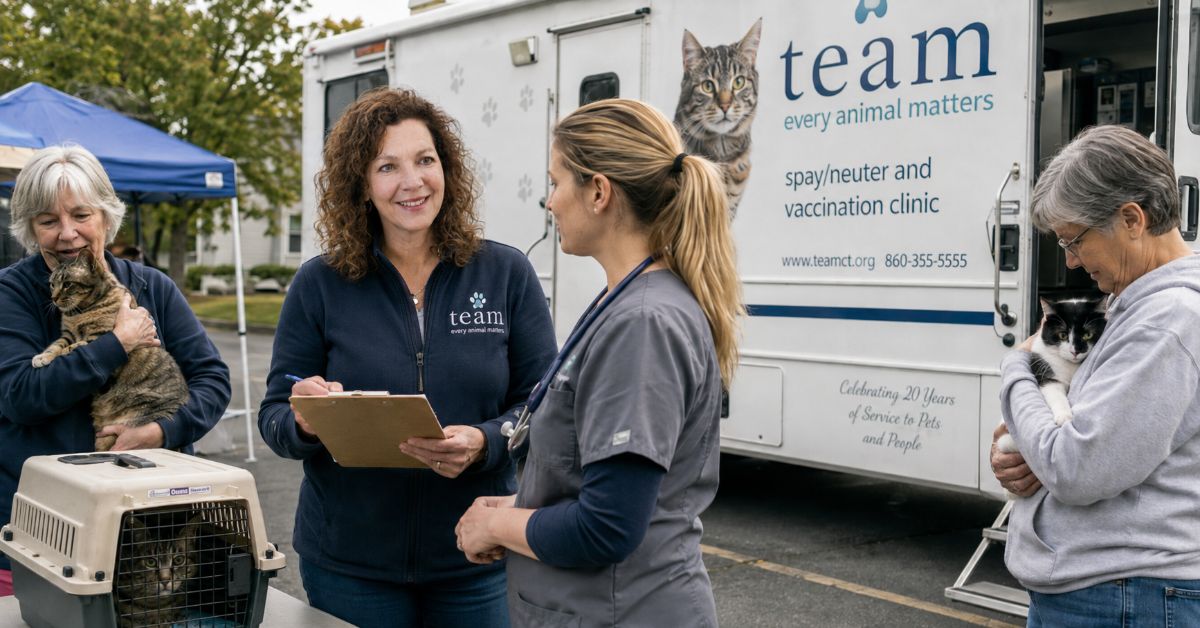
Donna Sicuranza is the long-serving Executive Director associated with Tait’s Every Animal Matters (TEAM), the Westbrook, Connecticut nonprofit behind a mobile feline spay/neuter and vaccination clinic that now reports more than 225,000 cats served since 1997. I found that number striking because the strongest story here is not celebrity, but operational endurance: a clinic that treated 10 cats on its first day has stayed focused on preventive feline care for nearly three decades (Tait’s Every Animal Matters, n.d.-a).
For readers searching the name, the most reliable public record is professional rather than personal. TEAM’s current staff page lists Sicuranza Marconi as Executive Director, while the organization’s historical materials and Connecticut reporting identify Sicuranza in the same leadership context. I found no reason to turn that record into speculation about age, wealth, family life, or other private details that the authoritative sources do not establish.
The more useful question is what her career shows about nonprofit animal welfare. TEAM’s model takes a narrow service – feline sterilization, vaccination, and related preventive care – and makes it mobile, lower cost, and available to domestic and feral cats across Connecticut. That matters because access barriers are still real. A 2024 veterinary-access study found that 28.4% of surveyed pet owners in a representative Colorado sample had unsuccessfully tried to obtain veterinary care in the previous two years, with appointment availability and affordability among the leading barriers. The study is not Connecticut-specific, but it helps explain why access-oriented models remain relevant (Niemiec et al., 2024).
In this profile, I separate what can be verified from what cannot. I also look at TEAM’s service history, the trade-offs of a mobile clinic, national shelter trends, and what a realistic 2027 outlook can say without pretending that TEAM has announced plans it has not made public.
Who Is Donna Sicuranza in the Verified Public Record?
TEAM’s current staff page names Donna Sicuranza Marconi as Executive Director and separately lists medical and veterinary staff. That role separation matters: Sicuranza is publicly identified as the nonprofit executive, while clinical work is assigned to veterinary professionals (Tait’s Every Animal Matters, n.d.-b).
TEAM says mobile-clinic planning began in 1996 under John A. Caltabiano, DVM, and Executive Director Sicuranza. The clinic launched on March 1, 1997. Connecticut reporting quoted Sicuranza in 2001, and Patch identified her as executive director in 2021 (Tait’s Every Animal Matters, 2021; Christie, 2001; Patch, 2021).
The supplied profile lists earlier writing, editing, and public relations work, plus English studies at Fairfield University and Trinity College-Hartford. I did not find primary university records confirming every degree date, so I treat the education details as profile-supplied information.
This timeline separates strongly verified milestones from profile-supplied background.
| Period | Verified or supplied record | What it shows |
| 1983-1997 | Professional profile supplied with the brief lists freelance writing, editing, and public relations work. | A communications background preceded nonprofit leadership. |
| 1996 | TEAM says mobile-clinic planning began under John A. Caltabiano, DVM, and Executive Director Sicuranza. | Her leadership is documented before the clinic launch. |
| March 1, 1997 | TEAM says the first mobile clinic treated and vaccinated 10 cats. | The program started small and focused on delivery. |
| 2001 | Connecticut reporting quoted Sicuranza on TEAM operations and reported more than 40,000 cats sterilized since launch. | Independent historical reporting confirms an established public role. |
| 2021 | Patch identified Sicuranza as program executive director and reported more than 200,000 cats served. | The leadership role continued more than two decades after launch. |
| 2026 | TEAM lists Sicuranza Marconi as Executive Director and reports more than 225,000 cats sterilized and vaccinated since 1997. | The current official record shows continued executive leadership and program continuity. |
What Did Donna Sicuranza Help Build at TEAM?
TEAM’s own history explains the problem its founders were trying to solve. Before low-cost sterilization programs were common, the organization says pet owners with limited resources and people caring for homeless cats had few affordable options. In 1996, TEAM began planning a mobile clinic with a single operational idea: bring the service closer to the people and cats who needed it.
The official TEAM history says the first unit treated 10 cats on March 1, 1997. Six months later, the organization reported 5,000 surgeries, and by the first anniversary it reported 8,000. Those are organizational figures rather than audited public-health outcomes, but they document fast early adoption of the service model (Tait’s Every Animal Matters, 2021).
What I find most important is the discipline of the model. TEAM did not try to become every kind of veterinary provider. Its core offering centers on feline spay/neuter, vaccination, brief examination, and related preventive services. A narrow mission can align staff, equipment, routing, scheduling, fundraising, and public messaging around one recurring need.
Sicuranza also drew a clear boundary around the service in a 2021 Patch interview. She said TEAM was not trying to replace traditional veterinary hospitals and encouraged owners to use them for everyday needs. That distinction is critical: mobile preventive care can reduce one access barrier without becoming a substitute for diagnostics, emergency medicine, chronic-disease management, or long-term primary care.
“We want to keep the fees low, even with the volume we do.” – Sicuranza, Patch, 2021
Why Does TEAM’s Mobile Clinic Model Matter?
A mobile clinic changes the delivery channel. Licensed veterinary professionals still perform surgery and vaccination, but the unit travels to communities instead of requiring every client to reach a permanent hospital. That can reduce practical barriers for price-sensitive owners and community-cat caretakers.
Access research gives this model wider context. In a 2024 peer-reviewed study of veterinary access and workforce challenges, 28.4% of 919 pet owners in a representative Colorado online sample reported a time in the previous two years when they tried but failed to get veterinary care. Among those respondents, unavailable nearby appointments, clinic hours, and affordability were major barriers. The geography differs from Connecticut, so I use the study as evidence of the access problem, not as a local estimate.
The service difference is easiest to understand side by side.
| Dimension | TEAM mobile clinic | Traditional full-service veterinary hospital |
| Primary purpose | Focused feline sterilization, vaccination, and related preventive services. | Broad preventive, diagnostic, medical, surgical, dental, and emergency care depending on practice. |
| Location model | Travels to multiple Connecticut communities. | Usually operates from a fixed clinic or hospital. |
| Target access problem | Affordability and practical access to routine feline sterilization and vaccination. | Continuity of care across a pet’s broader health needs. |
| Best use | Planned spay/neuter, vaccines, and limited related services for eligible cats. | Illness, injury, diagnostics, chronic care, complex surgery, and ongoing primary care. |
| Key trade-off | High focus and mobility, but narrower clinical scope. | Broader scope and continuity, but cost and appointment access can be barriers for some owners. |
The trade-off is the design. TEAM positions the clinic as a focused spay/neuter and vaccination service while directing broader health needs to conventional veterinary care.
What Do TEAM’s Numbers Reveal – and What Do They Not?
TEAM’s lifetime service count is the strongest measurable public indicator of scale. The organization currently reports more than 225,000 cats sterilized and vaccinated since 1997. In May 2021, its own history page reported more than 206,000, while Patch reported more than 200,000 that year. Simple subtraction from the official 2021 figure to the current 225,000-plus figure indicates at least 19,000 additional cats served after that milestone.
Across roughly 29 years, 225,000 cats produces a simple lifetime average of about 7,600 per year. That is not TEAM’s reported annual volume because demand and operations varied. It is only a scale check showing the program was not a short campaign.
The public record shows a long service curve rather than a single headline number.
| Public checkpoint | Reported cumulative cats served | Interpretation |
| March 1997 | 10 on the first day | Proof of concept began at very small scale. |
| July 2001 | More than 40,000 | Historical news reporting showed rapid early volume. |
| May 2021 | More than 206,000 on TEAM’s history page | The model had sustained operations for about 24 years. |
| Current TEAM site | More than 225,000 | The program continues to add volume beyond the 2021 milestone. |
The numbers also have limits. A cumulative count does not reveal geographic coverage, client income, unique households, complication rates, wait times, or litters prevented. It cannot prove TEAM caused a statewide population change. That would require longitudinal, year-by-year outcome data.
What Leadership Lessons Stand Out From Sicuranza’s Career?
I see four practical leadership lessons in the verified record.
- Keep the mission narrow enough to operate. TEAM centers on a specific upstream problem – feline reproduction and preventive care access – instead of expanding into every animal-welfare service.
- Make distribution part of the solution. The clinic’s mobility addresses where care happens, not only what care costs. That matters when transportation, work schedules, and colony management create friction.
- Use communication as operating infrastructure. Sicuranza’s supplied professional background in writing, editing, and public relations fits the practical needs of a nonprofit that depends on education, scheduling, donor trust, media relationships, and community awareness.
- Preserve role clarity. TEAM’s current staff page distinguishes executive leadership from veterinary leadership. That is an important governance and trust signal in a medical-service nonprofit.
What are the risks and trade-offs of this model?
The model carries four clear risks: donation dependence, finite surgical and route capacity, a deliberately narrow clinical scope, and limited public outcome reporting. Lifetime procedure counts are useful, but annual volume, locations, wait times, and outcomes would make impact easier to evaluate.
Those trade-offs define the operating questions: where to schedule stops, how to preserve affordable fees, how donor funding fills the gap, and how clients transition to full-service care when needed.
How Does Sicuranza’s Work Fit Today’s Animal-Welfare Data?
National shelter data shows why upstream sterilization still matters. Shelter Animals Count’s 2025 Annual Data Report estimates that 3 million cats entered U.S. shelters and rescues in 2025, while 2.2 million cats were adopted. The same report estimates 277,000 cats were euthanized that year. These are national estimates, not Connecticut figures, but they show that shelter capacity remains a large system-level issue (Shelter Animals Count, 2026).
The sterilization trend is more directly relevant. Shelter Animals Count’s 2025 Altered Status Data Report analyzed more than 2.2 million cats and dogs from 262 organizations in 47 states. It found that the share of cats arriving at shelters already spayed or neutered fell from 27.9% in 2019 to 22.0% in 2023. Prealtered cats also moved through shelters faster, with an average stay 11 days shorter than cats that still needed sterilization.
That data does not prove a direct causal line from TEAM to statewide shelter outcomes, and I would not claim one. It does show that the problem TEAM chose in the 1990s remains structurally relevant: when fewer cats arrive already altered, shelters inherit more surgical demand, more cost, and potentially longer stays. Preventive access in the community can therefore be understood as one upstream pressure-release mechanism within a much larger animal-welfare system.
The Future of Sicuranza and TEAM in 2027
I found no verified public 2027 roadmap from Sicuranza or TEAM, so this forecast focuses on sector pressures rather than unannounced promises: demand for affordable sterilization, workforce constraints, and stronger impact measurement.
First, the sterilization gap is moving in the wrong direction nationally. Shelter Animals Count’s altered-status analysis shows a decline in the share of cats arriving already spayed or neutered between 2019 and 2023. If that pattern persists, mobile and low-cost programs will remain relevant as part of a broader capacity strategy. Second, access research shows that appointment scarcity and cost often stack together. A mobile nonprofit can reduce some of that friction, but only if it can recruit veterinary staff, maintain vehicles, manage scheduling, and finance subsidized fees.
By 2027, data quality may matter as much as cumulative counts. Clear annual metrics on service locations, volume, wait times, and client access could strengthen fundraising and partnership decisions without changing TEAM’s mission.
The realistic future is evolutionary: preserve a proven delivery model while improving capacity, measurement, and coordination with the wider veterinary-care system.
Key Takeaways
- Sicuranza is publicly documented as a long-term executive leader at Tait’s Every Animal Matters, with current TEAM materials listing her as Executive Director.
- TEAM says its mobile feline clinic began on March 1, 1997 with 10 cats and now reports more than 225,000 cats sterilized and vaccinated.
- The clinic’s value comes from focused access: it brings feline spay/neuter and vaccination services into Connecticut communities while explicitly not replacing full-service veterinary hospitals.
- A simple lifetime average is about 7,600 cats served per year, but that calculation should not be confused with a reported annual volume because demand and operations changed over time.
- National data keeps the mission relevant: only 22.0% of cats in Shelter Animals Count’s 2023 intake dataset arrived already altered, down from 27.9% in 2019.
- The biggest unanswered questions are operational rather than biographical: annual capacity, wait times, geographic reach, funding mix, and measurable downstream outcomes.
Conclusion
Sicuranza’s public record is most persuasive when it stays grounded in work rather than mythology. She is tied to a Connecticut nonprofit that chose one practical problem, built a mobile delivery model around it, and kept that model operating long enough to report more than 225,000 cats sterilized and vaccinated. I find the continuity more informative than any unsupported personal detail because it shows what nonprofit leadership looks like when the mission depends on scheduling, fundraising, public education, veterinary staffing, and repeated service delivery year after year.
The record also deserves careful limits. TEAM’s cumulative count is substantial, but it is not a population-level evaluation of Connecticut’s cat overpopulation problem. National shelter data supports the continuing need for accessible sterilization, yet it cannot be used to assign statewide outcomes to one organization. The balanced reading is simpler: Sicuranza helped sustain a focused access model that still addresses a real animal-welfare pressure. Its next chapter will depend on capacity, data transparency, funding, and coordination with full-service veterinary care, not on hype.
Frequently Asked Questions
Who is Donna Sicuranza?
She is a Connecticut nonprofit executive associated with Tait’s Every Animal Matters, or TEAM. Current TEAM materials list Sicuranza Marconi as Executive Director, while historical sources identify Sicuranza in the same leadership context.
Is Sicuranza the Executive Director of Tait’s Every Animal Matters?
Yes. TEAM’s current staff page lists Sicuranza Marconi as Executive Director, and historical TEAM material identifies her as executive director during mobile-clinic planning in 1996.
What is Tait’s Every Animal Matters?
Tait’s Every Animal Matters is a Westbrook, Connecticut nonprofit commonly known as TEAM. Its best-known program is a mobile feline spay/neuter and vaccination clinic that travels to communities across the state and serves domestic and feral cats.
Is Sicuranza a veterinarian?
The public sources reviewed identify Sicuranza as an executive director and communications professional, not as a veterinarian. TEAM separately lists Art Heller, DVM, as Medical Director and identifies veterinary technicians on its staff page.
How many cats has TEAM helped?
TEAM states that its veterinarians have sterilized and vaccinated more than 225,000 cats since 1997. The cumulative figure is not a direct measure of prevented litters or statewide population change.
What is known about Sicuranza’s education and earlier career?
The supplied professional profile lists writing, editing, public relations, and English studies at Fairfield University and Trinity College-Hartford. I did not find primary university records confirming every degree date, so the education details remain profile-supplied information.
Methodology
I built this profile from the supplied professional brief, TEAM’s current pages, historical Connecticut reporting, a 2021 Patch interview, Shelter Animals Count datasets, and a 2024 peer-reviewed veterinary-access study. I prioritized primary or first-party records for biographical claims.
The supplied profile includes an earlier communications career and education details that I could not fully verify through primary university records. I label those details accordingly and exclude unsupported claims about age, net worth, or private family matters.
IThe national datasets provide context, not a direct evaluation of TEAM. Shelter Animals Count figures are national estimates, and the access study is Colorado-based. The 2027 discussion is sector analysis, not an announced TEAM roadmap.
AI assistance was used for research organization and drafting. A human editor should verify statistics, references, links, first-person authority signals, and final publication wording before the article goes live.
References
Patch. (2021, April 16). TEAM Mobile Cat Veterinary Unit still making the rounds in CT.
Christie, J. (2001, July 20). Feline unit offers alternatives. The Middletown Press.
Shelter Animals Count. (2026). 2025 Annual Data Report.
Tait’s Every Animal Matters. (n.d.-a). About us. Retrieved September 2, 2026.
Tait’s Every Animal Matters. (n.d.-b). Meet the team. Retrieved September 2, 2026.