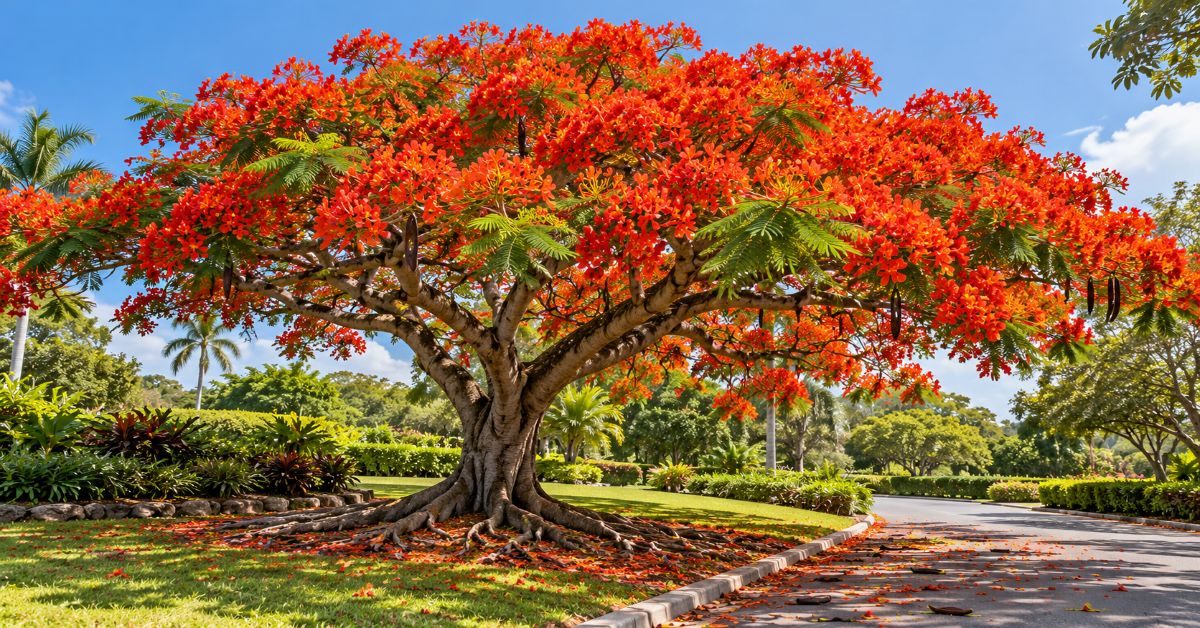
The Gulmohar Tree is one of the most visually dramatic shade trees a warm climate can support, but the same architecture that creates its famous red-orange canopy can become a long-term maintenance problem when the tree is squeezed into the wrong site. Royal Botanic Gardens, Kew identifies Delonix regia as a species native to northern and western Madagascar and specifically cautions that its wide-spreading roots can affect paving, drains and nearby foundations, while its branches can be brittle.
That trade-off is the useful starting point for anyone searching this keyword. Gulmohar is not difficult in the usual sense. In a hot, sunny, well-drained location it can grow vigorously with relatively straightforward care. The harder decision comes earlier: whether the chosen planting position can tolerate a broad crown, surface-root pressure, seasonal leaf and pod drop, and a tree that benefits from formative pruning.
This guide therefore goes beyond the standard “sun-water-soil” checklist. It covers identification, growth habit, flowering, propagation, pruning, climate limits, common problems, planting-distance logic and the real-world situations in which gulmohar is either a strong landscape choice or a future conflict with paving and structures. That site-fit lens is the main information gap across many current ranking pages, which tend to treat planting location as one tip among many rather than the decision that controls almost everything that follows.
Delonix regia at a Glance
Gulmohar belongs to the bean family Fabaceae. Its accepted botanical name is Delonix regia, while common names include flame tree, flamboyant and royal poinciana. Indian botanical resources commonly describe it as a medium-sized, deciduous or seasonally deciduous tree with a spreading crown, bipinnate leaves and large, showy red to orange-red flowers.
| Feature | What to expect | Why it matters |
| Botanical name | Delonix regia | Confirms the species behind common names such as gulmohar and royal poinciana. |
| Native range | Northern and western Madagascar | It is widely cultivated elsewhere, but it is not native to South Asia. |
| Typical form | Broad, spreading, often umbrella-shaped crown | Requires more horizontal room than its trunk size initially suggests. |
| Flowers | Scarlet to orange-red, with a contrasting upper petal | Peak display is the main ornamental reason people plant it. |
| Leaves | Fine, fern-like, bipinnate foliage | Creates light, filtered shade rather than a dense evergreen screen. |
| Pods | Long, flat, woody seed pods | Persistent pods add litter and cleanup around paths and lawns. |
| Climate | Warm tropical to subtropical conditions | Young trees are frost-sensitive and poor fits for cold-winter sites. |
Why the Tree’s Shape Matters More Than Its Care Routine
A small nursery plant can hide the scale of the adult tree. Mature gulmohar develops a low, spreading framework that can be wider than many urban planting strips. The result is excellent shade in the right setting and repeated pruning pressure in the wrong one.
The canopy is a feature, not a compact habit
The canopy naturally wants to spread. That makes gulmohar especially effective as a specimen in a large lawn, campus, park or broad roadside verge. It is much less compatible with narrow setbacks, overhead wires or spaces where branches must constantly be cut back to stay clear of buildings. Repeated severe pruning can create weak regrowth instead of solving the underlying space conflict.
Roots and branches create the expensive risks
Kew’s species profile is unusually direct on this point: roots can interfere with nearby hard surfaces and drainage infrastructure, and branches can be brittle. Those are not reasons to reject the species everywhere. They are reasons to treat distance from buildings, paved areas, parked cars and pedestrian targets as a design decision rather than an afterthought.
From Madagascar to South Asian Summer Streets
Gulmohar’s familiarity in India, Pakistan and other warm regions can make it feel native, but its botanical origin is Madagascar. Kew records the species as native to northern and western Madagascar, while Indian herbarium resources describe it as widely planted along roads and avenues. The Indian Express has also documented how thoroughly the tree has become associated with the early-summer streetscape despite that non-native origin.
That distinction matters for two reasons. First, a culturally familiar tree and an ecologically native tree are not the same thing. Second, planting policy increasingly pays attention to species diversity, invasive potential and local habitat value, so municipal guidance should take priority over nostalgia or appearance. In South Florida, for example, UF/IFAS currently treats royal poinciana with caution in its assessment of non-native plants in natural areas.
The Growing Conditions That Actually Control Performance
Full sun and drainage do most of the work
Strong flowering requires a genuinely sunny site. Six or more hours of direct sun is a sensible minimum, but an open position is better than one shaded for much of the day by buildings or taller trees. Soil can be moderately fertile rather than rich, provided excess water drains away. Consistently saturated ground is a poor match for a species adapted to seasonally dry tropical conditions.
Young trees need regular moisture while their root system establishes. Once established, gulmohar can tolerate dry periods better, but drought tolerance should not be confused with zero-water establishment. Deep, less frequent watering generally produces a more resilient tree than repeatedly wetting only the surface.
Heat is usually easier than cold
Warm summers support active growth and flowering. Frost is the more serious climatic limit. Young plants are particularly vulnerable, and even mature trees can be damaged in colder sites. Where winters regularly bring freezing temperatures, gulmohar is better treated as a container or conservatory subject than as a dependable landscape tree.
How to Grow Gulmohar From Seed
Seed propagation is inexpensive, but the seed coat is hard and naturally slows water entry. That is why so many growers use scarification before sowing.
Step 1: Break seed dormancy safely
- Select fully mature seeds from dry, brown pods.
- Lightly nick or abrade one small area of the seed coat without cutting into the embryo.
- Soak the treated seed in warm water for roughly 12 to 24 hours.
- Sow in a free-draining seed mix and keep it warm, bright and evenly moist rather than saturated.
Step 2: Transplant before the roots become pot-bound
Move seedlings up gradually, then transplant to the final site while the root system is still manageable. A tree kept too long in a small container can develop circling or distorted roots. The final planting hole should not be enriched like a flower pot; good backfill, proper grade and drainage matter more than a pocket of rich compost that discourages roots from expanding outward.
Care After Planting: Build Structure Before Chasing Flowers
Watering and mulch
During establishment, water deeply enough to moisten the developing root zone and then allow some drying before the next irrigation. Apply organic mulch over the root zone to moderate heat and evaporation, but keep mulch pulled back from the trunk flare. A constantly wet trunk base invites problems that mulch is supposed to prevent.
Pruning is a structural job
The most valuable pruning happens while the tree is young. Select a stable framework, remove crossing or damaged branches, and avoid allowing several tight, competing stems to dominate the same point. Mature trees should be pruned conservatively; large indiscriminate cuts can stimulate weak shoots and destroy the natural crown.
Feeding should solve a problem, not create one
Gulmohar usually does not need aggressive fertilization in ordinary soil. Excess nitrogen can push leafy growth at the expense of compact structure and flowering. A soil test or visible deficiency is a stronger reason to fertilize than a calendar. Compost and mulch can support soil condition without turning feeding into the central care task.
Where Gulmohar Fits—and Where It Usually Does Not
The best planting decision is easier when the site is judged by future canopy and root conflict rather than by the size of the sapling today.
| Site | Fit | Main advantage | Main concern |
| Large lawn or estate | Strong | Room for full crown and seasonal display | Leaf, flower and pod cleanup |
| Campus or park | Strong | Shade, visibility and landmark value | Needs planned pruning and target clearance |
| Wide roadside verge | Conditional | Excellent avenue effect | Utilities, pavement and branch clearance must be designed in |
| Small urban courtyard | Weak | Fast shade | Crown and roots quickly exceed available space |
| Beside driveway or paving | Weak | Convenient shade | Root pressure, falling pods and branch targets |
| Directly beside a house | Poor | Immediate visual impact | Foundation, roof, drainage and pruning conflict |
Flowering, Shade and the Seasonal Trade-Off
In South Asian conditions, gulmohar is strongly associated with late spring and early summer flowering. The CSIR-NEERI biodiversity portal records flowering beginning around late April and ending by June in its Indian context. Individual flowers are large and conspicuous, and the crown can appear almost flame-colored when bloom density is high.
The foliage provides filtered shade rather than the heavy darkness of a dense evergreen. That can be useful in parks and large gardens, where dappled light and seasonal color are desirable. For readers interested in why access to parks and tree-lined spaces can matter beyond aesthetics, Rubble Magazine’s guide to relaxation and nature exposure provides broader context. The important landscape caveat is that ornamental value does not cancel maintenance: petals, fine leaves and long pods all fall.
Common Problems and What They Usually Mean
| Symptom or issue | Likely cause | Practical response |
| Few flowers | Too much shade, young age, or overly lush nitrogen-driven growth | Increase sun exposure where possible; avoid unnecessary high-nitrogen feeding. |
| Yellowing with wet soil | Poor drainage or overwatering | Reduce irrigation and correct standing-water conditions. |
| Branch splitting | Weak unions, heavy lateral growth or storm load | Use early structural pruning; have large mature defects assessed professionally. |
| Paving lifts near trunk | Expanding surface roots | Do not sever major roots casually; redesign hardscape or consult an arborist. |
| Cold damage | Frost or prolonged low temperature | Protect young trees and avoid exposed cold sites. |
| Heavy litter | Normal leaf, flower and pod drop | Place away from pools, narrow drains and high-cleanliness surfaces. |
Uses and “Benefits”: Separate Landscape Value From Medical Claims
Gulmohar has documented ornamental, shade and environmental uses in botanical databases, and different plant parts have histories of traditional use. That does not make the tree a proven home medicine. Search results often mix laboratory studies, traditional practice and consumer health advice into one “benefits” list. Those evidence levels are not interchangeable.
For a general reader, the defensible benefits are concrete: canopy shade, visual identity, avenue planting and habitat interactions such as flowers visited by insects. Any medicinal use should be evaluated separately with qualified clinical guidance, because a botanical history of use is not the same as established safety, dosage or treatment efficacy.
The Future of Delonix regia Planting in 2027
The likely 2027 shift is not a new way to grow gulmohar; it is stricter site selection. Urban planting programs are increasingly judged by infrastructure conflict, storm resilience, species diversity and ecological fit rather than by flower color alone. That pressure favors a “right tree, right place” approach: keep gulmohar where its broad crown can function normally, and choose smaller or more locally appropriate species where space is constrained.
Regional invasive-species screening will also matter more. UF/IFAS currently places royal poinciana in a caution category for South Florida natural areas, which shows why a species can be a valued ornamental and still require local ecological judgment. That status should not be generalized to every country, but it is a useful model for decision-making: check the local authority rather than assuming global cultivation means universal suitability.
A second trend is maintenance realism. Cities and homeowners are under pressure to reduce avoidable pruning, pavement repair and storm damage. Trees that are forced into undersized spaces become expensive. Gulmohar’s future is therefore strongest in generous, intentionally designed sites where the crown can spread and the tree can be trained early instead of repeatedly corrected later.
Key Takeaways
- The gulmohar tree is Delonix regia, a Madagascar-native species now widely cultivated across warm regions.
- Full sun, warmth and fast drainage matter more than complicated fertilizer routines.
- The adult crown is broad, and roots can conflict with paving, drains and nearby structures.
- Young-tree pruning is preventive maintenance; waiting for weak branch unions to become large is costlier.
- Seed scarification improves water entry through the hard coat and usually speeds germination.
- The species suits large open landscapes far better than tight courtyards or narrow sidewalks.
- Local ecological and municipal guidance should override generic internet advice, especially where the tree is assessed as non-native or potentially invasive.
Conclusion
The gulmohar tree earns its popularity. Few warm-climate trees combine such fine foliage, broad shade and a summer crown of red-orange flowers. But its beauty can distract from the planning question that matters most: does the site have enough room for the tree it will become?
In open ground with strong sun, drainage and adequate clearance, Delonix regia can be a commanding specimen and a memorable avenue tree. In a narrow yard beside hardscape, drains, walls or roofs, the same growth habit can turn into years of pruning and repair. Good care cannot fully compensate for poor placement.
The practical rule is simple: choose the site for the mature crown and root zone, not for the sapling. If that future footprint works, establishment is straightforward. If it does not, the better decision is usually to choose a smaller tree rather than force gulmohar into a space that will never fit it.
Frequently Asked Questions
How fast does gulmohar grow?
Growth can be rapid in warm, sunny conditions, especially while young, but exact annual growth depends on climate, soil, irrigation and pruning. Fast early growth is one reason structural training should start before branches become large.
When does gulmohar flower?
In much of South Asia, the main display is associated with late spring and early summer. CSIR-NEERI records flowering from late April through June in its Indian reference material, although timing shifts with local climate.
Can gulmohar grow in a pot?
A seedling or young plant can be raised in a container temporarily, but this is a large spreading tree rather than a permanent pot specimen. Long-term container culture requires root and crown restriction and will not reproduce normal landscape form.
How do you germinate gulmohar seeds?
Because the seeds have a hard coat, lightly scarify one area or soak treated seeds in warm water before sowing. Use a free-draining medium, warmth and steady moisture without waterlogging.
Is Delonix regia safe near a house?
It is generally a poor choice immediately beside a house. Kew warns that wide-spreading roots may affect paving, drains and nearby foundations, and brittle branches can create target risk. Give the species generous clearance.
Is gulmohar native to India or Pakistan?
No. Delonix regia is native to northern and western Madagascar. It has been planted so widely across South Asia that it is culturally familiar, but widespread cultivation does not make it native.
Does gulmohar have medicinal benefits?
Different parts of the plant have histories of traditional use and have been studied experimentally, but that does not establish a safe home treatment or clinical dose. Medical claims should be separated from the tree’s well-established ornamental and shade value.
Methodology
Competitive review
Research was conducted on October 1, 2026. Ten prominent current pages surfaced for “gulmohar tree” and close informational/growing-intent searches were reviewed as a competitive sample: Green Leaf Store’s Pakistan guide; NurseryLive; Green Leaf Store’s Pakistan and Gulf guide; Apollo 24|7; CSIR-NEERI; The Indian Express; Gardening Guider; Herbarium JCB; Trinjal; and Garden & Acre. Rankings vary by country, device, personalization and time, so this sample is not presented as a permanent universal Google top 10.
The recurring strengths were basic identification, sunlight and watering requirements, seed propagation, flowering season and general benefit lists. The recurring weaknesses were more important: site-selection risk was often buried, root and branch liabilities were not consistently sourced, native-versus-cultivated status was sometimes blurred, and “benefits” pages often combined ornamental value with medical claims. This article was structured independently around mature-tree fit, infrastructure conflict, establishment, structural pruning and evidence boundaries.
Sources, internal linking and limitations
Taxonomy, native range, hazards and broad ecological context were validated primarily against Royal Botanic Gardens, Kew; Indian identification and flowering context against CSIR-NEERI and Herbarium JCB; current non-native assessment context against UF/IFAS; and cultural context against The Indian Express. World Flora Online was used as a secondary check for accepted status and conservation information.
A site-restricted audit of Rubble Magazine found only one indexed page close enough to this topic to link naturally: the relaxation guide’s discussion of parks, gardens and tree-lined streets. Unrelated internal pages were not inserted merely to reach a numerical quota. Internal linking should expand when the site publishes directly relevant gardening, urban-tree, landscaping or plant-care coverage.
Cultivation timing varies by climate and microclimate, and municipal planting rules can differ materially. Root and branch risk depends on tree age, soil, pruning history, storms and surrounding infrastructure. This guide therefore provides general horticultural decision support rather than a property-specific arboricultural inspection.
References
- Royal Botanic Gardens, Kew. (2026). Delonix regia (Bojer ex Hook.) Raf. Plants of the World Online.
- CSIR-National Environmental Engineering Research Institute. (n.d.). Gulmohar: Delonix regia. Biodiversity Portal.
- Indian Institute of Science, Centre for Ecological Sciences. (n.d.). Delonix regia (Hook.) Raf. Herbarium JCB.
- Mitchell, R. E. (2026, May 30). Everywhere is coming up royal poincianas. UF/IFAS Extension Charlotte County.
- World Flora Online Consortium. (2026). Delonix regia (Bojer ex Hook.) Raf.
- Liddle, M. (2024, May 6). Though not a native to India, gulmohar trees have become the signature of early summer. The Indian Express.