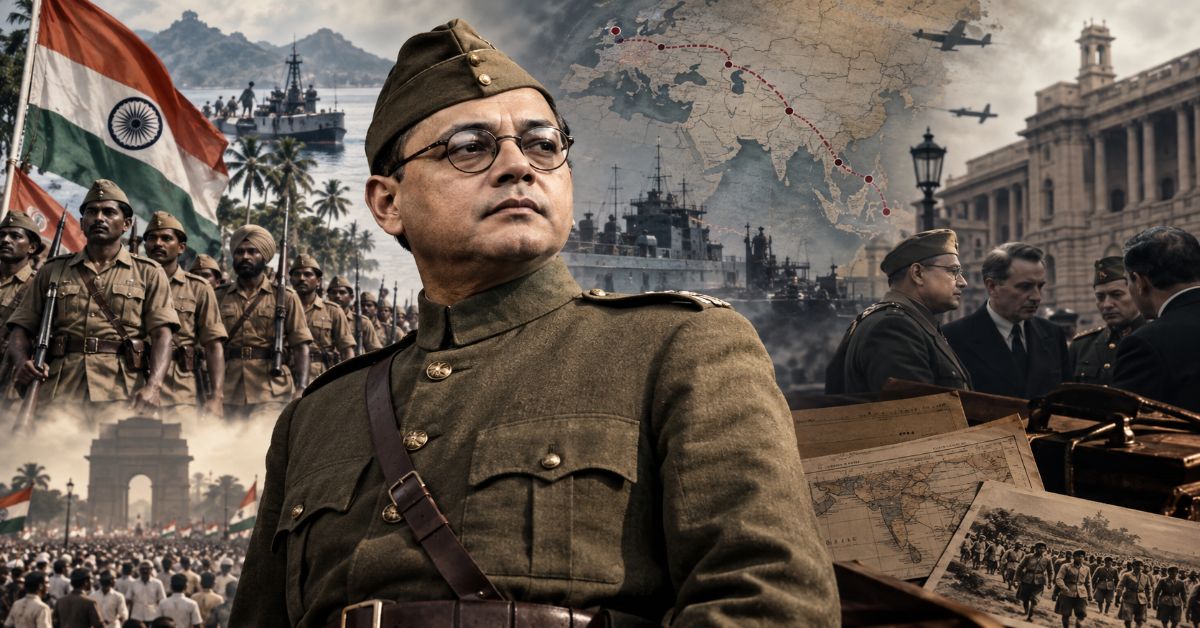
Subhas Chandra Bose was one of the most consequential leaders of India’s independence movement, but the sharpest way to understand him is not as a collection of slogans: it is as a strategist who repeatedly chose speed, confrontation and international leverage when other nationalist leaders chose mass civil resistance. That difference carried him from the Indian Civil Service and Congress leadership to exile, Axis capitals, the Indian National Army and a death in 1945 that still attracts dispute despite decades of inquiry.
Bose’s record therefore resists two easy stories. One treats him only as the heroic “Netaji” who militarised the fight for freedom. The other treats his cooperation with Nazi Germany and Imperial Japan as sufficient to dismiss the political goals that made him influential. Both flatten the evidence. His career included a serious economic programme, repeated electoral success inside the Congress, an insistence on religious unity in the nationalist cause, and a willingness to accept alliances whose authoritarian and imperial character created profound moral and strategic risks.
This article follows the decisions rather than the mythology. It traces why Bose left a prestigious colonial career, why he collided with Gandhi’s political method, what he actually inherited and rebuilt in the INA, how the Provisional Government of Free India functioned, what wartime records show about his Axis strategy, and what the official inquiries and declassified files can—and cannot—settle about his death. That structure also exposes a useful distinction often lost in short biographies: Bose’s historical importance and the wisdom of every choice he made are separate questions.
The Decisions That Defined Bose Before the War
That resignation is more than a dramatic origin story. It established a pattern that would recur throughout his career: when institutional advancement conflicted with his political objective, he was willing to abandon the institution. The Ministry of Culture profile places the choice at the start of his rapid rise in the Indian National Congress, while government records also document his repeated imprisonment and later leadership roles.
The timeline below highlights decisions rather than trying to reproduce every biographical event.
| Date | Decision or event | Why it mattered |
| 1921 | Resigned from the Indian Civil Service path and returned to India | Converted elite credentials into full-time anti-colonial politics. |
| 1938 | Elected Congress president at Haripura | Gained the movement’s highest organisational office and pushed planning and industrial development. |
| 1939 | Re-elected Congress president, then resigned | Exposed a deep strategic conflict inside the nationalist movement. |
| 1941 | Escaped British surveillance and left India | Shifted from domestic opposition to an international strategy. |
| 1943 | Reached Southeast Asia and took leadership of the INA movement | Joined military mobilisation to a provisional-government project. |
| 21 Oct 1943 | Proclaimed the Provisional Government of Free India in Singapore | Attempted to create political legitimacy alongside armed struggle. |
| 18 Aug 1945 | Reportedly died after an air crash in Taiwan | Created a historical endpoint that later inquiries and public debate have repeatedly revisited. |
Congress Leadership: The Conflict Was About Method and Power
At Haripura in 1938, Bose’s presidency highlighted his interest in state planning, industrialisation and a stronger central role in economic transformation. The following year he won re-election against Pattabhi Sitaramayya, the candidate identified with Gandhi’s preference, but victory at the ballot did not produce a workable governing coalition inside the Congress. Bose resigned in April 1939 and soon organised the Forward Bloc.
A useful recent reconstruction is The Indian Express explainer on the Forward Bloc split, which shows that the break hardened around Bose’s view that the approaching world war created an opportunity for a decisive anti-colonial push. The disagreement was therefore not merely personal. It was a dispute over whether a global crisis should be used to accelerate confrontation with Britain.
From Escape to Axis Capitals
Bose’s 1941 escape from house arrest changed the scale of his strategy. He travelled through Afghanistan and the Soviet sphere to Germany, where he worked with the Special Bureau for India, broadcast through Azad Hind Radio and supported the formation of the Indian Legion from Indian prisoners of war. By 1943, with the centre of gravity of the Asian war moving east, he transferred by German and Japanese submarines to Japanese-controlled Southeast Asia.
The UK National Archives’ 2026 research project reproduces British intelligence reporting from July 1943 describing Bose’s belief in an Axis victory, his call for revolt inside India, and his plan to coordinate that revolt with invasion from the east. Because these are British wartime intelligence records, they should be read with awareness of source perspective; they are nevertheless direct evidence of how the colonial state understood and monitored his strategy.
The strategic bargain can be separated into benefits and costs without pretending they carried equal moral weight.
| Strategic choice | Immediate advantage | Trade-off or risk |
| Seek German support | Radio access, diplomatic reach, Indian Legion recruitment | Dependence on a Nazi regime pursuing racial dictatorship and war in Europe. |
| Shift to Japanese-controlled Southeast Asia | Access to a much larger Indian POW and expatriate population | Reliance on Imperial Japan, whose own expansion had devastated parts of Asia. |
| Build an army around POWs and expatriates | Created a visible armed alternative to British Indian military service | Recruitment conditions and Japanese operational control complicated claims of full autonomy. |
| Proclaim a provisional government | Added diplomatic and institutional form to the military project | Recognition came largely from Axis-aligned states and did not equal sovereign control over India. |
| Attempt an eastern military advance | Brought the independence war physically toward India | Success depended on Japanese logistics and battlefield fortunes that collapsed in 1944–45. |
The INA: What Bose Inherited and What He Changed
One of the most repeated errors in popular summaries is that Bose simply “founded” the Indian National Army. The first INA emerged in 1942 under Mohan Singh from Indian prisoners captured by Japan after the fall of Malaya and Singapore, within a broader Indian Independence League network. It suffered a serious leadership crisis before Bose reached Southeast Asia.
Bose’s historical role was different and, in practical terms, larger than the founder label suggests. He arrived in 1943 with a national reputation that earlier organisers lacked, assumed leadership, reorganised the military movement, connected it to a provisional government, expanded propaganda and fundraising, and made the INA a recognisable symbol inside and outside India. The Rani of Jhansi Regiment, associated with Lakshmi Swaminathan (later Lakshmi Sahgal), also gave the project a highly visible women’s military unit at a time when combat institutions were overwhelmingly male.
The National Archives of India catalogue records a publication built from declassified Ministry of Defence files on INA activities and photographs. That archival base matters because the INA is often remembered through patriotic iconography; military organisation, Japanese command structures and battlefield outcomes require documentary evidence as well as memory.
Azad Hind Was a Political Project, Not Only a Slogan
On 21 October 1943 in Singapore, Bose proclaimed the Provisional Government of Free India, commonly called Azad Hind. He served as head of state, prime minister and minister for war and foreign affairs. The government-in-exile claimed to represent an independent India and was recognised by several Axis or Axis-aligned states.
A Press Information Bureau record marking the government’s 75th anniversary notes that the project developed symbols and institutions including a bank, currency and stamps. These acts did not create effective sovereignty over India, but they reveal Bose’s aim: the army was supposed to serve a political state-in-waiting rather than function as a detached expeditionary force.
The Central Contradiction: Anti-Imperialism Through Imperial Powers
Bose’s wartime strategy contains a contradiction that serious biography should not conceal. He opposed British imperial rule in India while seeking decisive help from states that were themselves imperial and authoritarian. The fact that Britain was a colonial power does not erase the nature of Nazi Germany or Imperial Japan; the nature of those regimes does not erase Bose’s goal of ending British rule.
That is why the most useful evaluation separates intention, agency and consequence. His intention was anti-colonial independence. His agency was real—he negotiated, organised, broadcast and commanded—but constrained by larger powers. The consequences included genuine mobilisation and a durable nationalist symbol, alongside association with regimes responsible for immense violence and a military campaign whose operational dependence on Japan was impossible to escape.
What the Death Inquiries Actually Established
Bose was reported to have died on 18 August 1945 after a Japanese military aircraft crashed at Taihoku in Japanese-ruled Taiwan. The account was questioned almost immediately, and the dispute became part historical investigation, part political memory and part conspiracy culture.
India established multiple inquiries. A 1956 committee led by Shah Nawaz Khan concluded that Bose died after the crash. The one-man Khosla Commission, appointed in 1970 and reporting in 1974, also accepted the air-crash account. The Justice M. K. Mukherjee Commission, appointed in 1999 and reporting in 2005, reached a different conclusion and rejected the conventional account; the Government of India did not accept that commission’s findings.
The institutional point is independently verifiable. A 2014 Ministry of Home Affairs answer published by the Press Information Bureau records the Khosla Commission’s appointment on 11 July 1970, the Mukherjee Commission’s appointment on 14 May 1999, and the submission dates of their reports. The existence of competing inquiry findings is therefore not evidence that every survival theory has equal support; it is evidence that the official record itself contains disagreement over how the evidence should be interpreted.
The three inquiries are easier to compare when their mandates and outcomes are kept separate.
| Inquiry | Period | Broad finding | Important limitation |
| Shah Nawaz Committee | 1956 | Accepted that Bose died following the 18 August 1945 crash | A committee process conducted eleven years after the event; one member, Suresh Chandra Bose, dissented. |
| Khosla Commission | 1970–1974 | Accepted the air-crash/death account | Relied on testimony and documentary material available decades after the event. |
| Mukherjee Commission | 1999–2005 | Rejected the conventional plane-crash conclusion | Its conclusion was not accepted by the Government of India. |
Declassified Files Changed Access More Than They Changed the Debate
For Subhas Chandra Bose research, the declassification programme is one of the most important developments for modern readers because it changed who could inspect the evidence. In January 2016, the Government of India began releasing digitised Netaji files through the National Archives. The Press Information Bureau said the first public release included 100 files and noted that the National Archives already held 990 declassified INA files received from the Ministry of Defence in 1997, plus 1,030 files or items linked to the Khosla and Mukherjee inquiries received in 2012.
The National Archives of India Netaji Papers page explains the staged releases, while the 2016 official release notice states that digitisation was intended to meet public demand and facilitate research.
Bose’s memory remains unusually powerful because it combines political achievement with an unfinished ending. He was a Congress president who broke with Congress orthodoxy, a socialist-leaning planner who became a wartime military leader, a nationalist who insisted on cross-religious mobilisation, and an anti-imperialist who sought help from imperial powers. Each constituency can select a different Bose.
The most important development in 2027 is likely to be methodological rather than sensational. India’s archival infrastructure is expanding, and the National Archives reported in 2026 that its mass-digitisation programme had placed more than 20 crore digitised pages online across its broader holdings. That scale makes cross-referencing easier, but digitisation alone does not solve questions of metadata quality, missing records, foreign archives or interpretation.
Key Takeaways
- Bose’s defining pattern was institutional exit when he believed an institution blocked the pace or method of independence he wanted.
- His 1939 Congress rupture was a strategic and organisational conflict, not merely a personality clash with Gandhi.
- Bose did not create the first INA from nothing; his contribution was to reorganise, scale and politically integrate an existing but fractured movement.
- The Axis alliance offered resources and access while creating a fundamental dependence on authoritarian powers with their own imperial aims.
- Azad Hind was designed as a state-in-waiting, showing that Bose’s project combined military force with claims to political legitimacy.
- The official death record includes conflicting inquiry conclusions, but disagreement among inquiries does not automatically validate every later survival theory.
- Declassified archives are most valuable when they narrow claims and expose documentary context, not when they are treated as guaranteed containers of a hidden final answer.
Conclusion
Bose matters because he forced the Indian freedom struggle to confront questions it could not avoid: how fast independence should be pursued, whether violence could be justified against colonial rule, how much authority a nationalist organisation should centralise, and what risks were acceptable when seeking foreign support. His answers were dramatically different from Gandhi’s, and they carried him into alliances that remain ethically and historically difficult.
That difficulty is not a reason to simplify him. Bose’s record includes major organisational ability, electoral legitimacy within the Congress, a serious interest in planning and industrial development, military mobilisation across borders, and a political vision that tried to turn exile into an alternative state. It also includes strategic dependence on Nazi Germany and Imperial Japan and a battlefield project that failed to dislodge British rule.
The strongest account therefore keeps two ideas together: Bose expanded the repertoire and symbolism of India’s anti-colonial struggle, and some of the means he chose carried grave costs and constraints. History becomes more useful when both remain visible.
Frequently Asked Questions
Why did Bose leave the Indian National Congress presidency?
After winning re-election in 1939, Bose faced a deep conflict with Gandhi-aligned leaders over strategy, party organisation and the response to the approaching world war. Unable to form a workable leadership arrangement, he resigned and later developed the Forward Bloc as a vehicle for a more militant anti-imperialist programme.
Why did Bose work with Germany and Japan?
He believed Britain’s wartime enemies could provide the military and diplomatic leverage needed to end British rule in India. The strategy gained him resources and access but tied his project to Nazi Germany and Imperial Japan, creating serious moral and strategic dependence on authoritarian powers pursuing their own wars.
The conventional account is that Bose died from injuries after an aircraft crash in Taihoku, Taiwan, on 18 August 1945. Indian inquiries have not been unanimous: the Shah Nawaz and Khosla inquiries accepted the crash account, while the Mukherjee Commission rejected it; the Government of India did not accept the Mukherjee Commission’s conclusion.
What did the declassified Netaji files reveal?
The releases greatly expanded public access to correspondence, government files, intelligence material and inquiry records. Their biggest contribution is evidentiary: researchers can test claims against primary documents. They have not produced a universally accepted single document that ends every dispute about Bose’s death or wartime activities.
Subhas Chandra Bose remains central to debates about nationalism, military resistance, political planning, secular mobilisation and the ethics of wartime alliances. New archival access also means readers can increasingly compare popular memory with primary records rather than relying only on inherited narratives.
Methodology
Research was conducted on October 1, 2026. Ten prominent current pages surfaced for the focus keyword and close-intent variants were reviewed to identify recurring coverage and gaps. Because search results vary by location, device, personalisation and time, the competitive set is a benchmark rather than a claim that every user sees the same fixed ranking.
Factual validation prioritised the National Archives of India, the Government of India’s Press Information Bureau, the Ministry of Culture and the UK National Archives, with recent reputable explanatory reporting used for context. Older facts were retained where the primary or institutional record is necessarily historical. Competing interpretations—especially around Bose’s death and wartime alliances—were separated from established chronology rather than blended into a single certainty.
A site-restricted search of rubblemagazine.org did not surface a live article specifically relevant to Bose, the INA, Gandhi-era Congress politics, colonial India or the related archival questions. Unrelated internal links were therefore not inserted merely to hit a numerical target. Internal linking should be expanded when genuinely relevant Rubble Magazine pages are published.
References
Government of India, Ministry of Culture. (n.d.). Netaji Subhas Chandra Bose.
National Archives of India. (n.d.). Netaji Papers.
National Archives of India. (n.d.). Catalogue of publications: Azad Hind Fauj ki Gaurav Gatha.
Mahoney, M. (2026, February 9). Subhas Chandra Bose and India at war. The National Archives (UK).