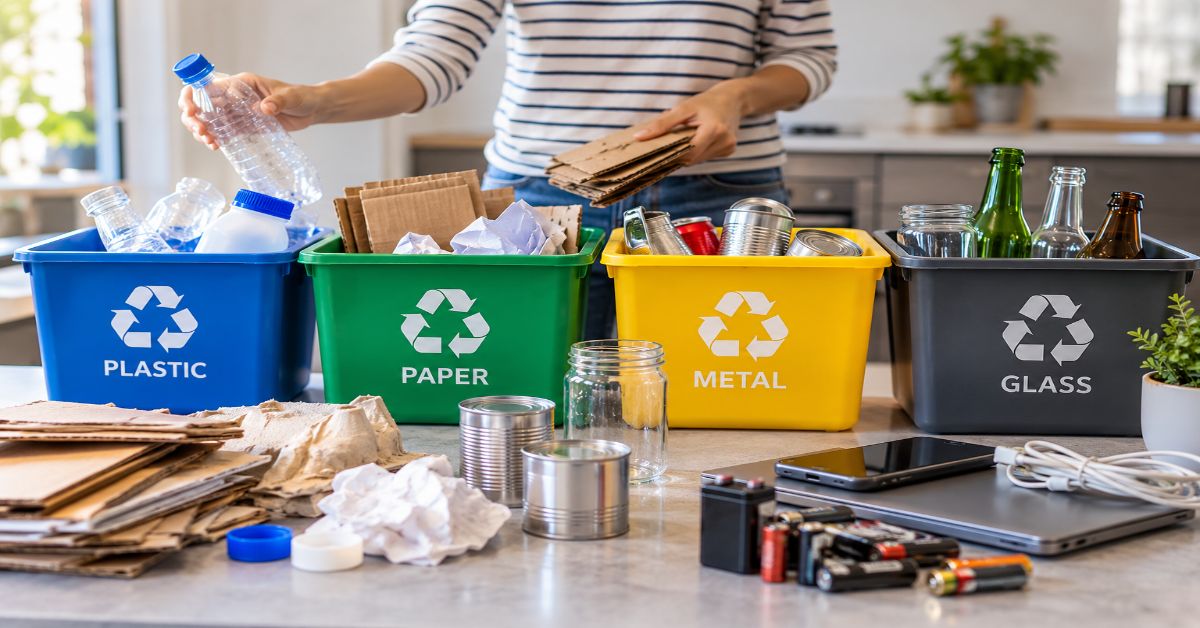
A reliable recycling guide starts with one rule: your local program decides what belongs in your bin, not the recycling symbol on the package—and that distinction matters as the UN Environment Programme projects municipal solid waste will reach 3.8 billion tonnes by 2050. The practical goal is not to put more things into a recycling container. It is to send clean, accepted materials into a system that can actually sort and market them.
That sounds obvious, yet most household mistakes happen because several signals compete. A plastic container may carry a resin code but still be excluded locally. A paper box may be recyclable until food or grease makes the useful fibre hard to recover. A battery may contain valuable metals but create a fire risk if it enters an ordinary sorting line. And a product made from several bonded materials can be technically recyclable in theory while having no realistic curbside route where the reader lives.
The better approach is a decision system, not a memorized list. This article starts with the local-rule test, then shows how to prepare common materials, how to route batteries and electronics, why contamination matters, where reuse beats recycling, and what broader waste trends mean for 2027. The emphasis is deliberately practical: when a label, a generic internet list, and a municipal rule disagree, the municipal rule wins.
The Four-Step Test Before Anything Reaches the Bin
Most ranking recycling pages begin with material categories. That is useful, but it skips the moment where people actually get stuck: standing over a bin with one specific object. A more dependable workflow is to test the object in four steps.
| Decision | Question to ask | What to do |
| 1. Identify | What is the item mainly made from? | Separate obvious paper, metal, glass, rigid plastic, organics, electronics, batteries, and mixed-material products. |
| 2. Verify | Does the local program accept this exact form? | Use the city, council, hauler, or facility list. Do not infer acceptance from a symbol alone. |
| 3. Prepare | Is it empty, reasonably clean, dry, and loose? | Remove food and liquid; flatten cardboard where requested; follow cap and lid rules locally. |
| 4. Divert | Is it hazardous, electronic, flexible, tangled, or composite? | Use a specialist drop-off, retailer take-back, reuse route, compost system, or trash when no recovery route exists. |
The key word is exact. “Glass” is not a single curbside category. Bottles and jars may be accepted while drinking glasses, mirrors, ceramics, and heat-resistant cookware are rejected because they melt differently or disrupt processing. “Plastic” is even more variable. The U.S. EPA’s recycling guidance emphasizes checking what can be recycled locally and explains that collected material must be sorted, cleaned, processed, and sold into manufacturing markets.
What Common Household Materials Usually Need
Local rules still control, but the preparation logic is fairly consistent. The table below separates the material from the condition that often makes it fail.
| Material | Often accepted curbside | Preparation | Frequent reason for rejection |
| Paper and cardboard | Office paper, mail, cartons, boxes in many programs | Keep dry; flatten boxes if required | Food-soaked fibre, tissues, laminated or heavily coated paper |
| Metal | Aluminium and steel food or drink containers in many programs | Empty; quick rinse when needed | Pressurised, hazardous, or partly full containers |
| Glass | Bottles and jars where glass is collected | Empty; follow local lid rules | Ceramics, mirrors, windows, cookware, drinking glasses |
| Rigid plastic | Selected bottles, jugs, tubs, pots, trays depending on region | Empty and clean enough to avoid residue | Wrong shape or resin, black plastic in some systems, mixed materials |
| Flexible plastic | Rarely accepted loose in ordinary curbside bins | Use store or specialist take-back only when explicitly accepted | Bags and film can wrap around sorting equipment |
| Food and yard waste | Separate organics programs in some locations | Use the designated organics stream | Plastic packaging mixed into compostable material |
The Plastic Number Is an Identifier, Not a Permission Slip
The chasing-arrows symbol and resin number are among the most misunderstood signals in household recycling. The number identifies the plastic resin family. It does not tell a resident that a specific local system has a buyer, sorting method, or processing route for that object. Shape can matter as much as chemistry: a bottle, tray, black food container, foam block, and plastic film may all behave differently in collection and sorting.
This is why a universal “1 through 7” rule is weak advice. Local programs may accept only selected bottles and containers, while specialist schemes may take films, foams, or other categories separately. If the municipal guidance says “bottles and jugs only,” a resin code on a clamshell package does not override that rule.
The OECD’s plastics outlook gives the bigger reason to be precise. Under its baseline policy scenario, global plastic waste rises sharply through 2060 and recycling improves but remains far from universal. Better recycling matters, but it cannot compensate for unchecked growth in short-lived plastic products. The useful household response is therefore two-part: recycle accepted packaging correctly and reduce avoidable packaging where a practical alternative exists.
Contamination: When a Recyclable Material Stops Being Useful
“Clean and dry” is often repeated as a slogan, but the underlying issue is recoverability. Food and liquid can damage paper fibres, add weight and odour, or soil nearby material. A half-full container also creates extra work before processing. The answer is not to wash every package as if it were going back into a kitchen cupboard. It is to remove the contents and use a quick rinse when residue would otherwise remain.
There is also a second kind of contamination: the wrong object in the right-looking bin. Plastic bags, cords, hoses, chains, and other flexible or string-like items can be particularly troublesome in automated facilities because they can wrap around equipment. Batteries are a different risk again: they may ignite when crushed or damaged. Those items need dedicated routes, not optimistic placement in mixed recycling.
Batteries, Electronics and Other Items That Need a Separate Route
Some of the most valuable recyclable materials should never be treated like ordinary curbside packaging. Batteries, phones, laptops, appliances, paint, chemicals, fluorescent lamps, and medical sharps can require specialist handling for safety, data security, or material recovery.
| Item | Why curbside is often wrong | Better route |
| Lithium-ion batteries | Fire risk if crushed or damaged | Battery retailer, household hazardous-waste site, or approved battery program |
| Phones and laptops | Contain recoverable metals and may hold personal data | Manufacturer/retailer take-back, certified e-waste recycler, or reuse after secure data removal |
| Large appliances | Bulky, mixed materials, refrigerants or other regulated components | Municipal bulky-waste program, retailer haul-away, or appliance recycler |
| Paint, solvents, chemicals | Can contaminate loads or create hazardous exposure | Household hazardous-waste collection or approved drop-off |
| Textiles | Often unsuitable for ordinary mixed recycling | Reuse, repair, donation, textile collection, then disposal if unusable |
For textiles, the highest-value route is often to delay disposal. Repairing a damaged garment can preserve far more of the original product than breaking it down as waste. Rubble Magazine’s guide to patching jeans is a practical example of extending product life before recycling becomes necessary.
Reuse Before Recycling: The Part Most Bin Guides Underplay
Recycling is useful, but it sits below prevention and reuse in the waste hierarchy because manufacturing a replacement still requires material, energy, transport, and processing. The EPA similarly notes that reducing and reusing are among the most effective ways to cut waste because they avoid creating it in the first place. For usable furniture, tools, electronics, clothing, and household goods, resale or donation can keep the product intact. Rubble Magazine’s Facebook Marketplace guide and Craigslist guide explain the transaction and safety trade-offs when secondhand resale is the better route.
This creates a simple priority order for household decisions: do not buy what is unnecessary; choose durable or refillable products where practical; repair or reuse what still works; recycle accepted material; then dispose of the remainder safely. That order prevents the common mistake of treating recycling as permission for unlimited consumption.
What the Current Top 10 Results Commonly Miss
A September 2026 competitive review of prominent current results found a strong consensus on basic content: accepted materials, “do not recycle” lists, plastic numbers, rinsing, special waste, and beginner tips. The Waste Monkeys and Zero Waste Lifestyle use practical household yes/no guidance; Home Sapiens and GeekChamp provide beginner explanations; municipal pages from Providence, Cape Town, Milwaukee and others give location-specific lists; WM and WIN Waste package the advice into simple operational rules.
The weakness is not lack of information. It is transferability. A reader can finish a 2,000-word guide and still be unsure what to do with an unfamiliar object because the article gave categories instead of a decision rule. This article’s local-rule-first model is designed to survive those edge cases. It also separates three questions that many pages blur: Is the material technically recyclable? Is it accepted by this collection system? Is the item in a condition that makes recovery realistic?
That distinction matters for search quality because the correct answer can legitimately change by city, contractor, facility, and market. A good general guide should therefore teach the reader how to verify a local answer, not pretend one global list is universal.
How to Build a Home System That People Actually Use
A household system fails when it depends on constant memory. The practical setup is to make the correct action easier than guessing. Keep recycling next to general waste, not in another room. Add a small container for batteries and e-waste that never enters curbside recycling. Flatten cardboard near the place where deliveries are opened. If organics collection or home composting is available, keep food scraps separate before they are mixed with packaging.
The second improvement is a local “uncertain items” note. Save the municipal recycling page on a phone, or print the accepted-items list near the bin. When a new package appears, check once and make the result part of the household rule. This reduces wishcycling without turning every disposal decision into research.
Why Better Recycling Still Requires Better Buying
The recycling loop is incomplete if households only supply material and never create demand for recycled content. EPA describes recycling as a cycle of collection and processing, manufacturing, and purchasing new products made with recycled materials. That final stage matters economically: recycled material competes with virgin inputs, and markets influence what facilities can sell.
Buying decisions therefore affect waste upstream. Favor products that are durable, repairable, refillable, or made with credible recycled content when price and performance make sense. For unfamiliar products, a structured review process helps separate durability evidence from marketing language; Rubble Magazine’s product reviews guide explains how to evaluate evidence, ownership costs, and review quality before buying.
The Future of Recycling in 2027
The most important 2027 trend is likely to be less tolerance for ambiguity. Waste systems are under pressure from rising material volumes, more complex packaging, battery-heavy products, and the cost of contamination. At the same time, policy is shifting toward circularity: prevention, reuse, recycled-content markets, producer responsibility, and better recovery infrastructure rather than recycling alone.
UNEP’s Global Waste Management Outlook 2024 models a steep rise in municipal waste without stronger intervention and finds that circular-economy approaches can reduce long-run economic and environmental costs. The OECD Global Plastics Outlook likewise shows that stronger policy can raise recycling and secondary-plastics use, but prevention and demand-side measures remain necessary.
For households, the visible result may be more standardized labels, retailer take-back programs, separate food-waste collection, and stronger rules for batteries, textiles, packaging, and electronics. The exact timeline will differ by jurisdiction, so any 2027 prediction should be treated as directional rather than universal. The durable principle remains the same: design the system around verified local routes and keep high-risk items out of ordinary mixed recycling.
Key Takeaways
- Local acceptance rules are the final authority for curbside recycling.
- A resin code identifies plastic type; it does not guarantee local recyclability.
- Emptying food and liquid protects the value of paper and other recovered materials.
- Batteries, electronics, chemicals, and many textiles need separate recovery routes.
- Reuse and repair often preserve more value than recycling a still-functional product.
- A saved local accepted-items list is more useful than memorizing a universal internet checklist.
- Recycling works best as part of a broader waste hierarchy that starts with prevention.
Conclusion
The hardest part of recycling is not learning that paper, cans, bottles, and cardboard can often be recovered. It is knowing when a familiar-looking item falls outside the local system. That is why a useful recycling guide should teach a decision method rather than offer false certainty.
Start with the material, verify the exact local rule, prepare the item so it is empty and recoverable, and divert hazardous or specialist waste to a separate route. When uncertainty remains, checking the municipality or hauler is better than adding an item “just in case.” For products that still work, reuse, repair, resale, or donation can preserve more value than recycling them at all.
The broader waste numbers are moving in the wrong direction, so better sorting is necessary but insufficient. The strongest household strategy is to combine correct recycling with less avoidable waste, longer product life, and buying choices that support recycled-material markets.
Frequently Asked Questions
What is the first rule for recycling correctly?
Check the rules for the local collection program before relying on a package symbol or generic list. Facilities differ in the materials, shapes, contamination levels, and markets they can handle, so local acceptance determines whether an item belongs in curbside recycling.
Do recycling symbols mean an item can go in the recycling bin?
Not necessarily. A recycling symbol or plastic resin code may identify a material, but it does not guarantee local acceptance. The collection program still needs a practical way to sort, process, and market that item.
Should containers be washed before recycling?
They should be empty and reasonably free of food or liquid. A quick rinse is usually enough when residue remains. Excessive washing is unnecessary unless local guidance specifically asks for it; the goal is to prevent contamination, not sterilize packaging.
Can plastic bags go in curbside recycling?
Many curbside systems reject loose plastic bags and film because they can wrap around sorting equipment. Some retailers or specialist programs collect clean film separately. Check the local program before using any drop-off route.
How should batteries and electronics be recycled?
Use a dedicated battery, e-waste, retailer take-back, or household hazardous-waste program. Do not place lithium-ion batteries in ordinary trash or curbside recycling where they can be crushed or damaged and create a fire risk.
Is recycling better than reusing?
Usually, reuse preserves more of the product’s original material, manufacturing effort, and value. Recycling is important when reuse is no longer practical, but prevention, repair, resale, and donation can avoid waste before processing is required.
Why are recycling rules different by location?
Programs use different collection contracts, sorting equipment, end markets, safety rules, and economics. A material that one facility can recover profitably may be rejected by another, which is why local guidance should override broad internet advice.
Methodology
Research was conducted on September 30, 2026. The competitive review examined ten prominent current pages surfaced for “recycling guide” and close household-intent searches: The Waste Monkeys, Home Sapiens, Zero Waste Lifestyle, Recycling-Guide.org.uk, City of Providence, Clean & Green Singapore, City of Cape Town, WIN Waste Innovations, WM Recycle Right, and GeekChamp. Search rankings vary by location, device, personalization, and time, so this set is a competitive sample rather than a permanent universal top ten.
The recurring strengths were accepted-material lists, plastic-number explanations, preparation tips, special-waste sections, and beginner-friendly checklists. The recurring weakness was decision transfer: many pages tell readers what belongs in a bin but provide less help when a specific object falls between categories or when generic advice conflicts with local rules. The article was therefore structured independently around a local-rule-first decision system rather than mirroring competitor section order.
For factual validation, primary and institutional sources were prioritized: U.S. EPA recycling basics, U.S. EPA National Recycling Strategy, UNEP Global Waste Management Outlook 2024, and the OECD Global Plastics Outlook. The article uses these sources for system mechanics, policy context, and global waste or plastics trends rather than treating any one jurisdiction’s accepted-material list as universal.
References
Organisation for Economic Co-operation and Development. (2022). Global Plastics Outlook: Policy scenarios to 2060. OECD Publishing.
United Nations Environment Programme. (2024). Global Waste Management Outlook 2024: Beyond an age of waste—Turning rubbish into a resource. UNEP.
U.S. Environmental Protection Agency. (2021). National Recycling Strategy: Part One of a Series on Building a Circular Economy for All.
U.S. Environmental Protection Agency. (n.d.). Recycling basics and benefits. Retrieved September 30, 2026.
U.S. Environmental Protection Agency. (n.d.). What you can do: Reduce, reuse, recycle. Retrieved September 30, 2026.