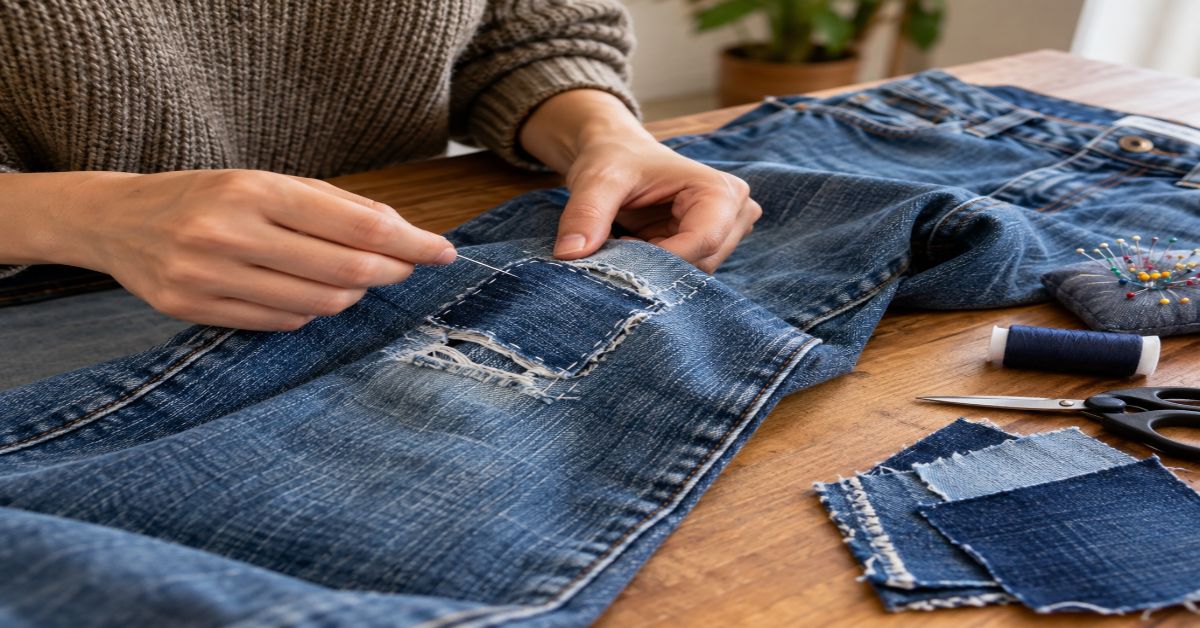
The durable answer to how to patch jeans is to reinforce healthy denim around the damage, then secure a patch with stitching that suits the stress and stretch of that area. The catch is that a small visible hole can need a much larger repair: if the surrounding cloth is thin, sewing only around the opening creates a tidy patch with a weak perimeter.
I compared ten prominent current pages ranking for this query and close variants before drafting. Most explain one technique well—hand sewing, machine darning, sashiko, or iron-on patches—but the recurring gap is diagnosis. A knee hole, inner-thigh abrasion, crotch blowout, torn pocket corner, and split seam do not fail the same way. Neither do rigid cotton denim and stretch denim containing elastane. This guide therefore starts with the damage map, not the sewing method.
The European Environment Agency reports that 3,000 of 3,157 textile items logged by participating European Repair Cafés in 2025 were successfully repaired; trousers and pants had a 97% success rate. Those figures describe a specific volunteer repair network, not every garment or beginner, but they show that repair is often realistic when sound material still surrounds the damage.
I did not run a controlled repair test for this article. The recommendations come from current repair guidance, manufacturer needle documentation, professional denim-repair practices, and recent repairability data. The goal is to help you decide what to patch, how far to reinforce it, which stitch strategy fits the location, and when DIY becomes false economy.
How to Patch Jeans by Reading the Damage First
Turn the jeans inside out under good light. Rub the cloth around the tear between your fingers. Sound denim feels consistent; failing denim feels soft, fuzzy, translucent, or thinner. Mark the whole weak zone, then size the patch beyond it.
I use three variables: damage geometry, movement, and access. They tell me whether I am dealing with a clean tear or abrasion field, how much flex the area sees, and whether a machine can reach it flat.
This damage map is more useful than choosing a technique by appearance alone.
| Damage location | What is usually happening | Best starting repair | Main risk |
| Knee | Localized hole plus bending stress | Inside patch with hand stitching, sashiko, or machine reinforcement | Patch too small; repeated flex tears the edge |
| Inner thigh | Broad abrasion from friction | Large soft backing patch plus dense machine darning or repeated hand rows | Repairing only the center while surrounding denim keeps thinning |
| Crotch/seat | Multi-directional tension and seam stress | Wide backing reinforcement; professional repair if seams are distorted | Bulky patch, puckering, or new failure beside a stiff repair |
| Pocket corner | Concentrated load where pocket stitching ends | Reinforce behind the corner and restitch into sound fabric | Stitching into already-frayed denim |
| Straight tear on leg | Cut or snag with otherwise healthy cloth | Inside patch with perimeter and bridging stitches | Over-trimming frayed fibers and enlarging the opening |
| Hem or seam | Construction failure rather than surface wear | Re-sew construction first; patch only if cloth is also damaged | Covering the symptom without restoring the seam |
What Tools Do You Actually Need?
For a basic hand repair, you need patch fabric, sharp scissors, pins or clips, a hand needle, thread, and a fabric marker. A thimble helps on heavy denim. Press the area flat before cutting the patch; if laundering could enlarge a fragile hole, stabilize it first and follow the care label afterward.
For machine work, use a needle intended for denim or another thick woven fabric. SCHMETZ says its Jeans/Denim needle uses a reinforced blade designed for dense wovens.
That is the kind of specification I would verify before buying a repair kit or machine accessory; Rubble Magazine’s guide to trustworthy product reviews is useful for separating manufacturer claims, retailer feedback, and real test evidence when you are comparing tools.
For needle selection, see SCHMETZ’s current Jeans/Denim needle documentation and match the actual needle size to your machine, thread, and fabric thickness rather than copying one universal size from a tutorial.
Which Repair Method Fits the Job?
Learning how to patch jeans well means matching the method to speed, appearance, flexibility, and structural support. There is no single best technique for every pair.
| Method | Best for | Strength profile | Appearance | Trade-off |
| Hand-sewn inside patch | Small-to-medium holes; hard-to-reach areas | Good when stitches extend into sound denim | Can be subtle or visible | Slow on broad abrasion |
| Machine darning over backing | Inner thigh, seat, large worn zones | Very strong because stitching spreads load across a field | Can blend with matched thread | Requires machine access and patience |
| Sashiko-style visible mend | Knees, thighs, decorative reinforcement | Strong when rows cross the weak zone and anchor the patch | Intentional, decorative | Time-intensive and visibly changes the garment |
| Iron-on patch | Quick low-skill stabilization | Moderate alone; stronger when edge-stitched | Usually obvious unless placed inside | Adhesive can lift or stiffen with wear |
| Professional denim repair | Crotch blowouts, seams, valuable denim, wide thinning | Can rebuild fabric with specialized darning and construction access | Often the least visible option | Costs more than DIY |
Levi’s current Tailor Shop menu treats patching, darning, crotch repair, and sashiko as distinct repair services rather than interchangeable techniques. That distinction matters: each method solves a different structural problem. The same principle applies at home.
Step-by-Step: A Durable Inside Patch With Reinforcement
For the widest range of ordinary holes, I would start with an inside backing patch. It keeps the outer appearance relatively clean while giving the weak fabric something solid to stitch into.
1. Define the weak zone
Lay the jeans flat without stretching them. Trim only threads that catch or prevent the fabric from lying flat. Mark beyond the visible hole until you reach denim that feels consistent again.
2. Cut a patch larger than the damage
Use denim or sturdy woven cotton with a similar hand. Extend the patch beyond the entire weak zone and round the corners. On stretch jeans, use comparable stretch and align its stretch direction with the garment.
3. Position the patch from the inside
Turn the jeans inside out, center the patch, and pin or baste it while the fabric lies naturally. Do not pull the hole closed so tightly that the leg narrows or puckers.
4. Anchor the perimeter in healthy denim
Sew around the patch edge with small hand stitches or a machine straight stitch. The stitch line must sit in sound denim; if the needle passes through a fuzzy, paper-thin ring, move farther out.
5. Bridge the weak area
Add rows across the damaged zone so old denim and backing behave as one layer. With a machine, work back and forth; by hand, use parallel running stitches or a sashiko-style grid to spread the load.
6. Check the repair from both sides
Turn the jeans right side out and flex the repair. Look for puckering, loose edges, tight stitch lines, or a halo of thin fabric. If it feels like a hard island surrounded by weakness, enlarge the reinforcement.
7. Finish for the actual wear pattern
Trim only nonstructural backing that creates bulk. Then imitate the original stress: bend a knee deeply, rub inner-thigh layers together, or gently load a repaired pocket corner.
How to Patch Stretch Jeans Without Creating a Stiff Spot
Stretch denim is designed to elongate. A rigid patch behind a flexible thigh or seat may survive while movement transfers to its border. I think of this as a stiffness cliff: flexibility changes too abruptly, so the next weak point can appear beside the repair.
Match the patch to the garment. A soft stretch-denim scrap is better than thick non-stretch denim for a fitted elastane blend. Pin the jeans in their natural shape and avoid unnecessary dense stitching. The goal is reinforcement with flexibility, not armor.
If you need donor denim, an old pair is often the easiest match for weight and wash. For local secondhand sourcing, the site’s Facebook Marketplace safety guide is useful when you are buying inexpensive jeans or fabric lots from local sellers; inspect the actual material before treating a listing photo as proof of condition.
Why Jeans Patches Fail
Patches usually fail because the repair boundary was wrong, the materials moved differently, or the original construction problem remained unfixed.
| Failure pattern | Likely cause | Better correction |
| New tear just outside patch | Patch ended inside a weak abrasion field or was much stiffer than the jeans | Remove or extend reinforcement into sound fabric with a softer transition |
| Patch peels or curls | Adhesive-only repair in a flex/friction zone | Stitch the edge and, if needed, reinforce through the center |
| Puckering | Fabric was stretched or pulled closed while sewing | Release tight stitches and repin the jeans in their natural shape |
| Thread keeps breaking | Needle/thread mismatch, abrasion, or stitches too tight | Use appropriate denim needle/thread setup and reduce tension on the repair |
| Hole reopens at seam | Surface patch did not restore seam construction | Open enough access to rebuild the seam, or use a professional repairer |
| Bulky inner-thigh repair | Patch too heavy, excess layers, or large seam allowance | Use a softer backing and trim nonstructural bulk after stitching |
When Should You Use Visible Mending, Sashiko, or a Professional Repair?
Visible mending is not a weaker second choice. Because the stitches can show, reinforcement can spread across a wider area. Manchester Metropolitan University researchers Amber Martin-Woodhead and Martyn Evans argued in July 2026 that visible mending is becoming part of the fashion conversation rather than merely a hidden correction.
Sashiko-style rows suit knees and thighs because repeated stitches can anchor a backing patch widely. The pattern should cross weak denim and reach healthy cloth; a grid floating only over frayed fibers is decoration, not reinforcement.
Professional repair is sensible when damage crosses an inseam or crotch seam, distorts fit, reaches a zipper or rivet, spans a large abrasion field, or affects valuable denim. Levi’s lists patching, darning, belt-loop replacement, seat and crotch repair, and sashiko; its current Tailor Shop repair menu is a useful example of how professional denim repair separates structural jobs by type.
Virginie Jure, a Levi’s master tailor in Paris, noted in a 2023 Levi Strauss & Co. profile that “it sometimes only takes a very minor alteration.” Repair can be proportional: a small intervention is enough when the surrounding material is still healthy.
The Future of Patching Jeans in 2027
The most important 2027 change is likely to be repairability expectations, not a new stitch. The European Environment Agency says product-specific ecodesign rules addressing durability and repairability are expected from 2027 onward under the EU Ecodesign for Sustainable Products Regulation.
That does not mean every pair of jeans will receive a repair score in 2027. The direction is clearer than the timetable: EU policy is moving toward longer use, repair, reuse, and better product information, while the Commission’s textile strategy frames 2030 around durable, repairable, and recyclable products.
For the policy context, see the European Environment Agency’s textile repairability metric and the European Commission’s textiles strategy when updating this section before publication.
For home menders, more repair services and better product information could make denim repair a more normal ownership step. The uncertainty is whether design rules, brand services, and consumer behavior change at the same speed.
Key Takeaways
- Map the entire weak zone before cutting a patch; the visible hole is often smaller than the structural damage.
- Anchor stitches in sound denim and reinforce across the weak field, not only around the opening.
- Use machine darning for broad abrasion, hand stitching for control and access, and iron-on patches mainly as a fast stabilizer or low-stress fix.
- Match stretch direction and patch softness on elastane-blend jeans so the repair does not create a rigid stress boundary.
- Treat seams, pocket corners, crotch blowouts, zippers, rivets, and very valuable denim as construction problems that may justify professional repair.
- A good repair is not necessarily invisible; visible mending can make the reinforcement wide, inspectable, and intentional.
Conclusion
Patching jeans works best when you stop treating the hole as the whole problem. The durable repair is the one that reaches healthy denim, matches the way the garment moves, and spreads stress across a larger area instead of concentrating it at one neat seam. That principle explains why a small knee tear can survive with a simple inside patch, while an inner-thigh abrasion or crotch blowout may need broad darning or professional reconstruction.
The method is secondary to diagnosis. Hand stitches, machine rows, sashiko, and iron-on patches can all work when fabric, location, and movement suit them—and all can fail when anchored into disappearing cloth.
So the decision is not simply “repair or replace.” Inspect the weak zone, confirm sound denim still surrounds it, choose a compatible patch, and decide whether the complexity fits the value of the jeans. A good repair is honest about what the fabric can still support.
Frequently Asked Questions
How to patch jeans without a sewing machine?
Use an inside patch secured with small hand stitches that reach healthy denim. Running stitch, backstitch, or a sashiko-style grid can work. Iron-on patches can stabilize first, but knees and thighs usually benefit from stitching too.
Can you patch jeans from the inside?
Yes. An inside patch is often the cleanest way to reinforce a hole while keeping the outer appearance subtle. Place the patch behind the weak area, anchor its perimeter in sound denim, then add stitches across the damaged field so the original fabric is supported rather than merely framed.
What is the best fabric for patching denim?
Choose woven fabric compatible with the jeans’ weight and movement. Similar denim is a strong default; stretch jeans need a softer patch with similar stretch direction. Avoid an unnecessarily heavy patch that moves stress to its edge.
Do iron-on denim patches stay on?
They can work for quick, low-stress repairs, but adhesive alone is vulnerable where fabric bends, rubs, or stretches. Knees and thighs usually benefit from edge stitching or added reinforcement.
How big should a jeans patch be?
Size the patch to the weak fabric, not just the visible opening. It should extend beyond the thinned or frayed zone into denim that still feels solid. There is no universal margin because a clean cut and a broad abrasion field have different repair boundaries.
Is it worth repairing a crotch blowout in jeans?
Often, yes, if the fit matters and enough sound denim remains. Crotch repairs combine friction, stretch, curves, and seam stress. If seams are involved or the surrounding fabric is broadly paper-thin, professional darning can outlast a bulky home patch.
Methodology
I researched this article on September 22, 2026 and reviewed ten prominent organic results for the exact query and close variants: MindyMakes, Taylor Stitch, XxBrits, RageuraWear, Closet Core Patterns, Melly Sews, Clothes Doctor, Lavals des Tissus, CurvyWorkwear, and InfozArena. Rankings vary by location, device, personalization, and time, so this is a current benchmark, not a permanent universal order.
Common strengths were materials lists, beginner patch steps, sashiko, iron-on options, and machine demonstrations. The gaps were diagnosis by location, broad thinning versus a clean hole, stretch-denim behavior, patch-edge failures, and current repairability policy. I built the structure around those gaps.
Validation prioritized the European Environment Agency, European Commission, SCHMETZ, and Levi Strauss & Co. / Levi’s. I did not perform a controlled repair test, so first-person statements describe source comparison and editorial analysis, not invented hands-on results.
I audited Rubble Magazine with site-restricted searches. Three live pages fit naturally: Product Reviews, Facebook Marketplace, and Craigslist. More internal links should be added as genuinely related sewing, clothing-care, sustainability, secondhand, or DIY repair content is published. For a used sewing machine, the Craigslist safety and buying guide is the third internal resource used here.
References
European Commission. (2026). EU strategy for sustainable and circular textiles. Directorate-General for Environment.
European Environment Agency. (2026). Repairability of textile products. Circularity Metrics Lab.
European Environment Agency. (2025). Circularity of the EU textiles value chain in numbers. EEA Briefing 03/2025.
Levi Strauss & Co. (2023, January 11). Give your jeans a fresh start.
Levi’s. (2026). Tailor Shop: Jeans alteration, repair & customization. Retrieved September 22, 2026.
Manchester Metropolitan University. (2026, July 28). Visible mending: Why showing off repairs is better than hiding them. Commentary by Amber Martin-Woodhead and Martyn Evans.
SCHMETZneedles. (2026). Jeans/Denim sewing machine needles. Retrieved September 22, 2026.