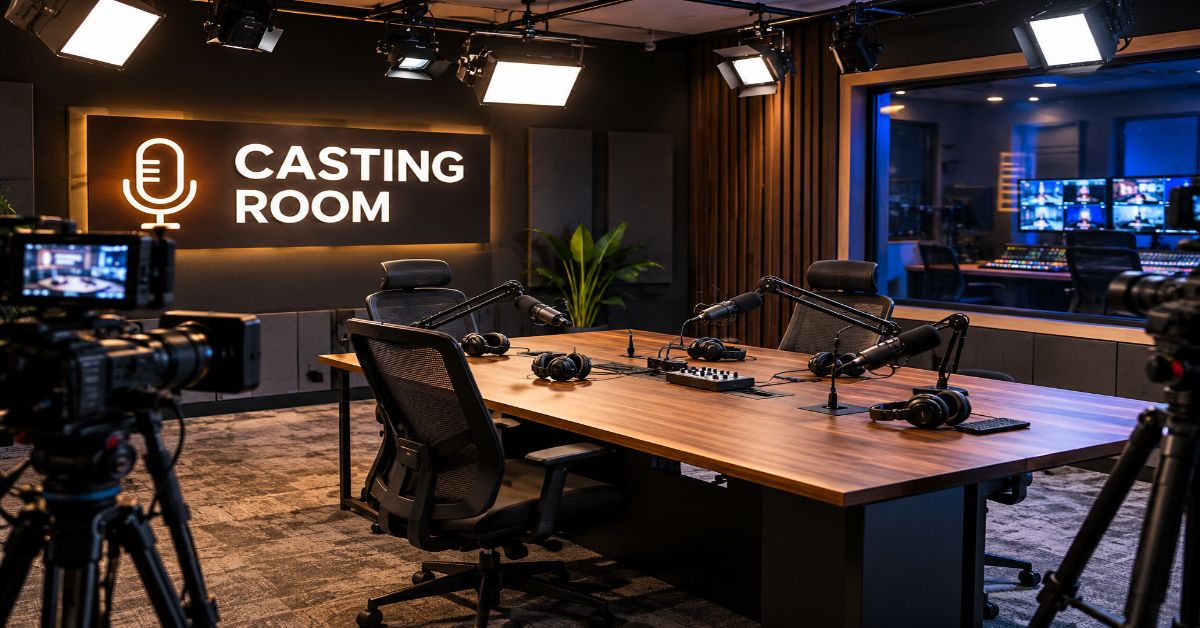
A Back Casting Room is most usefully understood as a physical or digital workspace where people conduct a backcasting exercise: they define a desired future first, then work backward to identify the milestones and actions required to reach it. The important caveat is that the phrase itself is not a standardized professional term, so its meaning depends on context.
That ambiguity is not a minor detail. Current search results use the same phrase for strategic planning, film and television background-casting operations, and secondary audition spaces. A useful explanation therefore has to separate the established planning method called backcasting from the less formal label “back casting room.”
Backcasting itself has a documented history in energy and futures research. John B. Robinson’s 1982 paper, Energy Backcasting: A Proposed Method of Policy Analysis, described setting policy goals and determining how those goals could be met. Later work developed the approach as an alternative to relying only on conventional forward forecasts.
What Is a Back Casting Room?
In the planning sense, a back casting room is not defined by special furniture, software, or architecture. It is the environment in which a team performs a structured backcasting exercise. It can be a conference room with a wall-sized timeline, a workshop space covered with notes, or a virtual whiteboard shared by people in different locations.
The defining feature is the direction of reasoning. Instead of asking, “If current trends continue, where will we end up?”, participants ask, “If this is the future we want, what would have to happen before we got there?” That distinction is consistent with Robinson’s original formulation of backcasting and with later research describing it as a way to explore feasibility and alternative pathways. citeturn1search0turn1search8
Is “Back Casting Room” an Official Industry Term?
There is no single universally accepted professional definition of “back casting room” in the sources I reviewed. That is one of the most important findings for this keyword. The established term is “backcasting”; the room label is descriptive and appears to have been adopted by different websites for different contexts.
For strategic planning, the phrase can describe the place where a team runs a backcasting workshop. In entertainment-related results, similar wording can refer to background performers or an additional audition space. Those are different concepts, even though the wording looks almost identical.
The distinction becomes clearer when the two meanings are placed side by side.
| Context | Starting point | Main activity | Typical output |
| Strategic backcasting | Desired future | Work backward through milestones | Pathway, decisions, actions |
| Forecasting | Current conditions | Project forward | Expected or possible future |
| Background casting | Production brief | Select and coordinate extras | Background performers for scenes |
| Secondary audition room | Casting call | Handle overflow or preliminary reads | Audition throughput and candidate records |
How Backcasting Differs From Forecasting
Forecasting and backcasting can work together, but they answer different questions. Forecasting generally begins with what is known now and estimates what may happen if important conditions continue or change. Backcasting begins with a chosen future state and asks what pathway could make that state achievable.
| Question | Forecasting | Backcasting |
| Where do we appear to be heading? | Central question | Secondary question |
| What future do we want? | May be outside the method | Starting point |
| What must change? | Derived from projected conditions | Core planning question |
| What is the output? | Projection or scenario | Pathway toward a selected future |
Robinson’s work is especially useful here because it frames backcasting as a response to limitations in conventional forecasting. His 1988 paper argues that the point is not simply to predict the most likely future, but to explore alternative futures and test their feasibility and implications. citeturn1search8
What Happens Inside a Back Casting Room?
A practical session can be organized into a sequence that moves from destination to present. The exact workshop format can vary, but the logic should remain visible throughout.
- Define the target year and end state. Make the destination specific enough to recognize when it has been reached.
- Describe what success looks like. Identify measurable conditions, not only aspirations such as “be more sustainable” or “grow faster.”
- Map the required conditions immediately before the end state. Ask what must already be true one checkpoint before the target.
- Continue backward through milestones. Repeat the question until the group reaches a timeframe it can act on.
- Identify dependencies and constraints. Record regulation, financing, skills, infrastructure, technology, behavior, and other conditions that could block the pathway.
- Assign ownership and evidence. Each near-term milestone should have an owner, a measure, and a review date.
- Test the pathway against current reality. Compare the backward-designed path with forecasts, budgets, technical limits, and known risks rather than pretending uncertainty has disappeared.
A Simple Example of Backcasting
Imagine a company chooses a target of reaching a defined level of low-carbon operations by 2040. A forecast might extend current energy use, technology adoption, and costs forward. A backcasting exercise starts at 2040 and asks what the company would need to have completed by 2035, then 2030, then 2028, and finally the next operating cycle.
The value is not the visual timeline itself. The value is the pressure it creates to expose prerequisites. If a 2035 milestone requires a new infrastructure system, the team can ask when design, financing, permitting, procurement, construction, testing, and training would need to occur. That can reveal a constraint that a broad future vision hides.
Where Is Backcasting Used?
Academic literature has used backcasting extensively in energy, environmental, sustainability, transport, and long-range planning. A review in the European Journal of Futures Research describes its origins in energy planning and its later use in sustainability-oriented planning. citeturn1search20
| Use case | Backcasting application |
| Energy and climate planning | Work backward from a desired emissions, energy, or infrastructure outcome. |
| Urban and transport planning | Map the policy, infrastructure, land-use, and behavior changes needed for a future city state. |
| Business strategy | Start from a defined strategic position and identify capabilities and investments required to reach it. |
| Product and technology roadmaps | Define what a product or capability must do later, then identify intermediate technical dependencies. |
| Personal or career planning | Translate a desired future role or life condition into skills, evidence, milestones, and near-term actions. |
For an individual example, Rubble Magazine’s career-change planning guide uses milestones, evidence, and decision gates in a way that is compatible with the backward-planning mindset, even though it is not presented as a formal backcasting exercise.
Why a Back Casting Room Can Be Useful
The strongest benefit is not optimism; it is constraint discovery. Starting from the desired endpoint forces a team to identify prerequisites that are easy to overlook when planning only from today.
- It separates a preferred future from a prediction. The group is choosing and testing a target rather than claiming it is inevitable.
- It makes long-term goals concrete. A 2040 target becomes a sequence of nearer checkpoints that can be reviewed.
- It exposes dependencies early. A milestone that depends on another milestone becomes visible before the final deadline.
- It creates a shared language. Participants can disagree about the pathway while still discussing the same defined destination.
- It encourages alternative pathways. If one route fails a feasibility test, the team can work backward again using another set of assumptions.
The same principle appears in Rubble Magazine’s personal-development planning framework where goals are tied to observable evidence rather than treated as abstract intentions. That is not formal backcasting, but it illustrates why a future goal becomes more useful when it has measurable checkpoints.
The Hidden Weakness: Backcasting Can Become Wishful Thinking
Backcasting is not a magic way to make an attractive future feasible. Its biggest weakness is that the chosen endpoint can quietly become an assumption rather than a hypothesis to test.
- A team may choose an end state without checking whether the necessary resources exist.
- Backward milestones can look precise even when their dates depend on uncertain technology, policy, financing, or behavior.
- Participants can confuse a logical pathway with a guaranteed pathway.
- A workshop can overfocus on one preferred route and fail to test alternatives.
- Long-range plans can become obsolete when external conditions change.
The safeguard is to pair backcasting with feasibility testing. Research on backcasting repeatedly emphasizes the distinction between exploring desirable futures and establishing what is actually possible. citeturn1search12turn1search17
How to Run a Better Backcasting Session
If I were structuring a practical session, I would keep the room disciplined around five questions: What is the destination? What must be true before it? What blocks that condition? Who owns the next move? What evidence will tell us whether the pathway still works?
| Checkpoint | Question | Evidence | Failure signal |
| Future state | What exactly is achieved? | Defined metric | Goal remains vague |
| Intermediate milestone | What must be true next? | Date + condition | No dependency is named |
| Feasibility | Can the condition realistically be met? | Budget, capacity, technical or policy evidence | Wish replaces evidence |
| Ownership | Who controls the next action? | Named owner | Shared responsibility |
| Review | What would make us revise the path? | Trigger and date | Plan becomes static |
The practical problem of turning intentions into small, visible next actions is also discussed in Rubble Magazine’s procrastination guide. A backcasting plan has the same operational challenge: the final vision is not useful unless it eventually produces a next action that someone can actually take.
Backcasting vs. Reverse Engineering
These ideas can look similar because both reason backward, but they start from different questions. Reverse engineering normally examines an existing object, system, or result and reconstructs how it was made. Backcasting starts with a desired future that does not yet exist and asks what pathway could create it.
Backcasting vs. Scenario Planning
Scenario planning explores multiple plausible futures and their implications. Backcasting is more strongly tied to a selected desirable future and the pathway needed to reach it. In practice, the methods can complement each other: scenarios can expose uncertainty, while backcasting can test pathways toward a preferred outcome.
Three Information Gains the Typical SERP Misses
The current results I reviewed tend to repeat the same definition, benefits, and five-step process. Three less-obvious points deserve more attention.
- The phrase itself is the SEO problem. Searchers can land on pages describing unrelated casting operations. A strong article must disambiguate the entity before teaching the method.
- The room is secondary to the planning discipline. A physical workshop can help coordination, but the method survives in a shared document or virtual whiteboard if the backward logic is preserved.
- The best output is not a beautiful timeline. It is a set of falsifiable conditions and near-term decisions. If a milestone cannot be checked, owned, or challenged, the backward plan is probably still too abstract.
The Future of Back Casting Room in 2027
In 2027, the practical evolution is likely to be less about dedicated rooms and more about collaborative planning systems. Digital whiteboards, project-management platforms, scenario tools, and AI assistants can make it easier to turn a future-state description into milestones and dependencies. The important uncertainty is not whether software can draw the timeline; it is whether the assumptions behind the timeline are sound.
The strongest workflow is likely to combine three layers: a preferred future created by people, structured backward reasoning that exposes dependencies, and forward-looking evidence that tests whether the pathway remains realistic. That combination avoids treating either a forecast or a vision as the whole answer.
I would also expect more emphasis on traceability. When a milestone changes, teams will increasingly want to know which assumption changed, which downstream actions are affected, and whether the target itself should be reconsidered. That is a more useful role for AI than simply generating optimistic future scenarios.
Key Takeaways
- “Back casting room” is a descriptive phrase, while backcasting is the established planning method.
- Backcasting starts from a defined desirable future and reasons backward to the present.
- Forecasting and backcasting answer different questions and can be used together.
- The room can be physical or digital; the backward reasoning process is what matters.
- A credible plan needs measurable milestones, owners, constraints, evidence, and review triggers.
- Backcasting does not eliminate uncertainty; it makes assumptions and dependencies easier to inspect.
- Because the phrase is used for different contexts online, readers should check whether a page means strategic backcasting or entertainment casting operations.
Conclusion
The most useful way to understand a back casting room is as the setting for a disciplined backward-planning exercise. The phrase itself is not a universally standardized industry term, which explains why current search results can look contradictory. The established method underneath the phrase is backcasting: define a desired future, work backward through the conditions that must exist before it, and turn those conditions into actions that can be tested.
That makes backcasting different from simply writing a long-term goal. A good session creates a chain between the destination and the next decision. It also makes room for disagreement: people can challenge the assumptions, dates, resources, and dependencies without losing sight of the shared endpoint.
The final test is practical. If the session produces a beautiful future vision but no measurable milestone, owner, evidence, or review trigger, the room has generated an aspiration rather than a usable pathway. If it produces those things, the physical room becomes almost incidental. The method is what does the work.
Structured FAQ
What is a back casting room?
It is best understood as a physical or digital setting used for a backcasting exercise. Participants define a desired future and work backward to identify milestones, dependencies, and actions. The phrase itself is descriptive rather than a universally standardized professional term.
Is back casting the same as forecasting?
No. Forecasting generally starts with current conditions and projects forward. Backcasting starts with a selected future outcome and works backward to determine what would need to happen to reach it. The two approaches can complement each other.
Is a back casting room a real physical room?
It can be, but it does not have to be. A conference room, workshop space, virtual whiteboard, or shared planning document can all support backcasting if the team preserves the backward sequence from future outcome to present action.
What is backcasting used for?
It has been used in energy, environmental, sustainability, transport, urban planning, business strategy, and other long-range planning settings. Its common purpose is to explore how a desirable future might be achieved rather than merely predict what is most likely.
What should happen in a backcasting workshop?
A useful workshop defines the future state, identifies what must be true immediately before it, works backward through milestones, records constraints and dependencies, assigns ownership, and establishes evidence and review triggers.
Can backcasting predict the future?
No. Backcasting is not primarily a prediction method. It tests pathways toward a chosen future and can reveal whether that pathway appears feasible under stated assumptions. External conditions can still invalidate the plan.
Methodology
I reviewed ten prominent current organic results for “back casting room” and close variants on September 26, 2026, including pages from Backcasting Room, Bents Magazine, List of Information, TechyBizz, Evolution Electric Solars, Antarvacna, Bilevel House, Techloy, Tech2Post, and OnlyForLight. Search rankings vary by country, device, personalization, and time, so this is a competitive sample rather than a permanent universal Google top ten.
The sample is fragmented. Some pages treat the phrase as a strategic-planning space; others describe background casting or a secondary audition room. The article therefore treats the ambiguity itself as the primary search problem and separates the established backcasting method from less-standardized uses of the phrase.
The Malta example is particularly useful as a practical planning comparison: Rubble Magazine’s Malta 2026 guide shows how a long-form guide can turn a broad destination into a sequence of current constraints and decisions, although it is not a backcasting article.
References
- Robinson, J. B. (1982). Energy backcasting: A proposed method of policy analysis. Energy Policy, 10(4), 337–344.
- Robinson, J. B. (1988). Unlearning and backcasting: Rethinking some of the questions we ask about the future. Technological Forecasting and Social Change, 33(4), 325–338.
- Quist, J., & Vergragt, P. (2018). Backcasting for sustainability: A synthesized scholarly and planning approach to strategic smart sustainable city development. European Journal of Futures Research, 6.
- Höjer, M., Gullberg, A., & Pettersson, R. (2008). Backcasting images of the future city: Time and space for sustainable development in Stockholm. Technological Forecasting and Social Change, 75(5), 713–728.