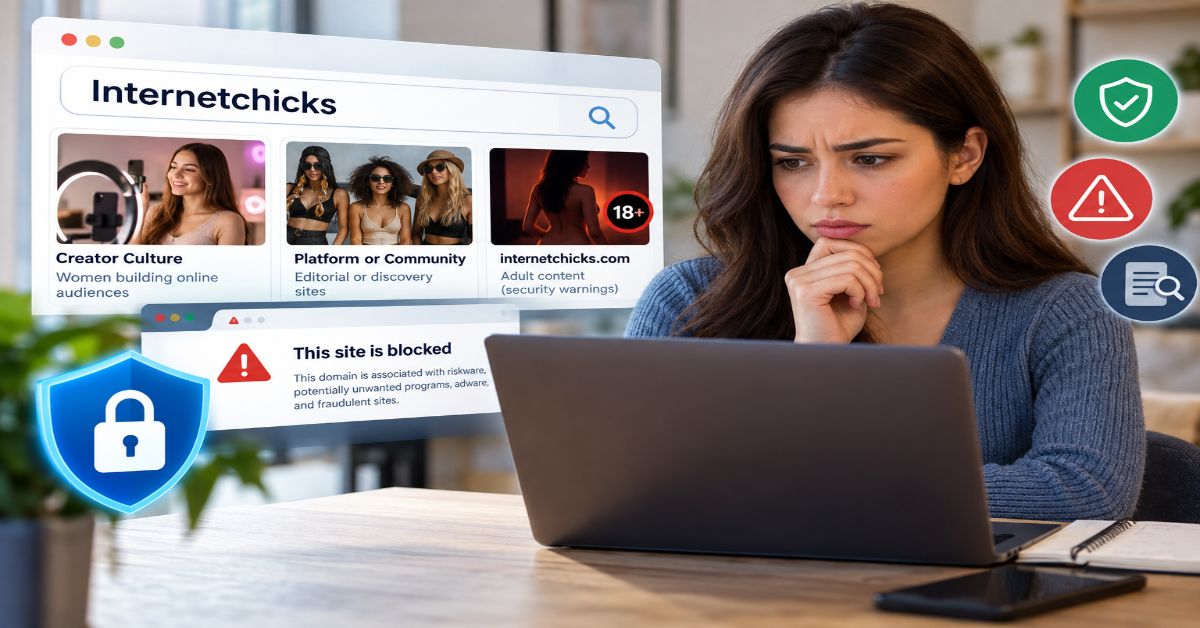
Internetchicks is not one cleanly defined product or community: current search results use the name for creator-culture commentary, lookalike brands, and an adult-content domain that security software has flagged. That identity collision is the most important fact to know before clicking, because a polished article about “female digital creators” does not tell you whether a similarly named web address is trustworthy.
I reviewed ten prominent current results on September 23, 2026, then checked the strongest claims against primary or first-party security and copyright sources. The SERP is crowded, but it is not well aligned. Some pages define the phrase as slang for women who build audiences online. Others describe a platform, community, or trend-discovery service. A third cluster treats internetchicks.com as the main entity and focuses on adult content, redirects, security warnings, or removal requests.
The direct answer is therefore contextual. If you saw the word inside a creator-culture article, it may be informal branding or slang. If you saw the exact .com domain in a browser warning, ad chain, security log, or copied-content complaint, treat it as a separate web-security and rights question. ThreatDown, the Malwarebytes business-security brand, currently says the domain is blocked because it is associated with riskware and is used to promote potentially unwanted programs, adware, and fraudulent sites (ThreatDown, n.d.).
That warning does not prove that every page view infects a device, and it does not make every similarly named site the same operator. The useful approach is narrower: verify the exact hostname, separate security from privacy and copyright, and judge each claim by its source and date.
What Does the Keyword Mean, Exactly?
The fastest way to understand the keyword is to separate the entity types instead of forcing them into one definition. Search engines are currently ranking pages that answer different questions under the same spelling.
I found three recurring uses. First, creator-culture sites use the label for women who publish, influence, stream, teach, sell, or build communities online. Second, several unrelated sites use close versions of the name as brands for editorial or discovery products. Third, the exact .com domain appears in security and adult-content discussions. Those categories overlap in search, but they should not be assumed to share ownership, policies, or safety characteristics.
This distinction matters because search familiarity creates false confidence. Seeing the same word repeated across many results can feel like evidence of one established brand. In this case, repetition is partly an SEO phenomenon: multiple publishers have built pages around a query whose underlying entity is ambiguous. I would treat the spelling as a search label first and a verified organization name only after checking the exact domain and first-party information.
This table separates the main result types before any safety or legality judgment is made.
| Search-result type | What it may mean | What to verify |
| Creator-culture article | Informal label for women building online audiences or businesses | Author, context, and whether the page is describing a culture rather than a service |
| Similarly named “platform” | A separate site using close branding | Exact hostname, ownership, policies, and independent evidence |
| internetchicks.com | A specific adult-content domain discussed by security and review pages | Current security-vendor status, redirects, permissions, and data requests |
| Removal or rights guide | Advice for creators who believe content was reposted | Whether claims about hosting, contacts, or ownership are current and independently verified |
Why Does Google Show Such Different Answers?
Google is effectively serving several intents under one spelling: “what does this word mean?”, “what is this website?”, “is this safe?”, and “how do I remove copied content?” A page can rank while answering only one of those questions.
That explains why current results can disagree without discussing the same entity. Creator-culture explainers describe an informal identity. Security pages inspect a hostname. Review sites apply their own scoring models. Removal services assume the reader is a rights holder. The mistake is carrying a conclusion from one intent into another.
For a reader, the search snippet is not enough. Check whether a result is discussing a phrase, a specific hostname, a country-code lookalike, or a self-described “platform.” Then ask whether the evidence is first-party, a security-vendor detection, an automated reputation score, a user report, or another article repeating the same claim.
That is the first information-gain opportunity: keep the entities separate and label the evidence behind each one.
Is the .com Domain Safe to Visit?
As of my September 23, 2026 review, the clearest verifiable warning is the ThreatDown detection page for the exact .com domain. It says Malwarebytes blocks the domain because it is associated with riskware and describes explicit-content lures that promote potentially unwanted programs, adware, and fraudulent sites (ThreatDown, n.d.). I would take that seriously while keeping the claim scoped to the source.
“Associated with riskware” is not the same as “every visit installs malware.” A product may block a domain because of redirects, ad partners, unwanted-software promotion, or other observed behavior. The reverse is also true: a page loading normally would not prove that it is private, authorized, or free from deceptive advertising.
The highest-value warning often appears after the first page: a forced redirect, fake update, extension prompt, notification request, login form, or payment page. Malwarebytes researcher Jérôme Segura gave a useful general rule after documenting malicious search ads: “We recommend avoiding clicking on ads to download any kind of software and instead visiting the official repositories directly” (Segura, 2024).
Rubble Magazine’s Incestflix safety analysis explains the same mechanism in another niche domain: the risky action is frequently a redirect or install prompt rather than the mere fact that the first page loaded. I use that distinction because it prevents two opposite errors—declaring a site harmless because it opens, or declaring a guaranteed infection without evidence.
The risk layers below show why a single trust score cannot answer every reader question.
| Risk layer | Strong evidence | What it can prove | Reader action |
| Domain reputation | Current security-vendor detection | A vendor observed behavior serious enough to classify or block | Treat the exact hostname cautiously and check the date |
| Redirect/ad behavior | Observed redirect, fake update, install prompt, or permission request | The browsing path has changed or is asking for higher-risk interaction | Stop, close the page, and do not install software |
| Privacy/account exposure | Privacy policy plus actual account/permission flow | What data is requested and how identity may be linked | Minimize identifiers and never reuse passwords |
| Content rights | Original files, timestamps, licenses, consent records, or rights-holder evidence | Whether a specific item may be unauthorized | Preserve evidence and use the correct rights process |
| SEO/review claim | Another article or model-specific score | A lead worth checking, not a final verdict | Verify against a primary or first-party source |
What Should Creators Know About Reposted or Copied Content?
The query also has a creator-rights side. Some ranking pages describe the domain as a place where creator material may be reposted, but I did not independently verify individual files or ownership claims by browsing the adult site. Specific infringement allegations therefore remain content-by-content questions.
Copyright and consent should be separated. Copyright asks who owns or controls reproduction rights. Consent asks whether intimate material was shared with authorization. They can overlap, but a DMCA notice is a copyright process rather than a universal remedy for every privacy harm.
The U.S. Copyright Office says an effective Section 512 notice generally contains six core elements: a signature; identification of the copyrighted work; identification and location of the allegedly infringing material; contact information; a good-faith statement; and an accuracy/authority statement made under penalty of perjury (U.S. Copyright Office, n.d.). Registration is not required merely to send a notice, although it has separate importance for U.S. litigation.
If I were documenting a repost, I would preserve the page address, publication context, and evidence of my original work without redistributing the copied material. Then I would identify the relevant service provider or designated agent and use the correct rights process. Rubble Magazine’s OnlyFans leaks creator-protection guide is useful for separating account security from content exposure, while the Coomer.party guide explains why copyright, platform status, and domain identity should not be collapsed into one issue.
The limitation is jurisdiction. Copyright, privacy, non-consensual-intimate-image rules, and intermediary obligations vary by country. This is a verification framework, not individualized legal advice.
How Should You Evaluate a Search Result Before Clicking?
I use a six-step check before trusting a result around an ambiguous or sensitive keyword.
- Read the full hostname, not just the title. A familiar brand word in a page title does not prove common ownership.
- Separate description from verification. A site calling itself a “community” or “creator platform” is a first-party claim until independently supported.
- Reset trust after a redirect. If the hostname changes, evaluate the new destination from zero before entering credentials or payment details.
- Reject unexpected software and permission requests. A content page should not need a mystery player, browser extension, executable file, or notification permission to prove it works.
- Minimize identifiers. Do not reuse a password, public creator email, payment credential, or social login merely to browse an unfamiliar destination.
- Match the response to the problem. Device-security warnings, privacy exposure, copyright infringement, impersonation, and non-consensual intimate imagery require different evidence and remedies.
Rubble Magazine’s ThisVid safety and privacy guide provides a broader framework for separating device security, tracking, and content rights. The Ebony Galore safety and privacy guide also shows why automated reputation tools should be treated as signals rather than verdicts when search results are fragmented.
One practical insight follows from those checks: exact-domain verification has a higher payoff than reading another generic “is it safe?” article. If two pages share a name but not a hostname, operator details, or policies, they are separate until evidence proves otherwise.
What Do the Current Top 10 Ranking Articles Miss?
The ten-result sample has useful material, but the same weaknesses recur. Some pages are strong on cultural context and weak on web-entity verification. Others are strong on a security score but let a model-specific rating read like a universal verdict. Removal guides can be actionable while relying on infrastructure or contact assumptions that change.
Freshness also varies by claim. A creator-culture definition may remain useful for years; a redirect chain, security detection, domain status, or abuse contact can change quickly. A strong ranking page should date-stamp fast-moving facts.
The second gap is evidence hierarchy. A current security-vendor detection should carry more weight for a block claim than an article repeating it. A self-description can show what a site claims to be, but not independently prove safety. A user report can surface a pattern, but cannot establish platform-wide behavior.
The third gap is legal precision. “Illegal,” “leaked,” “stolen,” “unsafe,” and “scam” are often treated as synonyms. They are not. A stronger page separates what is verified, what is alleged, what remains unknown, and what evidence would change the conclusion.
The competitive pattern is easier to see when the ten results are grouped by intent.
| SERP cluster | Examples reviewed | What it does well | Information gap used here |
| Creator-culture explainers | The Internetchicks; Cordless | Broad social and creator context | Do not establish the exact web entity before expanding the concept |
| Mixed meaning/safety guides | Kloutra; Entrepreneurship Life | Recognize ambiguity and reader concern | Still rely partly on secondary summaries and broad labels |
| Security/review pages | Gridinsoft; PornVerdict | Fast, scannable status or scoring | Model-specific scores can be mistaken for universal proof |
| Lookalike/self-described platform | Internet Chikes | Direct answers about features and safety | Self-description is not independent validation |
| Domain-risk explainers | SmartPostly; BioGPT | Focus on redirects and trust questions | Need tighter source hierarchy and dated claim handling |
| Removal-focused guide | Fanlock | Actionable for rights holders | Narrower intent; infrastructure and contact claims can age quickly |
The Future of Internet Chicks in 2027
I found no reliable public roadmap that supports a confident prediction about a single branded service in 2027. The more defensible forecast concerns the search environment around this keyword.
Ambiguity will likely persist because multiple publishers and lookalike domains already compete for the same spelling. Searchers will need stronger entity signals: exact domains, dated security status, ownership disclosures, clear abuse contacts, and transparent policies. Security pressure around deceptive ads and redirects will also remain relevant; Malwarebytes research shows that malvertising can exploit trusted search and web infrastructure, making professional-looking design a weak trust signal.
Rights enforcement will continue to depend on documented workflows. Creators need to distinguish copyright complaints from privacy, impersonation, and non-consensual-intimate-image processes. A site seeking durable trust will need visible, responsive handling for those categories.
For Rubble Magazine, the durable editorial strategy is a dated evidence map. If the security classification, domain behavior, ownership information, or removal process changes, the article should change with it.
Key Takeaways
- The keyword is an entity-resolution problem before it is a definition problem; confirm the exact hostname first.
- The strongest current domain-specific evidence is a ThreatDown/Malwarebytes riskware warning for the .com address.
- Redirects, fake updates, software prompts, browser permissions, credentials, and payments are separate risk events and should be evaluated separately.
- A site-reputation score is a signal generated by one method at one time, not a universal safety certificate.
- Copyright, consent, privacy, impersonation, and child-safety issues are different rights categories and should not be collapsed into one generic “DMCA” answer.
- A durable 2027-ready article should date-stamp security and domain claims and update them when the underlying evidence changes.
Conclusion
I would not treat this keyword as a single-platform query. The current search results are too fragmented, and the most important evidence points in different directions depending on the exact entity being discussed. Creator-culture articles can legitimately use the label as informal shorthand, while the exact .com domain has a current Malwarebytes/ThreatDown riskware warning that deserves separate attention.
The durable lesson is to reduce the problem into smaller decisions. Confirm the hostname. Distinguish a security-vendor detection from an automated trust score. Treat redirects, installers, browser permissions, and credential prompts as separate risk events. If copied creator content is involved, distinguish copyright from consent and use the remedy that matches the right being asserted.
That approach is less dramatic than a one-word “safe” or “scam” verdict, but it is more useful. Search results, domains, and ad chains change. Evidence types change more slowly. A reader who knows how to identify the exact entity, rank the source quality, and preserve the right evidence can make a better decision even after today’s SERP has moved.
Frequently Asked Questions
Is InternetChicks one website or a general term?
It can refer to different things. Current search results use the spelling for creator-culture commentary, lookalike brands, and the exact .com adult-content domain. Do not assume similarly named sites share ownership or safety characteristics; verify the hostname and source context.
Is internetchicks.com safe?
ThreatDown currently says Malwarebytes blocks the exact .com domain because it is associated with riskware and promotion of potentially unwanted programs, adware, and fraudulent sites. That is a meaningful warning, but it should not be stretched into a claim that every page view causes infection.
What does “internet chicks” mean in creator culture?
Some publishers use “internet chicks” as informal shorthand for women who create content, build audiences, stream, sell products, teach, or run online businesses. That cultural usage is separate from the safety status of any specific domain using a similar name.
Why do search results give conflicting descriptions?
The query has mixed intent. Some pages answer a definition question, some review a domain, some promote similarly named platforms, and some target creators seeking content removal. Those pages can rank together even when they discuss different entities.
What should I do if a page asks me to install a player or extension?
Leave the page unless you can independently verify the software through an official source. Unexpected installers, fake updates, browser extensions, notification prompts, and redirects are higher-value warning signs than a polished page design.
How can a creator respond to copied content?
Preserve the exact page location and evidence of the original work, identify the relevant service provider, and use the rights process that fits the problem. For U.S. copyright claims, Section 512 has specific notice requirements; privacy and consent issues may require different channels.
Methodology
I researched this article on September 23, 2026 and reviewed ten prominent current results for the exact keyword and close-intent searches: the main creator-culture homepage, Kloutra, Gridinsoft, Internet Chikes, Cordless, Entrepreneurship Life, PornVerdict, SmartPostly, BioGPT, and Fanlock. Rankings vary by country, device, personalization, and time, so this is a competitive sample rather than a permanent universal top ten.
Their shared strengths were quick definitions, safety sections, creator-culture context, review scores, and removal advice. The main gaps were entity confusion, evidence types presented as equivalent, overconfident safety labels, and legal language that blurred copyright with privacy or consent. I built this article around those gaps rather than copying a competitor structure.
For validation, I prioritized ThreatDown/Malwarebytes for the exact domain warning, Malwarebytes researcher Jérôme Segura for a documented malvertising safety principle, and the U.S. Copyright Office for Section 512 notice requirements. I verified five live Rubble Magazine internal pages and linked each once where it added context.
AI assistance was used for research organization, drafting, and document production. A human editor must review the article before publication and manually verify every statistic, named claim, reference, link, and first-person statement against the original source.
References
ThreatDown. (n.d.). internetchicks.com. Threat detection database. Retrieved September 23, 2026.
Segura, J. (2024, July 30). Threat actor impersonates Google via fake ad for Authenticator. Malwarebytes.
U.S. Copyright Office. (n.d.). Section 512 of Title 17: Resources on online service provider safe harbors and notice-and-takedown system. Retrieved September 23, 2026.