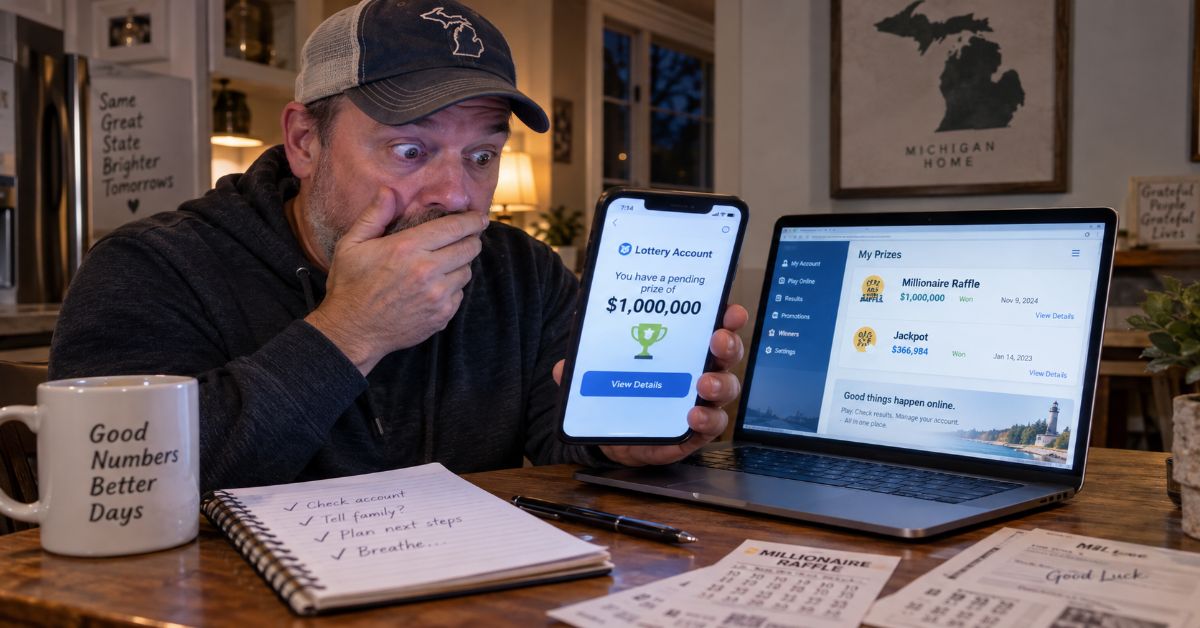
The Michigan Man $1M Lottery story is real: an anonymous 47-year-old Muskegon County player won the $1 million top prize in Michigan Lottery’s Millionaire Raffle on March 26, 2026, after collecting $366,984 from a separate jackpot in February 2025. The sharper story, however, is that several widely repeated details need qualification before the episode is reduced to a neat ‘one-in-billions’ headline.
I checked the Michigan Lottery’s April 17, 2026 winner release, the archived February 24, 2025 draw, current tax guidance, claim rules, and a ten-result competitive sample. The primary release itself contains a contradiction: its opening paragraph calls the first game Fantasy 7, while the winner’s quoted statement calls it Fantasy 5. The archived February 24 drawing resolves the conflict: Fantasy 5 had a $733,968 jackpot that night, with two jackpot winners receiving $366,984 each. That is the amount and split described in the official winner story.
The second win is easier to pin down. Millionaire Raffle sold 100,000 tickets and awarded one $1 million top prize plus 100 prizes of $1,000. The winner said he bought several raffle tickets because he liked the odds, then initially suspected the seven-figure notification in his online account was a technical error. He checked again the next day, later went to Lottery headquarters, and said he planned to invest the money.
What cannot be verified is equally important: the exact number of raffle tickets he bought, how many Fantasy 5 lines he played, his final after-tax proceeds, or an exact personal probability for winning both events. I separate those unknowns from the confirmed record below.
What Happened in the Michigan Man $1M Lottery Story?
I would describe the event as two independent wins connected by one player, one online account, and a 13-month interval. Michigan Lottery said both winning tickets were purchased through its online platform. The first payout was $366,984, half of a $733,968 jackpot in February 2025. The second was the sole $1 million top prize in the Millionaire Raffle drawing held after all 100,000 tickets sold.
The cleanest primary account is the Michigan Lottery’s April 17, 2026 winner release. It identifies the winner only by age and county, says he claimed at Lottery headquarters, and records his plan to invest. I found no reliable public source naming him, detailing an investment portfolio, or disclosing his complete tax return.
| Event | Verified date | Verified result | What I can confirm |
| First major win | February 24, 2025 | $366,984 share of a $733,968 jackpot | Fantasy 5 archive shows two Match 5 winners; winning tickets were online. |
| Second major win | March 26, 2026 | $1,000,000 Millionaire Raffle top prize | One top prize among 100,000 raffle tickets; winner bought several tickets online. |
| Winner announcement | April 17, 2026 | Second win publicly confirmed | 47-year-old Muskegon County man; identity withheld; plans to invest. |
| Research check | September 21, 2026 | No public identity or exact ticket count found | Those gaps prevent a precise personal repeat-win probability or net-tax calculation. |
Was the Earlier Jackpot Fantasy 5 or Fantasy 7?
This is the most important factual correction I found. Michigan Lottery Connect’s opening paragraph labels the February 2025 prize a Fantasy 7 jackpot. In the same release, the winner is quoted saying he won a Fantasy 5 jackpot. CBS Detroit, Detroit Free Press/AOL, and some Hearst local coverage reproduced the same inconsistency because they relied closely on the release.
I cross-checked the amount rather than choosing between labels by intuition. The February 24, 2025 Fantasy 5 archive lists winning numbers 4, 14, 17, 25, and 34; a $733,968 jackpot; and two Match 5 winners at $366,984 each. It also says the jackpot-winning tickets were sold online. Those details line up point-for-point with the later winner account. I therefore treat Fantasy 5 as the verified first game and flag the ‘Fantasy 7’ wording as a source-level error, not a second game.
That distinction matters for search quality. Once an error appears in a primary press release, syndication can turn repetition into apparent confirmation. My rule here is to resolve conflicting entity labels with the underlying dated result, not with the number of pages repeating one version.
What Were His Real Odds of Winning Twice?
A single Millionaire Raffle ticket had a transparent top-prize denominator: one $1 million ticket among 100,000 tickets. Fantasy 5 is a 5-from-39 game, so there are 575,757 possible five-number combinations (39 choose 5). A single distinct line therefore has a 1-in-575,757 jackpot chance under the standard game structure.
It is tempting to multiply 575,757 by 100,000 and declare that this man ‘beat odds of about 1 in 57.6 billion.’ That number is only a one-line, one-raffle-ticket illustration. The winner explicitly said he bought several raffle tickets, and the public record does not disclose how many Fantasy 5 lines he bought before the first win. His personal exposure is unknown, so the exact probability of his two wins is unknown.
| Probability claim | What is defensible | Why |
| Raffle top prize per single ticket | 1 in 100,000 | One top prize was available among 100,000 tickets. |
| Fantasy 5 jackpot per single 5-number line | 1 in 575,757 | There are C(39,5) possible combinations in a 5-from-39 game. |
| One Fantasy 5 line + one raffle ticket | About 1 in 57.6 billion | Illustrative multiplication if exactly one independent entry were used in each event. |
| This winner’s actual two-win probability | Not calculable from public data | He bought several raffle tickets; the number of Fantasy 5 plays is also undisclosed. |
Why two wins do not make the next ticket more likely
The drawings are independent in the practical sense relevant to a player: the earlier jackpot does not make a later raffle ticket ‘hot.’ The useful statistical lesson is exposure, not destiny. Buying more tickets raises the chance of holding the winning ticket, but it also raises spending, and the chance remains small. Looking backward after a rare outcome also creates selection bias: millions of losing play sequences never become national stories.
How Did the Online Account Change Discovery and Claiming?
The online account is more than a purchase channel in this story. The winner discovered the $1 million result as a pending prize notification, doubted it, then checked again the next day. That sequence is plausible because online play ties the wager, result, and account record together; it does not require a paper ticket to be scanned at a retailer.
Michigan Lottery’s current help guidance says online prizes of $100,000 or more require an online claim and a visit to Lottery Headquarters at 101 E. Hillsdale Street in Lansing, followed by identity documentation. The official winner release says this player visited headquarters, which is consistent with that workflow.
For another example of why a lottery-related search phrase can hide multiple entities, I use Rubble Magazine’s DC school bus lottery winner explainer as a useful internal model: it separates a school-placement lottery from an unrelated cash-prize story instead of letting one ambiguous phrase collapse two systems.
How Much of a $1 Million Michigan Lottery Prize Goes to Tax?
I would not publish a precise ‘take-home’ figure for this winner. The IRS’s 2026 Form W-2G instructions state that regular federal gambling withholding is 24% when lottery proceeds exceed the applicable threshold. Withholding is a prepayment, not necessarily the winner’s final federal tax liability; final liability depends on the taxpayer’s full return.
Michigan also taxes gambling and lottery winnings to the extent they are included in adjusted gross income, and the Michigan Department of Treasury set the 2026 individual income-tax rate at 4.25%. That establishes the state-rate context, but it still does not reveal this winner’s net proceeds because deductions, losses allowed by law, timing, other income, and withholding details are not public.
For scale, 24% of $1 million is $240,000 and 4.25% of $1 million is $42,500. Those arithmetic figures are not a prediction of his tax bill. The safer editorial distinction is gross prize versus withholding versus final liability. I found competing pages that blur those three concepts or import lump-sum figures from unrelated scratch-off games; this raffle story does not support that shortcut.
What Does His Plan to Invest Actually Tell Us?
Only one financial-intent fact is verified: the winner told Michigan Lottery he planned to invest. The public record does not say whether that means bank deposits, bonds, index funds, real estate, a business, or professional portfolio management. I would not turn a one-word plan into a fabricated wealth strategy.
For a sudden windfall, I would put records, account security, tax planning, and reversible decisions ahead of product selection. Large sums can also attract unsolicited investment proposals or contracts, where independent review can matter.
That legal-review context is covered in Rubble Magazine’s contract lawyer guide. For this lottery winner specifically, however, there is no public evidence that he hired a lawyer, accountant, or adviser, so I do not imply that he did.
What the Current SERP Gets Right – and What It Misses
I reviewed a current ten-result competitive sample for the keyword and close variants, including Michigan Lottery Connect, People, CBS Detroit, ClickOnDetroit, Detroit Free Press/AOL, Lottery Post, Hearst local coverage, Ground News/MLive-linked coverage, and two long-form SEO features. Rankings vary by country, device, personalization, and date, so I treat this as a benchmark sample rather than a permanent Google order.
The strongest recurring material is the human-interest sequence: second big win, disbelief at the online notification, 100,000 raffle tickets, and a plan to invest. The main gaps are factual reconciliation and probability discipline. Short news pages rarely resolve the Fantasy 5/Fantasy 7 conflict. Longer pages add odds and tax context, but some state an exact repeat-win probability or a precise after-tax amount that the disclosed facts cannot support.
The Future of the Michigan Lottery Repeat-Winner Story in 2027
As of September 21, 2026, I found no official announcement promising a 2027 return of this exact Millionaire Raffle. What is documented is Michigan Lottery’s digital scale: more than 1 million registered online players since 2014 and more than 200 online games, according to the April winner release.
If capped raffles return, their finite ticket inventory will keep the top-prize denominator unusually easy to explain. That transparency does not make a ticket an investment or remove expected loss.
The more durable 2027 direction is account-centered verification and claiming. This case shows how digital records can surface a prize and route a large winner into a formal claim process. Any future raffle’s ticket count, prize structure, and launch date still need fresh verification.
Key Takeaways
- The $1 million March 26, 2026 raffle win is verified, and Michigan Lottery says it was the same player who received $366,984 from a February 2025 jackpot.
- The earlier game is best identified as Fantasy 5 because the February 24, 2025 draw archive matches the $733,968 jackpot, two winners, $366,984 shares, and online sales described in the later story.
- One raffle ticket had a 1-in-100,000 top-prize chance, but the winner bought several tickets, so his personal raffle probability was better than one in 100,000 and cannot be calculated without the ticket count.
- An exact ‘odds of winning twice’ headline is not supported because his number of entries in both games is unknown.
- Federal gambling withholding and final federal tax are different concepts; Michigan’s 2026 individual income-tax rate is 4.25%, but the winner’s exact net amount is not public.
- The strongest ranking opportunity is accuracy: resolve the source contradiction, distinguish facts from calculations, and clearly label what remains unknown.
Conclusion
The michigan man $1m lottery story is remarkable without exaggeration. A 47-year-old Muskegon County player collected a $1 million Millionaire Raffle top prize in March 2026 after receiving a $366,984 share of a February 2025 jackpot, and both wins came through Michigan Lottery’s online platform. That verified sequence is already enough to explain why the story traveled nationally.
The better analysis comes from resisting details the record cannot prove. The first game is Fantasy 5 when checked against the archived draw, despite the ‘Fantasy 7’ typo in the official release. The one-ticket odds can be calculated, but this player’s exact repeat-win odds cannot because his exposure is undisclosed. Federal withholding and Michigan tax rules can be described, but his final net proceeds cannot. His plan to invest is confirmed; the investments are not.
That fact-versus-inference discipline is the reason I would publish this version. It preserves the human interest while giving readers something most retellings do not: a transparent audit trail for the disputed label, the probability math, the claim process, and the limits of what is publicly knowable.
Frequently Asked Questions
Who is the Michigan man who won the $1 million lottery prize?
Michigan Lottery identifies him only as an anonymous 47-year-old man from Muskegon County. The agency says he won the $1 million Millionaire Raffle top prize in the March 26, 2026 drawing and had already won $366,984 in February 2025. I found no reliable public source naming him.
Was the earlier $366,984 win Fantasy 5 or Fantasy 7?
Fantasy 5 is the better-supported answer. The April 2026 Michigan Lottery release says ‘Fantasy 7’ in its opening paragraph but quotes the winner saying ‘Fantasy 5.’ The February 24, 2025 Fantasy 5 archive shows a $733,968 jackpot split by two winners into $366,984 shares, matching the story.
What were the Michigan man $1M lottery odds?
The Millionaire Raffle had one $1 million top prize among 100,000 tickets, so one ticket had a 1-in-100,000 top-prize chance. The winner said he bought several tickets, so his personal chance was higher than one ticket’s chance. The exact figure is unknown because his ticket count was not disclosed.
Did he really win the lottery twice in about a year?
Yes. Michigan Lottery’s April 17, 2026 release connects the same anonymous Muskegon County player to the $366,984 February 2025 jackpot share and the $1 million March 2026 raffle prize. The two wins were just over a year apart and were purchased online.
How did the Michigan lottery winner discover the $1 million prize?
He said he saw a $1 million pending-prize notification in his Michigan Lottery online account, initially suspected a technical error, and checked again the next morning. The prize was still there. He later went to Lottery headquarters to claim it.
How much tax is withheld from a $1 million lottery win?
IRS instructions set regular federal gambling withholding at 24% for qualifying lottery proceeds above the threshold. Michigan taxes lottery winnings included in adjusted gross income, and the state’s 2026 individual rate is 4.25%. Withholding is not the same as final liability, so a precise net amount cannot be inferred from the headline prize.
Methodology
I researched this article on September 21, 2026. I started with Michigan Lottery Connect’s April 17 winner release and then checked the February 24, 2025 Fantasy 5 draw archive to resolve the release’s Fantasy 7/Fantasy 5 inconsistency. I used Michigan Lottery’s current online-prize FAQ to validate the claim workflow, IRS 2026 Form W-2G instructions for federal withholding, and Michigan Treasury guidance for gambling-income treatment and the 2026 state income-tax rate.
Before drafting, I reviewed ten prominent current and close-query results, including Michigan Lottery, People, CBS Detroit, ClickOnDetroit, Detroit Free Press/AOL, Lottery Post, Hearst local coverage, Ground News/MLive-linked coverage, and long-form SEO features. Rankings vary, so I treated them as a competitive sample, not a permanent order.
Key limitations are disclosure gaps: the player is anonymous, ticket counts are undisclosed, final tax liabilities are private, and the investment plan is unspecified. I therefore do not calculate his personal repeat-win probability or after-tax net.
I also audited Rubble Magazine with site-restricted searches. Only two live pages had a defensible contextual fit without forcing relevance: the DC school bus lottery explainer for entity disambiguation and the contract-lawyer guide for high-stakes agreement review. I linked each once. Internal linking should expand as the site publishes more lottery, personal-finance, tax, probability, and fraud-prevention coverage.
AI assistance was used for research organization, calculations, drafting, and document production. A human editor must review the article before publishing, verify every statistic and named claim against the original source, confirm all APA references and live links, and ensure that first-person wording accurately reflects the editor’s own research process.
References
Michigan Lottery Connect. (2026, April 17). Lottery Lucky Streak: Muskegon County Man Claims Second Big Michigan Lottery Prize.
Michigan Lottery. (2026). How do I claim an online prize?
Internal Revenue Service. (2026). Instructions for Forms W-2G and 5754.
Michigan Department of Treasury. (2026, April 15). 4.25% Income Tax Rate for Individuals and Fiduciaries in 2026 Tax Year.
Michigan Department of Treasury. (n.d.). Are gambling losses an allowable subtraction?
LottoNumbers.com. (2025, February 24). Michigan Fantasy 5 numbers for Monday February 24, 2025.